Why Does Ice Float? Hydrogen Bonds, Open Crystals and Lake Life
Drop an ice cube in a glass and it bobs at the top. Most solids would sink in their own melted liquid, and that small oddity shapes life in every frozen lake.
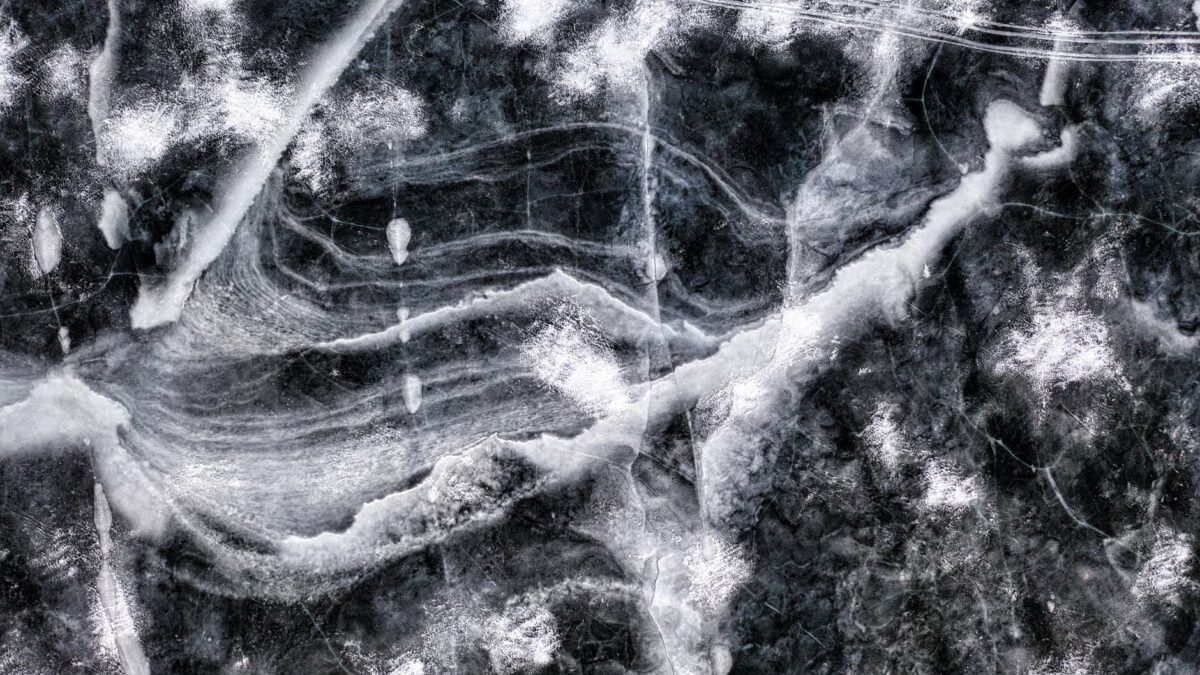
Ice floats because it is less dense than liquid water. When water freezes, its molecules lock into an open, six-sided crystal that holds them farther apart than in the liquid, so ice is about 9% less dense, according to the US Geological Survey. Liquid water is densest at about 4°C (39°F), which is why lakes freeze from the top down.
Watch an ice cube in a glass of water: most of it sits below the surface, with a small cap above. That cap is the visible sign of a rare property. For most substances, the solid is denser than the liquid and sinks.
Why is ice less dense than water?
Ice is less dense because of the way water molecules hold on to each other. A water molecule is one oxygen atom bonded to two hydrogen atoms, in a bent shape. The oxygen end carries a slight negative charge and the hydrogen ends a slight positive charge, so neighboring molecules attract each other. These attractions are called hydrogen bonds.
In liquid water, hydrogen bonds constantly form and break, and molecules can crowd close together. When water freezes, each molecule settles into a fixed position bonded to four neighbors, building a lattice of six-sided rings with a lot of empty space inside. The USGS describes the result in its page on water density: the molecules in ice are held in a regular lattice farther apart than in liquid water, and density drops by about 9% on freezing.
The six-sided pattern shows up at a scale you can see. It is why snowflakes have six arms.
How much of an ice cube sits underwater?
A floating object sinks until it pushes aside its own weight in liquid. Because the USGS puts the density of ice at about 90% of that of water, roughly 90% of a floating piece of pure ice sits below the surface in fresh water and about 10% shows above. The exact share varies, since air bubbles trapped in ice lower its density, and salty seawater is denser than fresh water, so ice rides a little higher in the sea.
That is the origin of the phrase “tip of the iceberg.” Icebergs are made of freshwater ice from glaciers, so most of their bulk is hidden below the waterline.
Why is water densest at 4°C?
Liquid water is densest at about 4°C (39.2°F), not at its freezing point. The USGS gives the density at that temperature as 0.9998395 grams per milliliter. Two effects compete as water cools. Like most liquids, it contracts as molecules slow down. But below about 4°C, more and more molecules start lining up in ice-like, open clusters held by hydrogen bonds, which takes up extra space. Below that temperature the second effect wins, and water expands slightly as it cools further toward 0°C (32°F).
| Water temperature | Density (USGS table, g/cm³) |
|---|---|
| 0°C (32°F), liquid | 0.99987 |
| 4°C (39.2°F), liquid | 1.00000 (rounded; 0.9998395 in the USGS text) |
| 100°C (212°F), liquid | 0.95865 |
| Ice | About 90% of liquid water (USGS) |
Why do lakes freeze from the top down?
Lakes freeze from the top because of water’s density peak. In autumn, surface water cools, becomes denser and sinks, so the whole lake mixes and cools. Once the lake reaches about 4°C throughout, further cooling at the surface makes the top water lighter, not heavier. It stays on top, keeps cooling and eventually freezes into a lid of ice.
The USGS points out the alternative: if water were densest at its freezing point, cold water would keep sinking and a lake could freeze from the bottom up.
The ice lid then insulates the water below. Water near the bottom of a deep lake can stay close to 4°C, the temperature at which it is densest, which is one reason fish and other animals survive the winter under the ice.
What about seawater?
Salt changes the picture. Salt lowers the freezing point of water, and NOAA says seawater of typical saltiness freezes near −2°C (28.5°F). Salt also keeps seawater getting denser as it cools all the way to its freezing point, so the oceans do not have the same 4°C density peak at the surface that lakes do. When sea ice forms, much of the salt is left in the water below. We explain where that salt comes from in why the ocean is salty.
Floating sea ice has one more consequence. Because it already displaces its own weight of water, melting sea ice barely changes sea level, unlike ice that melts from glaciers on land. How scientists track those changes is covered in how sea level is measured.
Is water the only substance that expands when it freezes?
No, but it is the most familiar one. A few other substances also form solids less dense than their liquids. The Royal Society of Chemistry notes that solid gallium floats on its liquid, and that bismuth, like water, expands as it freezes and floats on the melt (RSC periodic table). For the great majority of substances, though, the solid sinks.
The expansion of freezing water is also powerful enough to crack rock. Water that seeps into cracks freezes, swells and wedges them wider, one of the ways mountains and cliffs slowly break apart.
Bottom line
Ice floats because freezing forces water molecules into an open, hydrogen-bonded crystal that is about 9% less dense than the liquid. Liquid water is densest near 4°C, so lakes cool, then freeze from the top, and the ice lid helps keep the water below liquid through winter.
FAQ
At what temperature is water densest?
Liquid water is densest at about 4°C (39.2°F). The USGS gives its density there as 0.9998395 grams per milliliter.
Why do pipes burst when water freezes?
Water expands by about 9% when it turns to ice. If it is trapped inside a pipe, that expansion pushes outward on the walls until something gives.
Why don’t fish freeze in winter lakes?
The ice forms on the surface and insulates the water underneath, which in deeper lakes stays close to 4°C. Fish can stay active or slow down in that liquid layer below the ice.
Why does ice float higher in the sea?
Seawater is denser than fresh water because of its dissolved salt, so it gives floating ice more lift. Ice of the same density therefore shows a little more above the surface in the ocean than in a lake.