G1 Storm Watch Puts Northern Lights Over Eastern Canada Nov. 6
NOAA issued a G1 geomagnetic storm watch for Nov. 6 as a fast solar wind stream from a coronal hole reached Earth. What it means for auroras in Canada.
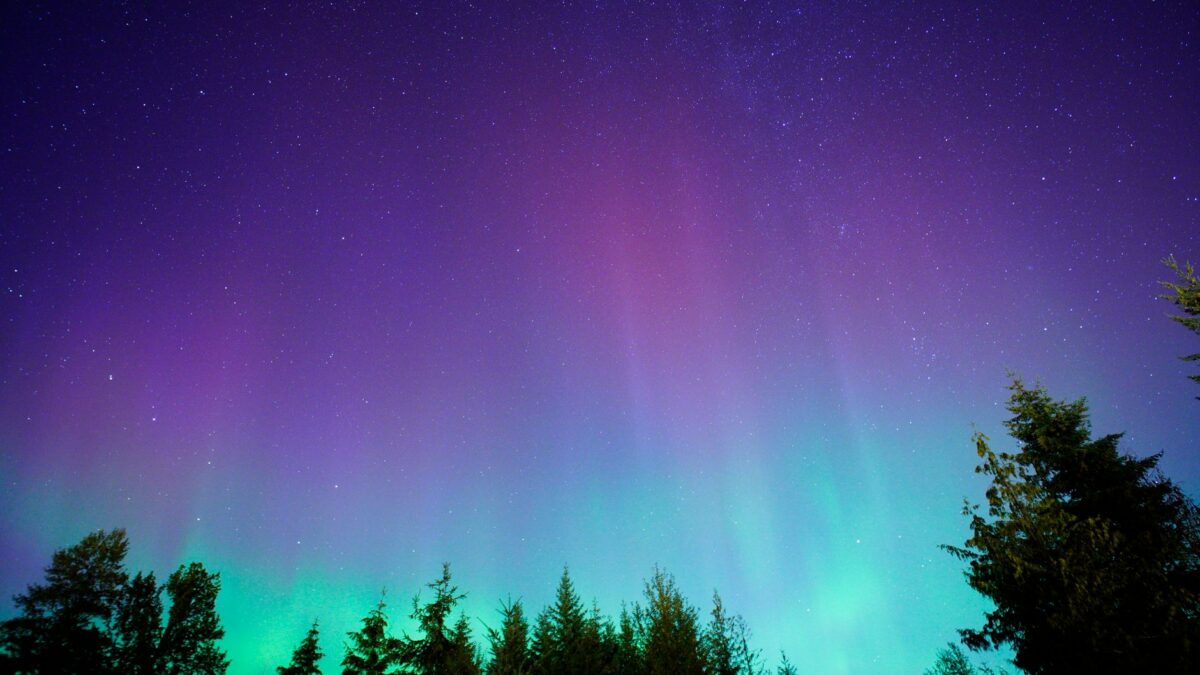
NOAA’s Space Weather Prediction Center (SWPC) issued a G1, or minor, geomagnetic storm watch for the night of Nov. 6, 2026, after a fast stream of solar wind from a large coronal hole on the Sun reached Earth. The forecast also allowed for brief stretches of G2, or moderate, activity, which raises the chance of northern lights over parts of Canada.
According to SWPC’s forecast, as reported by Yahoo, the most likely window ran from sunset until about 10 p.m. EST on Friday, Nov. 6. That timing favored eastern Canada. Auroras from a G1 storm usually stay far north, so the best odds were over Labrador, northern Quebec and northern Ontario. Visibility depends on location, cloud cover and how dark the sky is.
A hole in the Sun’s atmosphere
Space weather forecasters had tracked the coronal hole for several days as the Sun’s rotation turned it toward Earth. A coronal hole is a patch of the Sun’s outer atmosphere where the magnetic field lines open out into space instead of looping back to the surface. Charged particles escape through these openings more easily and faster than usual.
The result is called a coronal hole high speed stream, or CH HSS. It pushes through the slower, calmer solar wind that normally flows past Earth. On Thursday, the stream became “geoeffective,” the term forecasters use when Earth sits inside the flow and its magnetic field starts to respond. That response is what can set off a geomagnetic storm and, with it, auroras.
How NOAA measures a storm
SWPC rates geomagnetic storms on a scale from G1 upward, and it judges activity in blocks of three hours. For a storm to be logged, disturbance of Earth’s magnetic field has to stay above a set threshold for the whole 3-hour block. If it rises and then falls back before the block ends, NOAA records no storm for that period.
That rule matters for sky watchers, because some of the brightest auroras come from short events that never reach the official storm level.
Substorms: short bursts that can still put on a show
During a geomagnetic storm, Earth’s magnetic field can also produce substorms. These are pulses in which the aurora suddenly brightens and spreads farther south than before. To someone standing outside, a substorm can look as striking as the display during a full storm.
The difference is duration. A substorm usually lasts minutes, sometimes an hour or two, which is too short to register on NOAA’s three-hour scale. A quiet official reading does not rule out a bright burst of light overhead.
Scientists now have a new way to watch these events from space. The SMILE mission, a joint project of the European Space Agency and the Chinese Academy of Sciences, took its first ultraviolet images of Earth’s auroras on Aug. 24, 2026. Those images caught an auroral substorm as it unfolded over roughly 50 minutes, according to ESA and CAS.
What it means for sky watchers in Canada
A G1 watch is a forecast of possible activity, not a guarantee that auroras will appear. Coronal hole streams often produce storms in the minor range, and the light from them tends to stay at high latitudes. The chance of short G2 periods gave people farther south a slim opening, mainly in eastern Canada during the evening hours SWPC identified.
Because conditions in the solar wind change quickly, forecasters update their outlooks through the night. Readers hoping to see the northern lights should check current SWPC alerts, look away from city lights toward the northern horizon, and keep in mind that clouds and local light pollution can hide even a strong display.
Source: Yahoo