Octopuses Slip Through Holes Narrower Than Their Eyes, Study Finds
Common octopuses pass through holes smaller than the gap between their eyes in a stepwise routine, a new study reports, and robot designers are taking notes.
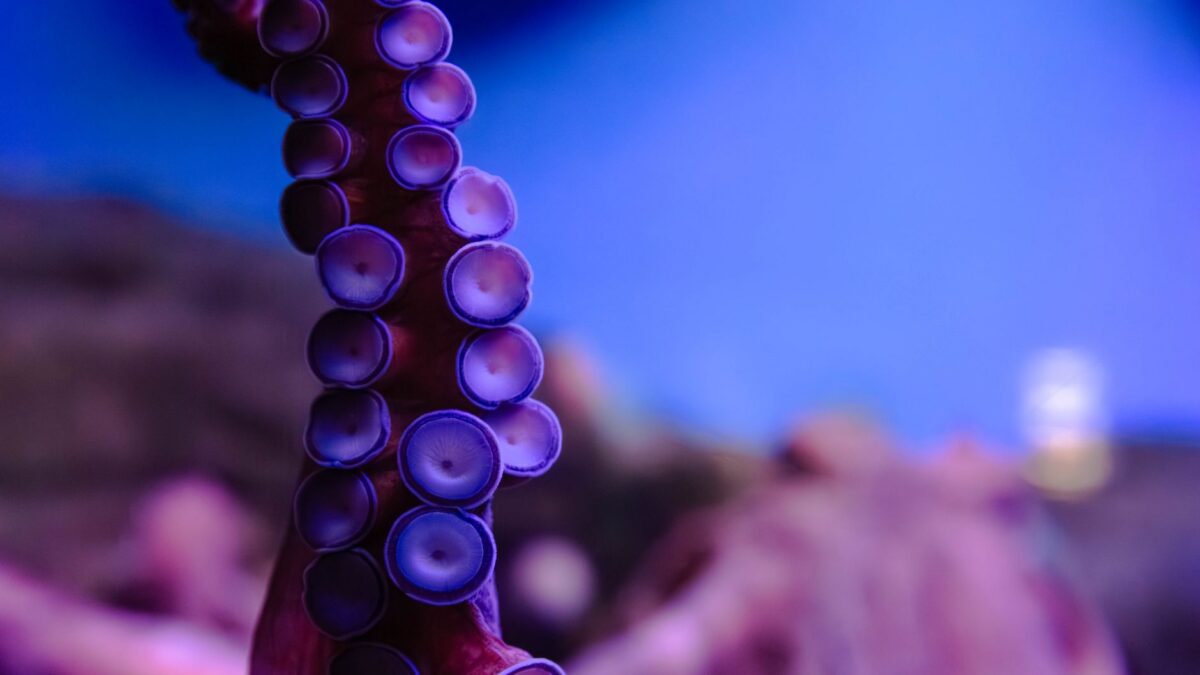
Common octopuses can pull themselves through an opening smaller than the distance between their eyes, and they do it in a fixed sequence of arm movements, according to a study published Nov. 5 in the Journal of Experimental Biology. Smithsonian Magazine reported on the work, which could also guide the design of soft robots meant for tight spaces.
Octopuses are known for slipping through narrow gaps to avoid danger, reach hidden prey or get out of captivity. Until now, nobody had systematically filmed how they manage it.
How the researchers tested the animals
The team, which included Michael Kuba of the University of Naples Federico II in Italy, Tamar Gutnick of the Haus des Meeres-Aqua Terra Zoo in Austria and lead author Wenci Xin of the National University of Singapore, ran laboratory experiments with three subadult common octopuses (Octopus vulgaris) and four juvenile Mayan octopuses (O. maya).
First they measured the distance between each animal’s eyes. That span tracks the size of the semi-rigid cartilage casing around the brain, the stiffest part of an octopus apart from its beak. The measurements ranged from about 0.4 to 1.4 inches. The researchers then fitted a clear acrylic partition into a tank with one central hole, sized either smaller or larger than that animal’s measurement. Each octopus went into the tank alone while the team filmed what it did.
Three steps, sometimes four
When the hole was larger than the gap between their eyes, the common octopuses tended to use a three-step maneuver. They first probed the opening with a single arm, making a U-shaped bend at the edge before pushing the limb through. Kuba told Reuters the idea is that the animals use the sense of touch in their arms to investigate the opening.
Next, they threaded a few more arms through. Last, they braced the arms already on the far side against the back of the partition and used that leverage to haul the rest of the body across.
A hole smaller than the eye span changed the last step. The octopuses still probed and still sent a few arms through, but then they passed the remaining arms through before pulling the head and mantle after them. Xin told IFLScience that this change puzzled the team at first. She said the animals follow the same general pattern, and the new version splits the final pull into separate stages.
Two species, two responses
The Mayan octopuses behaved like the common octopuses when the hole was larger than their eye span. When it was smaller, they ignored it and made no attempt to squeeze through. The researchers do not know why the species differ. They suspect differences in biology or habitat, and they note that other octopus species may have squeezing strategies of their own.
Scientists also still do not fully understand how octopuses tolerate the physical strain of these movements. Trevor Wardill, a neuroethologist at the University of Minnesota who was not part of the study, told the Washington Post it is remarkable that they go about their daily business afterward. He said a person or another animal with a backbone that distorted its brain this way would be “really spaced out for a very long time, if not dead.”
Why it matters for robot design
Most search-and-rescue robots today are long and slender, closer to snakes than octopuses, which helps them wriggle into narrow crevices. The researchers hope their results will lead to flexible, octopus-like machines that can move through confined spaces. According to the coverage, such a robot could carry sensors, communication devices and tools on its soft arms.
Xin told Science News the capability could let robots get past environmental limits and enter places that are hard to reach. The study itself describes animal behavior in a lab setting with a small number of animals, so any robot based on it is still a goal and not a working product.
Source: Smithsonian Magazine