Eclipse Glasses ISO 12312-2: How to Check Safety and Suppliers
An ISO 12312-2 label printed on eclipse glasses proves nothing. How to find a vetted supplier, test viewers and spot damage.
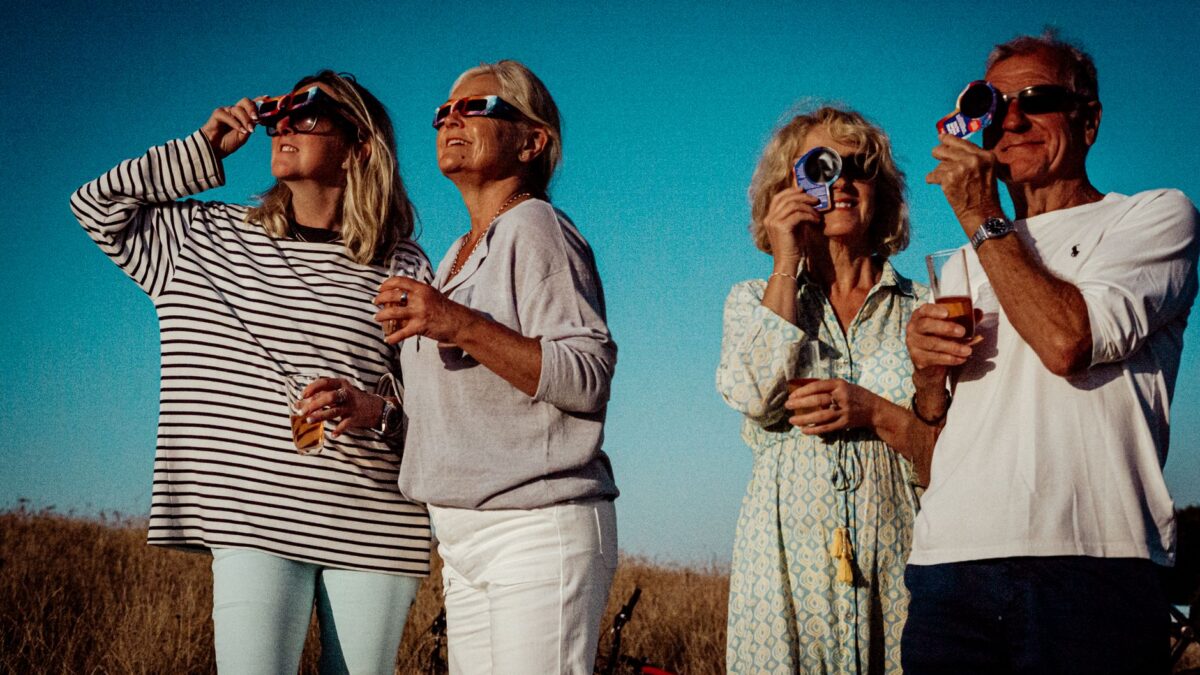
Eclipse glasses are safe when they meet ISO 12312-2, the international standard for filters used to look directly at the Sun. A printed “ISO 12312-2” label does not prove that: anyone can print it. The reliable check is where the glasses came from: buy from a manufacturer on the American Astronomical Society (AAS) list of vetted suppliers, or from a dealer that manufacturer names publicly.
What does ISO 12312-2 mean?
ISO 12312-2 is the international standard for filters for direct observation of the Sun. The American Academy of Ophthalmology, on its solar eclipse eye safety page, says the special-purpose filters in eclipse glasses and handheld solar viewers must meet it. NASA’s eclipse safety page says safe solar viewers are thousands of times darker than ordinary sunglasses, and that NASA does not approve any particular brand.
A compliant viewer does two jobs. It cuts the Sun’s visible light to a comfortable level, and it blocks ultraviolet and infrared radiation, which you cannot see. That second part is why looking through a viewer tells you little: you cannot judge invisible radiation by eye. The AAS also notes that the standard covers glasses and handheld viewers, not filters for telescopes, binoculars or camera lenses.
Why doesn’t a printed label prove the glasses are safe?
According to the AAS Solar Eclipse Task Force, the only sure way to confirm compliance is a test at a laboratory approved by a recognized accrediting body. That is the manufacturer’s job, and consumers cannot do it themselves. A statement of compliance on the frame or the box is just print.
The same goes for brand names. The AAS warns that some dishonest companies have printed the name of a listed manufacturer on their own products. Seeing a trusted name on the cardboard does not mean the glasses came from that company.
How do you check a supplier?
- Open the AAS page of suppliers of safe solar viewers and filters. It lists manufacturers of eclipse glasses, handheld viewers and filter sheets alphabetically; the order does not signal a preference.
- Buy directly from one of those manufacturers, or from an authorized reseller that the manufacturer itself identifies publicly. The AAS no longer vets wholesalers, distributors and retailers and asks manufacturers to publish their own reseller lists.
- Check where the company ships. The listed firms are based in North America, Europe and China, and not all of them ship to every country. Some sell only wholesale.
- Avoid buying whatever appears in online ads or search results, and be wary of marketplaces and shops that are only cashing in on an eclipse. The AAS says that risk is not worth your eyes.
Readers in Europe have a second list. The Volunteer Astronomy Observers of Spain (OVAE) vets suppliers on its Eclipse Seguro site, mainly for people watching the August 2026 and August 2027 total eclipses in Spain. The AAS points to it but says it does not supervise that process. If you are traveling for the next eclipse, our guides to totality times in Luxor and the eclipse in Tangier and Rabat cover where and when to look.
What about glasses you were given?
The AAS says glasses from an amateur or professional astronomer are probably fine, because astronomers buy filters from sources they trust. The same applies to astronomy clubs, university physics and astronomy departments, science museums, planetariums and astronomy trade shows. The test is whether you can trace the filters back to a listed manufacturer or one of its authorized dealers.
How can you tell if eclipse glasses are not safe?
You cannot prove a viewer is safe at home, but the AAS describes three checks that can show it is unsafe:
- Indoors, put the glasses on and look around. You should see nothing except, perhaps, very bright lights, and those should look faint. If you can make out furniture or pictures on the wall, the filter is not dark enough.
- Outdoors on a sunny day, look around again. At most you should see a faint reflection of the Sun off something shiny or a puddle.
- Glance at the Sun for less than a second. You should see a sharp-edged round disk at a comfortable brightness on a dark background. Depending on the filter, it can look white, bluish white, yellow or orange.
Passing all three means the glasses are probably safe. If you still have doubts, the AAS suggests looking for no more than 2 or 3 seconds every 5 minutes or so during the partial phases. Then inspect the condition:
- Throw out filters that are torn, scratched or punctured.
- Throw out glasses whose filters are coming loose from the cardboard or plastic frame.
The AAO adds that you should read the instructions that come with the glasses and help children use them correctly. NASA says children should always be supervised.
Can you use eclipse glasses with binoculars or a camera?
No. NASA warns that concentrated sunlight through a camera lens, telescope or binoculars will burn through the filter in eclipse glasses and cause serious eye injury. Optics need their own solar filter, mounted securely over the front opening. NASA says that with such a filter you do not need eclipse glasses as well, and both NASA and the AAO advise talking to an astronomer before trying it.
What if you cannot get safe glasses in time?
Use indirect viewing. With your back to the Sun, a pinhole projector (a small hole in an index card, or a box with a pinhole in aluminum foil and white paper inside, as NASA describes) casts an image of the crescent Sun you can watch safely. The AAS mentions crossed, slightly open fingers, a colander or the shadow of a leafy tree. Never look at the Sun through the pinhole.
Quick answers
Are dark sunglasses enough?
No. NASA and the AAO both say ordinary sunglasses, however dark, are unsafe for looking at the Sun. Homemade filters are unsafe too, according to the AAO.
When can I take the glasses off?
Only during totality, when the Moon fully covers the Sun’s bright face. The AAO says this lasts 1 to 2 minutes. Put them back on as soon as any bright Sun reappears. During a partial or annular eclipse there is no safe moment without protection, NASA says. Our guide to totality times in Jeddah and Medina shows how short that window is in one location.
Does NASA certify eclipse glasses?
No. NASA does not approve any particular brand of solar viewer; it points readers to the ISO 12312-2 standard.
Checked against official sources in November 2026. Hours, prices and rules change: confirm on the official page before you go or apply.
Site editor: Nikita Sheikin