Australia Total Solar Eclipse July 22: Sydney, Perth Times
Sydney sees 3 minutes, 49 seconds of totality on July 22, 2028. Local times for Sydney, Perth, Brisbane and Darwin, plus who else sees the eclipse.
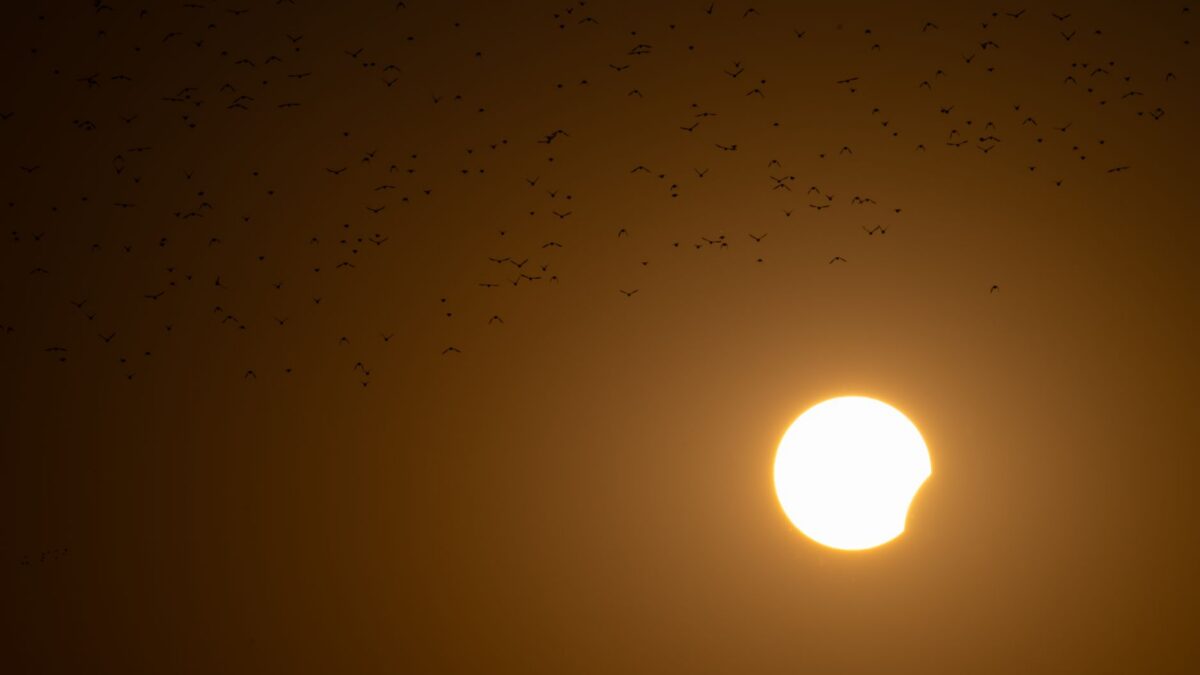
The total solar eclipse of July 22, 2028 is total in Sydney, where totality lasts 3 minutes, 49 seconds around 14:01 local time, according to timeanddate’s Sydney page. Perth, Brisbane and Darwin see a partial eclipse instead. All local times below are on a 24-hour clock.
The Moon’s shadow crosses Australia and New Zealand as a total eclipse, while a much wider area, from southern Asia to the Pacific, the Indian Ocean and Antarctica, sees a partial one. Whether you see anything depends on your location and on the weather that day.
What time is the eclipse in Sydney?
Sydney is in the path of totality. On Saturday, July 22, 2028, the partial phase begins at 12:40, the maximum is at 14:01 and the eclipse ends at 15:14. The whole event lasts 2 hours, 34 minutes, and totality is 3 minutes, 49 seconds.
What do Perth, Brisbane and Darwin see?
These three cities see a partial eclipse. Times are local, from timeanddate:
- Perth: begins at 09:30, maximum at 10:47, ends at 12:08. Duration: 2 hours, 38 minutes.
- Brisbane: begins at 12:41, maximum at 14:01, ends at 15:14. Duration: 2 hours, 33 minutes.
- Darwin: begins at 10:59, maximum at 12:32, ends at 14:03. Duration: 3 hours, 4 minutes.
Darwin has the longest partial eclipse of the three. Brisbane and Sydney reach their maximum at the same clock time, 14:01.
How the eclipse unfolds worldwide
Timeanddate lists the global timeline in UTC. The first location sees the partial eclipse begin on July 22 at 00:27:37 UTC, and the first location sees totality begin at 01:30:43 UTC. Maximum eclipse comes at 02:55:29 UTC. Totality ends at its last location at 04:20:04 UTC, and the last partial eclipse ends at 05:23:11 UTC. These figures use a Delta T value of 70.0 seconds.
NASA’s path table, which lists the Moon’s umbral shadow every two minutes, shows totality lasting 2 minutes, 28.2 seconds at the first limit of the path and growing to 5 minutes, 9.9 seconds near the greatest duration, around 02:52 to 02:54 UTC. The path is at most 234 km wide.
Which countries see a total eclipse?
Timeanddate lists totality in Australia, Christmas Island, the Cocos (Keeling) Islands and New Zealand. For Australia, the eclipse runs from 09:07 AWST to 15:49 LHST, across several time zones. For New Zealand it runs from 15:03 to 17:23 NZST. Christmas Island sees it from 07:39 to 10:25 CXT, and the Cocos (Keeling) Islands from 07:03 to 09:35 CCT.
The partial eclipse reaches many more places, including Indonesia, Singapore, Malaysia, Thailand, India, Fiji and Papua New Guinea, as well as Antarctica.
How many people can see it?
Timeanddate estimates that 1 billion people, or 12.65% of the world’s population, live where some part of the eclipse is visible. About 653 million live where at least 10% of the Sun is covered, and 138 million where at least 90% is. Only just over 6 million people, or 0.08% of the world, live where the eclipse is total. The estimates use CIESIN population data based on 2000 to 2020 figures.
How to watch safely
Never look directly at the Sun without proper eye protection, because it can seriously hurt your eyes. If you plan to take pictures, see our guide to photographing a total solar eclipse. The Aug. 2, 2027 total eclipse has its own path and times guide.
A solar eclipse always falls about two weeks before or after a lunar eclipse, and this is the second eclipse of its season. The first, a partial lunar eclipse, is listed by timeanddate as July 6 in its global timeline, and it appears as July 7 on the Sydney and Brisbane pages.
Which other eclipses can Sydney see?
Timeanddate’s Sydney page lists a penumbral lunar eclipse on Aug. 17, 2027, the partial lunar eclipse on July 7, 2028, this total solar eclipse on July 22, 2028, a total lunar eclipse on Jan. 1, 2029 and a partial lunar eclipse on June 16, 2030. Perth’s list differs: it includes a penumbral lunar eclipse on Feb. 21, 2027, and a total lunar eclipse on Dec. 31, 2028 to Jan. 1, 2029.
Where to check
Timeanddate’s global eclipse page and NASA’s path table for the 2028 eclipse keep the calculations and path details up to date. Timeanddate says its eclipse calculations are usually accurate to a few seconds.
Based on the sources linked above, November 2026.
Site editor: Nikita Sheikin