Webb Maps Dust in Cassiopeia A, Finds Star’s Layers Merged
Webb's mid-infrared map of dust clumps in supernova remnant Cassiopeia A shows the star's inner layers merged shortly before it exploded.
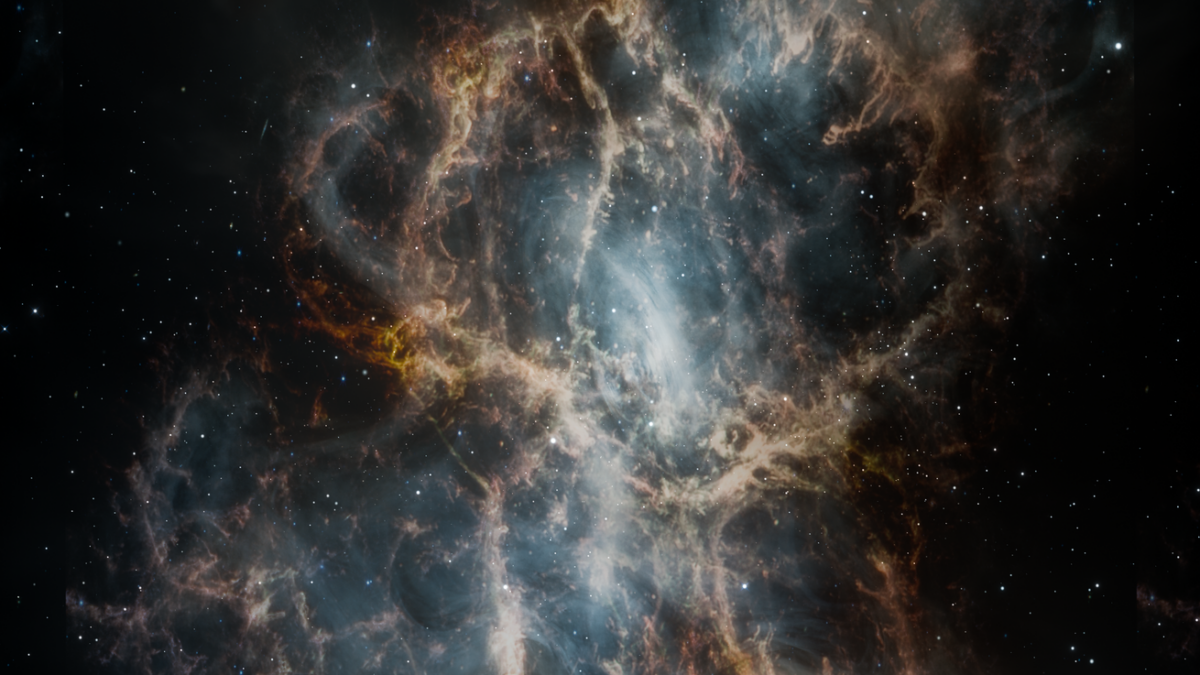
Dust in the supernova remnant Cassiopeia A (Cas A) carries evidence that layers inside the original star mixed together shortly before it exploded, according to NASA. The agency said the James Webb Space Telescope’s mid-infrared observations support a scenario in which the star’s interior changed dramatically, possibly just hours before its death.
The results were published Monday in The Astrophysical Journal Letters. Tea Temim of Columbia University in New York is the lead author.
How Webb read the dust
A massive star builds up shells of different elements as it ages. Once hydrogen in the core runs out, the core contracts and heats until helium fuses into heavier elements. The process repeats, with heavier elements fusing in the core, which stops at iron, and lighter ones fusing in surrounding layers. The result is a set of shells that records the star’s history.
When the star explodes, those elements scatter into space, and some condense into dust grains that can clump together. The team used Webb to map the composition of individual clumps in Cas A, each about the size of a solar system. This level of detail let them study the dust chemistry clump by clump.
To decide where to point Webb, the researchers used data from NASA’s retired Spitzer Space Telescope. Spitzer could not resolve fine detail in the region, but it picked out three areas for Webb to observe.
- Two targets lie in the reverse-shocked region, where an inward-moving shock wave meets debris thrown outward by the explosion. In one, the ejecta contained mostly silica dust. In the other, carbon dust dominated.
- The third is the “Green Monster,” a structure first discovered by Webb. It is rich in complex magnesium silicates and came from material the star shed before exploding, not from the supernova ejecta.
Webb then mapped dust composition across the whole remnant. The team combined this with X-ray observations from NASA’s Chandra X-ray Observatory and the JAXA-led XRISM mission. NASA said the observations together indicate the shell merger was underway very shortly before the explosion.
What a shell merger does
Temim said material within the shells churns and circulates, which can make them merge shortly before a supernova. She gave the example of the oxygen-burning and carbon-burning shells combining, which changes the star’s structure significantly and alters the chemical abundances seen in the ejecta afterward.
The dust map shows merger signatures across much of the remnant. Dan Milisavljevic of Purdue University, a co-author, said the work ties the explosion back to the makeup of the progenitor star (the star that exploded) hundreds of years later. “It’s telling us about what was happening, we think, in the hours leading up to core collapse,” he said.
How sure is this?
The work appears in a peer-reviewed journal, The Astrophysical Journal Letters. It rests on Webb data from three targeted regions plus a remnant-wide dust map, combined with X-ray data from Chandra and XRISM. NASA describes the result as data that “supports” the shell-merger scenario, and Milisavljevic framed the timing of hours before collapse with the words “we think.” NASA’s release does not give a sample beyond this single remnant or an exact timing for the merger.
The researchers say the approach gives other astronomers a new way to infer a progenitor star’s structure from the dust in a supernova remnant. For background on the telescope itself, see this explainer on where Webb is and what it sees.
Source: NASA
Site editor: Nikita Sheikin