How Snowflakes Form and Why No Two Look Alike: The Physics of Ice
Snowflakes grow when water vapor freezes onto a speck of dust inside a cold cloud. Why they have six sides, what shapes form at each temperature, and why none match.
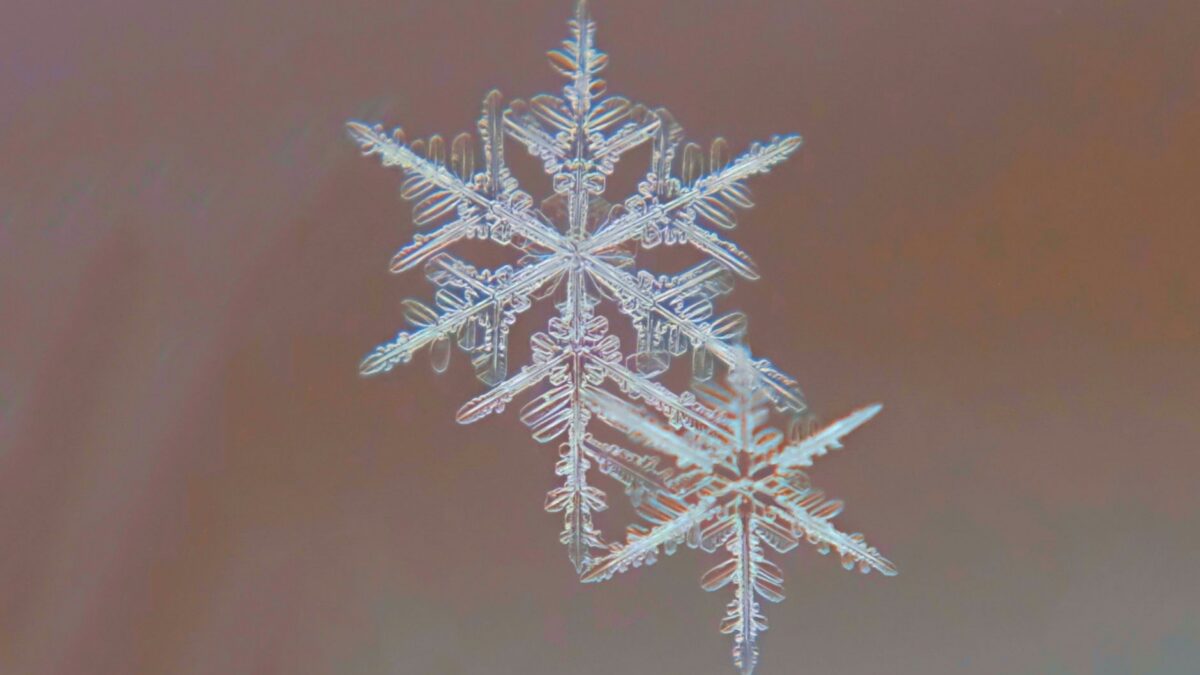
A snowflake forms when water vapor in a cold cloud freezes onto a tiny particle, such as dust or pollen, and then keeps growing as more vapor turns straight into ice on its surface. The six-sided shape comes from the way water molecules lock together in ice. No two snowflakes look exactly alike because each one falls along its own path through the cloud, meeting a slightly different mix of temperature and humidity at every moment.
Where does a snowflake start?
Every snowflake starts on a speck of something solid. Pure water droplets in clouds can stay liquid well below 32°F (0°C); these are called supercooled droplets. They need a surface to freeze on, and in the atmosphere that surface is usually a particle of mineral dust, pollen, ash or even certain bacteria. Scientists call these particles ice nuclei.
Once a small ice crystal exists, it grows quickly. Air inside a mixed cloud holds more water vapor than an ice surface can keep in balance with, so vapor moves onto the crystal and freezes there directly, skipping the liquid stage. As the crystal grows, nearby supercooled droplets shrink and evaporate, feeding it more vapor. Meteorologists call this the Bergeron process, and it is how most snow and much of the rain outside the tropics begins.
Why do snowflakes have six sides?
Snowflakes have six sides because ice has a hexagonal crystal structure. Each water molecule bonds to its neighbors through hydrogen bonds at fixed angles, and the result is a lattice of six-sided rings. A tiny new ice crystal is a flat hexagonal prism, a bit like a short pencil with six faces.
As the prism grows, its six corners stick out slightly farther into the moist air than the flat faces do. The corners pick up vapor a little faster, so they grow faster, which pushes them even farther out. That feedback turns the corners into arms, and side branches sprout from the arms the same way. This is why the familiar star-shaped snowflake, called a stellar dendrite, has six branching arms.
How does temperature change a snowflake’s shape?
Temperature decides the basic shape of a snow crystal, and humidity decides how fancy it gets. Japanese physicist Ukichiro Nakaya worked out this pattern in the 1930s by growing snow crystals in a lab, and his chart is still the standard guide:
- Around 32°F to 25°F (0°C to -4°C): thin, flat hexagonal plates.
- About 25°F to 14°F (-4°C to -10°C): long columns and thin needles.
- About 14°F to -8°F (-10°C to -22°C): plates again, with the classic branching stars forming near 5°F (-15°C) when the air is very moist.
- Colder than about -8°F (-22°C): mostly small plates and columns.
Higher humidity makes crystals grow faster and branch more. In drier air, the same temperature gives simpler plates or stubby prisms. The switch between plates and columns at different temperatures comes from how fast vapor attaches to the flat top faces of the prism compared with its sides, and physicists are still studying the details of that surface chemistry.
Why are no two snowflakes alike?
No two snowflakes are alike because no two take the same trip. A crystal may spend many minutes falling and drifting through a cloud, and it passes through pockets of air that are a little warmer, colder, wetter or drier. Each change alters how the arms grow at that moment, adding a plate here or a burst of branches there. The final crystal is a record of every condition it met.
All six arms of one crystal usually look similar because they are tiny and travel together, so they meet the same conditions at the same time. Two separate crystals, even a few feet apart, never share an identical history. A typical snow crystal also contains an enormous number of water molecules, quintillions of them, so the number of possible arrangements is far beyond anything that would repeat.
Very small, simple crystals, such as plain hexagonal prisms in their first moments, can look nearly identical under a microscope. The claim applies to the large, detailed crystals people picture when they think of a snowflake.
What is the difference between a snow crystal and a snowflake?
A snow crystal is a single ice crystal. A snowflake, strictly speaking, can be one crystal or many crystals stuck together. Near freezing, crystals are slightly wet and sticky, so they clump into large, fluffy flakes that can look like cotton balls. In very cold, dry air they fall apart as separate small crystals, the powdery snow skiers like.
Crystals can also collect frozen cloud droplets on the way down. This coating is called rime. Heavily rimed crystals turn into soft pellets known as graupel. Snow is one of several kinds of winter precipitation, and the temperature of the air layers below the cloud decides whether it reaches the ground as snow or turns into something else; the differences are explained in our guide to freezing rain, sleet and snow.
Where do the clouds that make snow come from?
Snow needs moist air that rises and cools. Air rises along storm fronts, inside low-pressure systems and where wind pushes it up the side of a mountain range. That last effect is why the windward slopes of high ranges get some of the heaviest snowfall on Earth; the ranges themselves are the subject of our explainer on how mountains form. Lake-effect snow forms when cold air crosses a warmer, unfrozen lake, picks up moisture and dumps it as snow on the downwind shore.
For forecasts, winter storm watches and warnings in the United States, the National Weather Service is the official source.
Who first photographed snowflakes?
Wilson Bentley, a farmer in Jericho, Vermont, took the first known photographs of single snow crystals in 1885 by attaching a camera to a microscope. Over his life he photographed thousands of them and found no two the same, which helped make the idea popular. Modern researchers grow snow crystals in temperature-controlled chambers to test exactly how each shape forms.
Quick answers
Are snowflakes always six-sided?
Nearly all snow crystals follow sixfold symmetry, but many are lopsided, broken or clumped. Rare forms include triangular crystals and 12-sided crystals made of two six-sided ones joined together.
Why is snow white if ice is clear?
Snow is a jumble of ice crystals and air. Light bounces off countless crystal surfaces and scatters in every direction, mixing all colors back together, so the pile looks white.
Can it be too cold to snow?
No. Very cold air holds little moisture, so heavy snow is less common in extreme cold, but light snow and ice crystals can fall at temperatures far below 0°F (-18°C).
How big can a snowflake get?
Single crystals are usually smaller than a pencil eraser. Clumped flakes that form near freezing can be much larger, often an inch or more across.