Sahara Meteorite From Mars Is 4.1 Billion Years Old, Oldest of Its Kind
A Martian meteorite found in Mali is 4.1 billion years old and holds manganese oxide. Researchers say it is not proof of life but points to a wetter early Mars.
A rock found in the Sahara Desert in Mali in 2022 has been dated to 4.1 billion years old and identified as Martian, making it one of the oldest Martian meteorites known, EarthSky reported. The meteorite, called Teghaza 001, contains large amounts of manganese oxide, a compound that is a common byproduct of microbial life on Earth.
The researchers do not claim this shows life on Mars. They say the rock adds evidence that early Mars had liquid water and conditions that could have been habitable. The peer-reviewed results were published in the journal Science on Oct. 29, 2026.
How the age was measured
The team found tiny zircon crystals in the meteorite. Zircons let scientists date igneous rocks, which form when molten magma cools. Using uranium-lead dating on the crystals, the researchers arrived at 4.1 billion years.
Carl Agee, director and curator of the Institute of Meteoritics at the University of New Mexico, said other Martian meteorites such as Black Beauty contain parts of about that age, but Black Beauty is a conglomeration of many rock types. Teghaza 001 is a single rock type. Agee called it the oldest Martian igneous rock found by a huge margin. He and colleague Karen Ziegler, a research professor at the university, examined it after noticing its oxygen isotope values resembled those of Black Beauty. Under the microscope he found domains rich in manganese oxide. Lead author Yang Liu of NASA’s Jet Propulsion Laboratory said a reviewer of the paper called the meteorite a “Rosetta Stone for Mars.”
Signs of water and a different Mars
Unusual oxygen isotope compositions and altered minerals in the rock point to fluids and water having moved through it. According to Agee, the rock probably formed in a more Earth-like environment, with surface waters and volcanoes driving hydrothermal systems. Most Martian meteorites, he said, formed and erupted a few hundred million years ago, when Mars was already a dry desert as it is now.
The rock dates to the Pre-Noachian period, the oldest geological epoch on Mars, roughly 4.5 to 4.1 billion years ago. Agee said that if abundant life ever existed on the Martian surface, that would be the time to look: Mars may still have had a magnetic field shielding it from radiation, along with a denser atmosphere and surface water.
Why it matters
Manganese oxide is one of the compounds Mars rovers look for as an indicator of environments friendly to life, Agee said. EarthSky describes its presence here as intriguing but not proof of ancient life.
The sample is also rare. Agee said it is like chipping a piece off an outcrop on Mars 4 billion years ago, and that the chance of getting another like it soon is very slim.
Where on Mars it came from
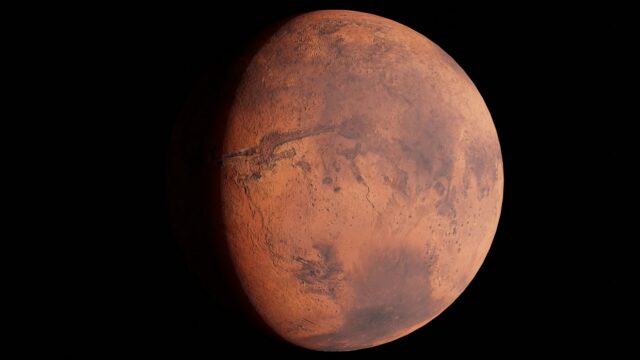
Scientists know the meteorite came from Mars but not from where. The researchers narrowed its origin to 13 primary candidate locations, several of them in the Southern Highlands. Pinning down the exact spot could help in planning where future rovers go.
Source: EarthSky