Mars Orbiter Finds Volcanic Gas Seeping From Fresh Cracks at Alba Mons
ESA's Trace Gas Orbiter detected hydrogen chloride over fresh cracks near Mars' Alba Mons volcano, a sign that magma may still move underground.
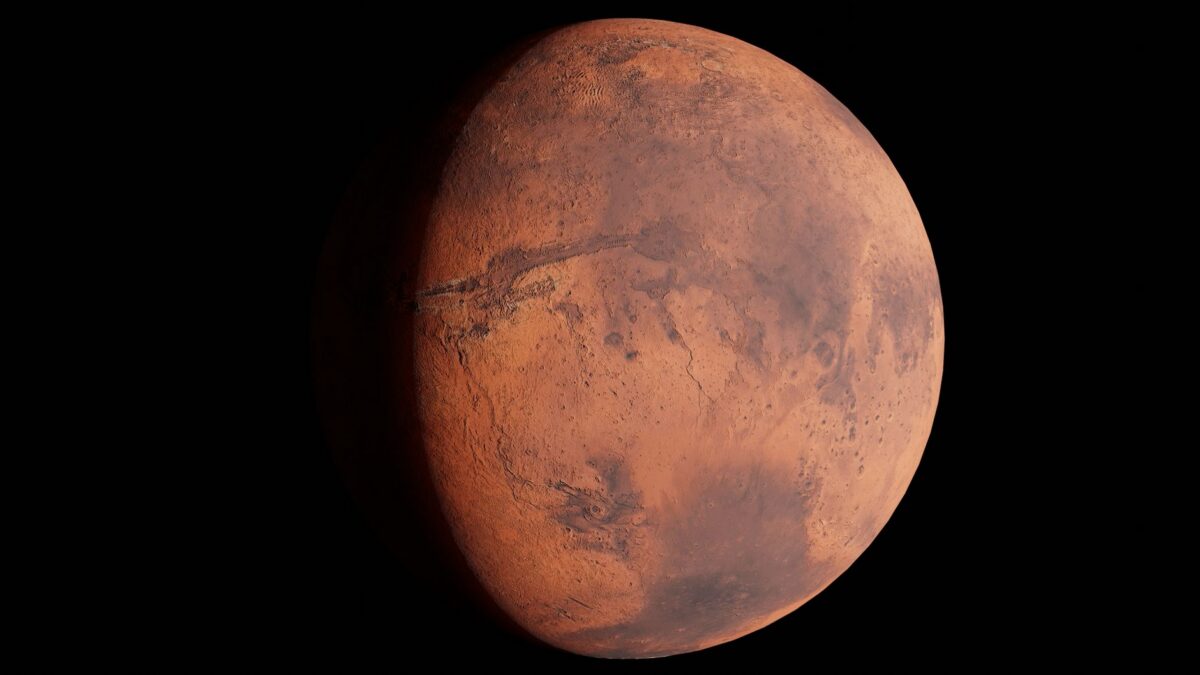
The European Space Agency’s Trace Gas Orbiter has detected hydrogen chloride, a gas that magma often releases on Earth, rising from fresh cracks in the ground around the Alba Mons volcano on Mars. The cracks are several hundred meters long and tens of centimeters wide. An international team reported the finding on Nov. 4, 2026, in the peer-reviewed journal Science Advances, according to EarthSky.
The researchers say the most likely explanation is magma still moving beneath the Martian surface. Mars’ volcanoes no longer erupt, but this would mean the planet’s interior is still warm enough for igneous activity, the term for processes driven by molten rock.
How the orbiter picked up the gas
Instruments on the orbiter, including the Atmospheric Chemistry Suite, measured the gas at parts-per-billion levels at low altitudes over the Alba Mons region, which lies northeast of Olympus Mons. That is a tiny concentration, but it was higher than scientists expected.
Timing made the detection stand out. Hydrogen chloride shows up widely in the Martian atmosphere during the warm season, when Mars is closest to the sun in its 2-year orbit, and researchers have tied those readings to aerosols (fine particles and droplets in the air). In the cold season, water ice crystals quickly soak up the molecules and they mostly vanish from view. The Alba Mons readings came during the cold season and were confined to that one area.
The team says weather and atmospheric chemistry do not explain them. Much of the study involved checking every chemical process in the Martian air that might produce the gas. The researchers also mapped narrow fissures, less than 1 meter wide, that they interpret as possible pathways leading down to bodies of magma.
Co-lead author Daniel Mège of the Space Research Center of the Polish Academy of Sciences compared the search to finding a needle in a haystack. He said the results suggest Mars kept enough internal heat for volcanic activity “until recently, and possibly still does.”
What is still uncertain
The signal is faint, and EarthSky notes that future studies still need to confirm the gas is there at all. The authors describe the readings as a hint of a volcanic origin, which stops short of proof.
The gas may also take an indirect route. A layer of permafrost above the magma could act as a buffer: ice traps hydrogen chloride in winter and releases it when it sublimates (turns straight from solid to vapor) in spring. A lasting source in the soil like this could explain why the gas appears in one place and only in certain seasons.
Sulfur dioxide, a gas that would point to active eruptions, has not been detected on Mars. The authors argue that halogen gases such as hydrogen chloride may be a better marker of active magma chambers.
Why it matters
For much of the space age, scientists regarded Mars as largely dormant. It has no moving tectonic plates, and giants like Olympus Mons, the largest volcano in the solar system, were seen as relics. That view has been shifting. NASA’s InSight lander recorded more than 1,300 seismic events, showing the planet still has marsquakes, and evidence of fairly recent volcanism has been building.
The finding also bears on Mars’ chlorine cycle. Because Mars lacks plate tectonics to recycle material, the researchers suggest volcanoes are probably the main source of chlorine reaching its surface and atmosphere.
Heat underground could also melt ice into groundwater and drive hydrothermal systems, the kind of warm, wet setting where microbes can live on Earth. Mège said the seeping fissures of Alba Mons would be a sensible place to look for signs of Martian life. No such life has been found, and the study did not test for it.
Source: EarthSky