Asteroid Up to 1,800 Meters Wide to Pass Near Earth on Aug. 7, 2027
Asteroid 1999 AN10 will pass about one lunar distance from Earth on Aug. 7, 2027, with no chance of impact. See when it peaks and how to spot it.

An asteroid estimated at 800 to 1,800 meters across (about 0.5 to 1.1 miles) will pass Earth on Aug. 7, 2027, at roughly the distance of the moon, EarthSky reported. The rock, called 1999 AN10, has zero chance of hitting Earth during this flyby, and it should be bright enough to see with binoculars.
Its closest approach comes at 7:12:05 UTC on Aug. 7, 2027, which is 2:12:05 a.m. CDT for observers in the Americas. At that moment it will be about 389,855 kilometers (242,240 miles) away.
How bright it will get and where to look
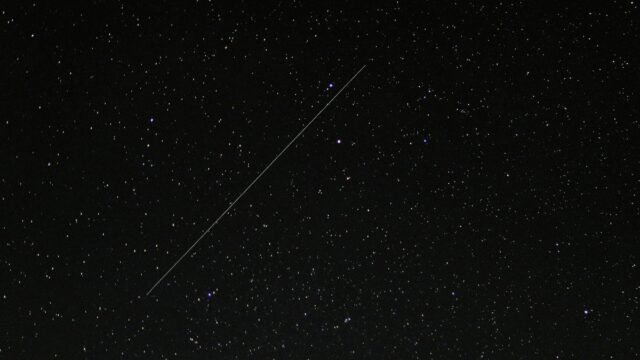
According to EarthSky, 1999 AN10 should peak near magnitude 7.3, just below what the naked eye can pick out, as it crosses the night sky over North and South America. During the night of Aug. 7 it will move through Taurus, Aries, Pisces and Pegasus. Whether you can actually see it will depend on your location and the weather that night.
The moon is no target either. The asteroid will come no closer to it than 763,391 km (474,349 miles), about twice its distance from Earth, because it passes on the side of Earth opposite the moon.
Why NASA calls it potentially hazardous
NASA lists 1999 AN10 as a potentially hazardous asteroid. The label has nothing to do with the 2027 pass. It applies to any object larger than 140 meters (460 feet) that can come within 0.05 astronomical units of Earth. Such a rock could, in principle, be nudged by another body in the future onto a path that crosses ours, so astronomers keep tracking it. You can read more about how NASA tracks asteroid impact risk.
Size is the main reason this one is on the list. NASA says an impactor bigger than 1 to 2 kilometers would have worldwide effects, throwing enough dust into the atmosphere to dim sunlight for months.
What astronomers know about 1999 AN10
The asteroid was discovered on Jan. 13, 1999, at the Lincoln Laboratory Experimental Test Site in New Mexico. It belongs to the Apollo class, whose orbits cross Earth’s path around the sun. 1999 AN10 takes 643 days to circle the sun on a stretched orbit that runs from inside Earth’s orbit to well past Mars.
Astronomers have cataloged about 2,500 potentially hazardous asteroids, which they estimate is only around half of the total. They believe they have found 90% of the largest ones, according to EarthSky.
Other large asteroids passing soon
Apophis, about 375 meters wide, will pass roughly 32,000 km (20,000 miles) above Earth’s surface on April 13, 2029, closer than many geostationary satellites. Further observations ruled out any impact risk from it for at least 100 years, and NASA’s OSIRIS-APEX spacecraft will study it after the encounter.
On June 26, 2028, an asteroid about 940 meters across will pass inside the moon’s orbit, roughly 248,700 km (154,500 miles) from Earth’s center, and should peak at magnitude 6.7, a little brighter than 1999 AN10. Another rock about 700 meters wide will come within about 929,000 km (577,000 miles) on Oct. 26, 2028. Early calculations after its 1997 discovery suggested a possible collision, but better data ruled that out.
Bennu, about 500 meters wide, carries impact odds of roughly 1 in 2,700 for Sept. 24, 2182, based on NASA’s 2021 orbital analysis. NASA’s OSIRIS-REx mission brought a sample of it back to Earth in 2023.
What it means for skywatchers
For anyone with binoculars, the 2027 pass is a chance to watch a mountain-sized asteroid move against the stars with no danger involved. How much of it you can see will depend on local sky conditions that night.
Source: EarthSky