How DNA Works: The Double Helix, Genes and How Proteins Get Made
Stretched out, the DNA in one of your cells is a long, twisted ladder with about 3 billion rungs. Here is how a cell reads it.
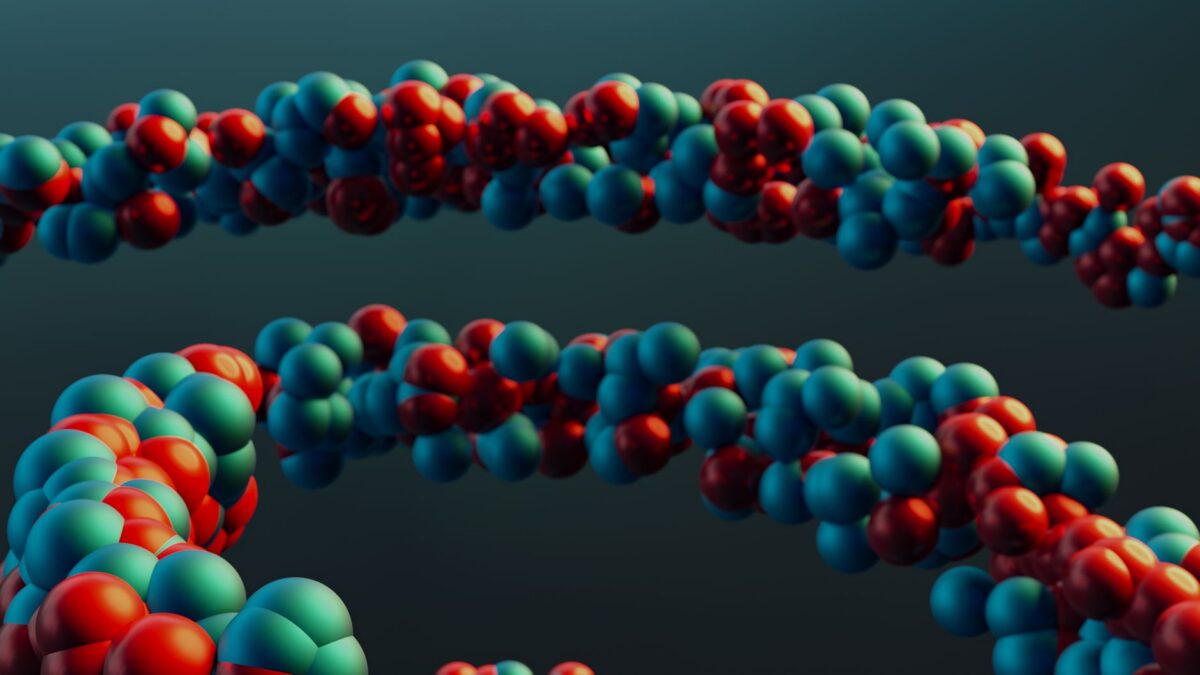
DNA stores the instructions for building and running a living thing as a sequence of four chemical bases, written A, T, G and C. The bases pair up across a twisted, ladder-like double helix. A cell copies a gene’s sequence into a messenger molecule called mRNA, then reads that message to string amino acids into a protein. The human genome holds about 3 billion bases and about 20,000 genes, according to the National Human Genome Research Institute.
Picture a ladder twisted into a spiral, with two long rails and a rung every step. Each rung is a pair of bases, and the order of those rungs along one side is the code.
What is DNA made of?
DNA, short for deoxyribonucleic acid, is built from units called nucleotides. Each nucleotide has three parts: a phosphate group, a sugar and one of four nitrogen-containing bases: adenine (A), thymine (T), guanine (G) or cytosine (C). That is how the NHGRI describes it in its DNA fact sheet.
The sugars and phosphates link into two long strands that form the rails of the ladder, running in opposite directions. The bases point inward and meet in the middle to form the rungs. In plants, animals and other organisms with a cell nucleus, DNA is packed tightly into chromosomes inside the nucleus, especially when a cell is dividing.
How do the bases pair up?
The bases pair by strict rules: A always pairs with T, and C always pairs with G. Because of that, one strand’s sequence fixes the sequence of the other. If one side reads ATGC, the opposite side must read TACG.
That rule makes copying possible. When a cell divides, the two strands separate and each becomes a template for a new partner strand, so each daughter cell gets a full copy. Copying is very accurate but not perfect, and rare errors, called mutations, are one source of the variation that evolution acts on. Bacteria offer a fast-moving example, described in how antibiotic resistance evolves.
The double-helix structure was worked out in 1953 by James Watson, Francis Crick, Maurice Wilkins and Rosalind Franklin, using X-ray diffraction images and models, the NHGRI notes. DNA itself had first been observed by the Swiss biochemist Friedrich Miescher in the late 1800s.
What are genes and chromosomes?
A gene is a stretch of DNA that carries the instructions for making a particular product, usually a protein. A chromosome is one very long DNA molecule, wound around proteins for packing, that carries many genes.
| Human genome feature | Figure (NHGRI) |
|---|---|
| Total length | About 3 billion bases |
| Genes | About 20,000 |
| Chromosomes | 23 pairs |
| Share of DNA that is genes | About 1% |
| Sequence shared between any two people | About 99.6% on average |
Genes make up only about 1% of the sequence. The rest is not useless: much of it helps control when, how and how much of each protein is made. Each person inherits one set of 23 chromosomes from each parent.
How does a gene become a protein?
A gene becomes a protein in two main steps, transcription and translation.
- Transcription. Inside the nucleus, enzymes read the DNA of a gene and build a matching single-stranded copy called messenger RNA (mRNA). RNA uses the base uracil (U) in place of thymine.
- Processing and export. In cells like ours, the mRNA is trimmed and edited, then moves out of the nucleus into the surrounding cell.
- Translation. Cell machines called ribosomes read the mRNA three bases at a time. Each three-base “word,” or codon, stands for a specific amino acid, or for stop.
- Folding. The chain of amino acids folds into a three-dimensional shape that lets the protein do its job, such as speeding up a reaction, carrying oxygen or forming part of a muscle fiber.
The same basic code is used, with small variations, by almost all life on Earth, from bacteria to whales. That shared code is one of the strongest lines of evidence that all known living things share common ancestry.
How alike are people genetically?
Any two people’s genomes are about 99.6% identical on average, according to the NHGRI’s fact sheet on human genomic variation. The often-quoted 99.9% counts only single-letter differences. Across about 3 billion bases, the remaining fraction still adds up to millions of differences, and those differences contribute to variation in traits such as height and eye color, along with many other factors.
Genetic differences also record history. DNA recovered from ancient bones has shown, for example, that many people living today carry a small share of Neanderthal DNA, explored in who were the Neanderthals. At Pompeii, ancient DNA overturned stories about who the victims were, as described in what happened at Pompeii.
This article explains basic biology. Questions about genetic tests or what your own DNA means for your health are for a doctor or genetic counselor.
Bottom line
DNA is a four-letter chemical code stored in a double helix, with A pairing with T and C with G. Cells copy genes into mRNA and translate that message into proteins, three bases at a time. The human genome is about 3 billion bases long with about 20,000 genes, and any two people’s genomes are about 99.6% identical on average.
FAQ
What is the difference between DNA and a gene?
DNA is the molecule; a gene is one stretch of it that carries instructions for a particular product, usually a protein. A single chromosome holds many genes.
How many genes do humans have?
The NHGRI puts the number at about 20,000 genes, spread across 23 pairs of chromosomes. Genes make up only about 1% of the DNA sequence.
Who discovered the double helix?
The structure was worked out in 1953 by Watson, Crick, Wilkins and Franklin, using X-ray diffraction data and models. Franklin’s X-ray images were a key part of the evidence.
What is the difference between DNA and RNA?
DNA is usually double-stranded and stores information long term. RNA is usually single-stranded, uses uracil instead of thymine and carries copies of genes to the ribosomes.