Einstein’s Equations Hide a Solar-Flare-Like Process in Gravity
Physicists report gravitational reconnection, a theoretical process in Einstein's equations that moves energy from gravity into matter, like a solar flare.
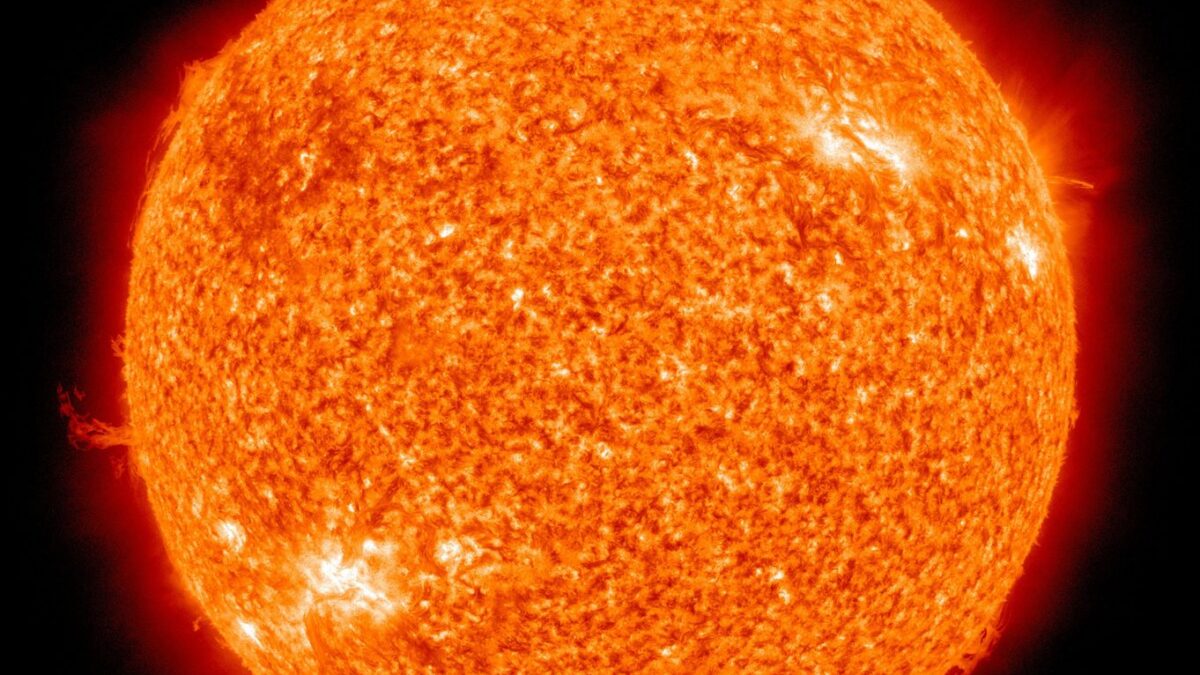
Two physicists report that Einstein’s equations of gravity contain a process in which the structures of a gravitational field break and reconnect, passing energy from gravity into matter. They call it “gravitational reconnection.” It resembles magnetic reconnection, the process behind solar flares, according to Columbia University, which announced the work.
The result is purely theoretical. Scientists have not yet established how the process works in real astrophysical settings or whether its effects can be observed.
How a solar-flare idea carries over to gravity
In a plasma, an electrically charged gas, magnetic field lines can be stretched and twisted. Under some conditions they break and reattach in a new arrangement, and the stored magnetic energy goes into the surrounding particles. This powers solar flares. “When they break and reconnect, they release energy,” said Luca Comisso of Columbia University.
Gravity works in four-dimensional space-time, with three dimensions of space and one of time. Comisso said that makes gravity involve field “sheets” rather than field lines. The sheets are mathematical representations, not physical surfaces that tear apart. Under the right conditions, the researchers found, these sheets can change their connections, and that rearrangement describes energy moving from the gravitational field into matter.
How the researchers found it
Comisso, an associate research scientist in Columbia’s Departments of Astronomy and Physics, worked with Felipe A. Asenjo of Universidad Adolfo Ibáñez in Chile. They used a rewritten version of Einstein’s equations developed by physicists in recent years. It uses different variables but is mathematically equivalent to the original and describes the same physics.
That version looks much like the equations used to study plasmas, which make up the Sun, are used in fusion experiments and fill much of the space between stars. Comisso has spent his career on plasma behavior, so the team applied methods built for magnetic fields to gravitational ones.
The work builds on an earlier paper in Physical Review Letters by Comisso, Asenjo and Maricarmen A. Winkler. It identified constraints on which changes in space-time geometry are possible. These limits are built into Einstein’s theory but had not been recognized in this form. In the new study, the pair examined what happens when the ideal conditions that normally preserve connections within gravitational structures no longer hold. Those connections can then change.
The new paper, “Reconnection of Gravitational Fields,” appeared in Physical Review D (DOI: 10.1103/lmqy-pf9k). The earlier paper, “Frozen-In Gravitational Fields,” is in Physical Review Letters (DOI: 10.1103/6c4q-kx6f). The research was supported by the National Science Foundation and NASA.
Why it matters for black hole studies
When two black holes merge, gravity distorts space-time so strongly that even powerful computer simulations are hard to interpret. Astrophysicists normally run large supercomputer simulations from chosen starting conditions to predict the gravitational waves a merger produces. Those waves are ripples in space-time detected by instruments such as LIGO.
The rules found by Comisso and Asenjo could complement such simulations. “Even without doing the full calculation, we know that space-time needs to behave in a certain way,” Comisso said. The constraints can show which behaviors are physically possible without solving every part of the equations.
What is still unknown
The reconnection process has not been tied to any observed event. Comisso’s next step is to study it in specific situations, especially black hole mergers. He hopes to estimate how much energy such events release and to test whether gravitational reconnection leaves recognizable signatures in gravitational wave signals.
Source: ScienceDaily