What Makes Fireworks Different Colors? The Chemistry Explained
Every burst of red or green in the night sky is a set of excited electrons dropping back into place. Here is the chemistry, and why a deep blue firework is still a small triumph.
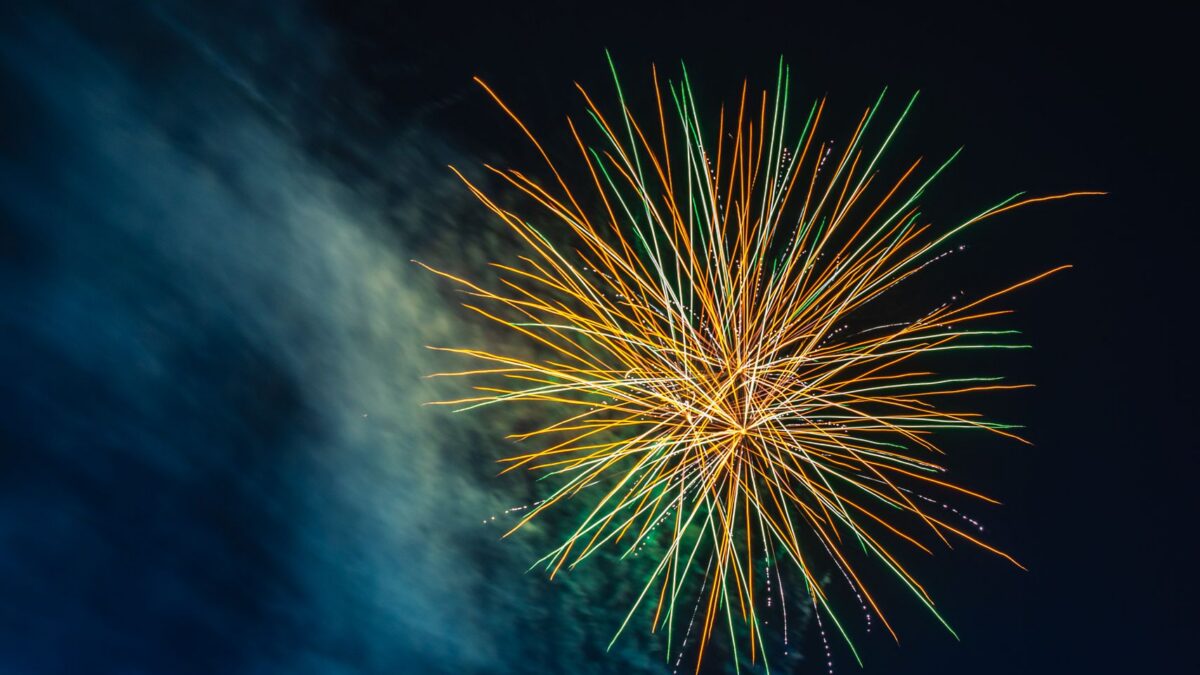
Fireworks get their colors from metal compounds packed into small pellets called stars: strontium gives red, barium gives green, copper gives blue, sodium gives yellow and calcium gives orange. When the stars burn, heat excites electrons in these substances, and as the electrons fall back they release light of colors specific to each element. Blue is the hardest color to make because the copper compound that produces it breaks apart if the flame gets too hot.
Silver and gold sparks work differently. They come from hot particles of metal or carbon glowing the way a stove element does.
How do metals make colored light?
Each element emits its own set of colors when heated, because its electrons can only sit at certain energy levels. Heat from the burning firework pushes electrons up to a higher level. They do not stay there. When an electron drops back, it gives off the energy difference as a particle of light, a photon, and the size of that drop sets the wavelength and so the color.
The same effect is behind the classroom flame test, where a pinch of a metal salt turns a flame a telltale color. The Royal Society of Chemistry explains that firework makers add powerful oxidizers to generate enough heat to excite the color-producing chemicals. Color from excited atoms and molecules is a different process from how sunlight gets its color in the sky, which we explain in why the sky is blue.
Which chemical makes which color?
Firework makers rely on a short list of metals, usually combined with a chlorine source, because the light often comes from metal chloride molecules that form in the flame.
| Color | Main element | Notes |
|---|---|---|
| Red | Strontium | Deep reds; hard to replace with greener alternatives |
| Orange | Calcium | Often mixed with other colors |
| Yellow | Sodium | Bright yellow, the same color as sodium streetlights |
| Green | Barium | Barium chloride is the green emitter |
| Blue | Copper | Copper chloride breaks down if the flame is too hot |
| Purple | Strontium plus copper | A blend of red and blue |
| Silver and white sparks | Aluminum, titanium | Hot metal particles glowing; a magnesium-aluminum alloy called magnalium is used as fuel |
The chlorine donor matters as much as the metal. The Royal Society of Chemistry notes that early makers used mercury(I) chloride for this job, and that it has since been replaced by chlorine-containing plastics such as PVC.
Why is blue the hardest color?
Blue is hard because the copper chloride molecule that emits blue light is fragile. If the flame runs too hot, the molecule falls apart before it can glow, and the color washes out to a pale, whitish blue. If the flame runs too cool, there is not enough energy to excite it strongly.
That leaves a narrow temperature window, and firework chemists must choose the oxidizer and fuel carefully to stay inside it. Brighter, purer blues have improved over the years, but a deep blue that holds its color across a large burst is still one of the harder effects in the trade. Green and red are more forgiving because their emitters survive a hotter flame.
How are firework shells built to make shapes?
An aerial shell is a paper or plastic casing fired from a tube called a mortar, and its shape in the sky comes from how the stars are arranged inside. The main parts are:
- Lift charge: black powder at the bottom of the mortar that launches the shell into the air.
- Time-delay fuse: lit by the lift charge, it burns while the shell climbs and sets off the burst near the top of the flight.
- Burst charge: explosive powder in the middle that breaks the shell open and throws the stars outward.
- Stars: the pellets of fuel, oxidizer and color chemicals that burn as the glowing points of light.
A round shell with stars packed evenly around the burst charge gives the classic sphere, often called a peony or chrysanthemum. Stars placed in a ring give a ring, and stars laid out in a flat pattern can make a heart or smiley face, which only looks right when seen from the side it faces. Stars can carry layers of different chemicals so they change color as they burn.
Why do you hear fireworks after you see them?
Light reaches your eyes almost instantly, while sound travels through air at about 343 meters per second (about 1,125 feet per second) at 20 C (68 F). Sound needs about 3 seconds to cover a kilometer, or about 5 seconds for a mile.
So the farther you are from the burst, the longer the gap. Counting the seconds between flash and bang gives a rough distance, the same trick used with lightning and thunder, explained in what causes lightning. The bang itself comes from the burst charge expanding gas very quickly, which sends a pressure wave through the air.
Are fireworks colors bad for the environment?
Some firework chemicals raise environmental concerns. Barium compounds and the perchlorate oxidizers used in many fireworks are among the ingredients chemists have tried to replace with cleaner options. Researchers have developed some red formulas without perchlorates, but strontium itself has proved hard to replace, according to the American Chemical Society. Smoke, metal particles and plastic debris also fall back to the ground and water after big shows.
Fireworks are explosives. Only licensed professionals handle display shells, and consumer fireworks rules vary by state, so follow local law and the instructions printed on the product.
Bottom line
Firework colors come from metal compounds whose excited electrons emit light of set colors: strontium red, calcium orange, sodium yellow, barium green and copper blue. Blue is hardest because the copper chloride emitter breaks down in a hot flame. Shapes come from how stars are packed around the burst charge, and the bang arrives after the flash because sound moves at about 343 meters per second.
FAQ
What chemical makes red fireworks?
Strontium compounds make the red in most fireworks. They give a deep red that firework makers have found hard to match with other elements.
Why are there so few truly blue fireworks?
The blue comes from copper chloride, a molecule that falls apart at high flame temperatures. Getting a strong, deep blue means keeping the flame in a narrow temperature range.
What makes the crackling and glitter effects?
Glitter and silver sparks come from metal particles such as aluminum and titanium burning and glowing as they fly. Crackling effects use special star compositions that burst into many tiny pops.
How far away is a firework if I hear it 3 seconds after seeing it?
About 1 kilometer, or a little over half a mile, because sound covers roughly 343 meters each second. Wind and temperature change the exact speed slightly.