What Is Dark Matter? The Evidence and the Hunt for It Explained
Galaxies spin too fast, light bends around empty-looking space and the afterglow of the Big Bang carries the same fingerprint. Here is why astronomers think dark matter exists and how they are trying to catch it.
Dark matter is an invisible form of matter that does not emit, absorb or reflect light and is detected only through its gravity. It makes up about 27% of the universe’s total matter and energy, more than five times the roughly 5% that is ordinary matter, according to NASA. Nobody yet knows what it is made of.
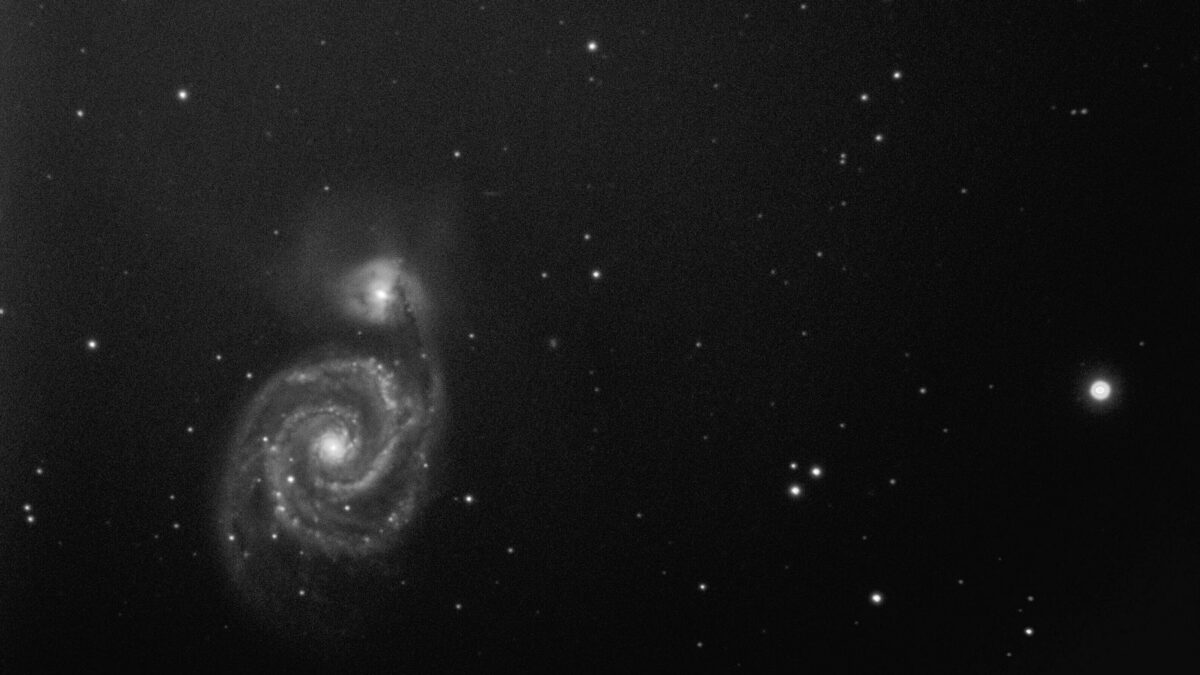
Picture a spiral galaxy turning like a giant pinwheel. By the laws of gravity, stars near its edge should orbit slowly, the way Neptune crawls around the Sun compared with Mercury. Instead they race around almost as fast as stars near the center. Something unseen is adding gravity, and it outweighs all the stars and gas we can see.
What is the evidence that dark matter exists?
Several independent lines of evidence point to the same missing mass:
- Galaxy clusters. In 1933 Fritz Zwicky found that galaxies in the Coma Cluster moved too fast to be held together by the gravity of their visible matter, according to NASA.
- Galaxy rotation. In the 1970s, astronomer Vera Rubin measured stars on the outer edges of spiral galaxies moving too fast for the visible matter to hold them.
- Gravitational lensing. Mass bends light from more distant galaxies behind it. The amount of bending reveals far more mass than the visible matter can supply.
- The Bullet Cluster. In this pair of colliding galaxy clusters, studied in 2006, the hot gas that holds most of the ordinary matter was slowed by the crash, while the mass mapped by lensing sailed ahead with the galaxies. It is often cited as some of the most direct evidence for dark matter.
- The cosmic microwave background. The pattern of tiny temperature ripples in the Big Bang’s afterglow depends on how much ordinary and dark matter the young universe contained, and it matches a universe dominated by dark matter.
How much of the universe is dark matter?
Dark matter makes up about 27% of the universe, ordinary matter about 5% and dark energy about 68%, the round numbers used by NASA and CERN. The European Space Agency’s Planck mission, which mapped the cosmic microwave background in detail, gave more precise figures in 2013.
| Ingredient | Share of the universe (Planck, 2013) | How we know it |
|---|---|---|
| Dark energy | 68.3% | Accelerating expansion of the universe |
| Dark matter | 26.8% | Gravity of galaxies, clusters, lensing, cosmic background |
| Ordinary matter | 4.9% | Stars, gas, planets and everything made of atoms |
Put another way, for every kilogram of ordinary matter there are about five kilograms of dark matter.
Could dark matter just be gas, dust or dead stars?
No. Gas, dust and dead stars are made of ordinary atoms, which leave clear traces in the cosmic microwave background and in the amounts of light elements made just after the Big Bang. The measurements leave room for only about 5% ordinary matter, so most of the missing mass must be something else.
It is also not dark energy, which CERN describes as spread evenly through space and driving the universe’s accelerating expansion rather than clumping around galaxies. And it is not antimatter: antimatter annihilates with ordinary matter in bursts of light, while dark matter seems to pass through everything. Our explainer on what antimatter is covers that separate mystery.
Black holes have been proposed too. Primordial black holes formed soon after the Big Bang remain on NASA’s list of candidates, but searches have ruled out many mass ranges. Ordinary black holes from dead stars are far too few. For the basics, see what a black hole is.
What could dark matter be made of?
The leading idea is a new kind of particle that barely interacts with ordinary matter except through gravity. The main candidates:
- WIMPs (weakly interacting massive particles): heavy, slow particles that might very rarely bump into an atomic nucleus.
- Axions: extremely light particles first proposed in 1977 to solve a separate problem in particle physics.
- Other new particles predicted by theories such as supersymmetry, or a “hidden” sector of particles that interact mostly with each other.
Some physicists argue instead that gravity behaves differently on galactic scales. Such modified-gravity theories can explain galaxy rotation, but most researchers find they struggle with clusters, lensing and the cosmic background at the same time.
How are scientists searching for dark matter?
The hunt runs underground, at particle colliders and in space:
- Underground detectors wait for a dark matter particle to knock into an atom. The LZ experiment uses 10 tonnes of ultrapure liquid xenon nearly one mile below ground at the Sanford Underground Research Facility in South Dakota. In September 2026 its team reported a single event they could not explain with known backgrounds, at a significance of 2.6 sigma, well short of the 5-sigma standard for a discovery. The result had not yet been peer-reviewed, and the team said, “We are not claiming to have seen dark matter,” according to the US Department of Energy.
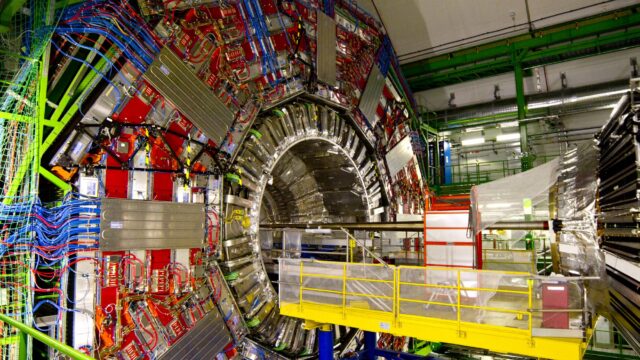
- Particle colliders. At CERN’s Large Hadron Collider, dark matter particles created in collisions would escape the detectors unseen. Physicists look for collisions with missing energy and momentum. None has been found so far.
- Telescopes in space. Mapping how dark matter is spread across the sky tests what it can be. ESA’s Euclid telescope is mapping galaxies for this purpose, and NASA’s Nancy Grace Roman Space Telescope launched on Aug. 30, 2026, with science operations expected by early 2027.
- Gamma-ray searches. If WIMPs annihilate each other, they could produce gamma rays from places dense with dark matter, such as the center of the Milky Way.
Telescopes like the James Webb Space Telescope also help, by measuring how galaxies formed and grew in the early universe, a process shaped by dark matter’s gravity.
Bottom line
Dark matter is about 27% of the universe and over five times as common as ordinary matter, and its gravity shows up in galaxies, clusters, bent light and the Big Bang’s afterglow. Its nature is still unknown. Detectors are getting more sensitive and new telescopes are mapping it in detail, but as of November 2026 no experiment has confirmed a dark matter particle.
FAQ
Has dark matter been detected directly?
Not yet. Its gravity has been measured many ways, but no experiment has confirmed a dark matter particle. The LZ hint reported in 2026 is far below the threshold for a discovery.
What is the difference between dark matter and dark energy?
Dark matter clumps around galaxies and pulls with gravity. Dark energy is spread evenly through space and makes the expansion of the universe speed up.
Is there dark matter on Earth?
If dark matter is made of particles, they should be streaming through Earth and through you all the time, interacting so rarely that we do not notice. That is exactly what underground detectors try to catch.
Could dark matter be a mistake in our theory of gravity?
Some physicists think so, and modified-gravity models remain under study. Most cosmologists favor dark matter because one ingredient explains galaxies, clusters, lensing and the cosmic background together.