Engineered Bacteria Could Grow 870 Square Meters of Mars Habitat
A Pioneer Labs paper on arXiv describes Mars Seed, a 20-metric-ton system that uses bacteria and a nuclear reactor to build habitats from Martian materials.
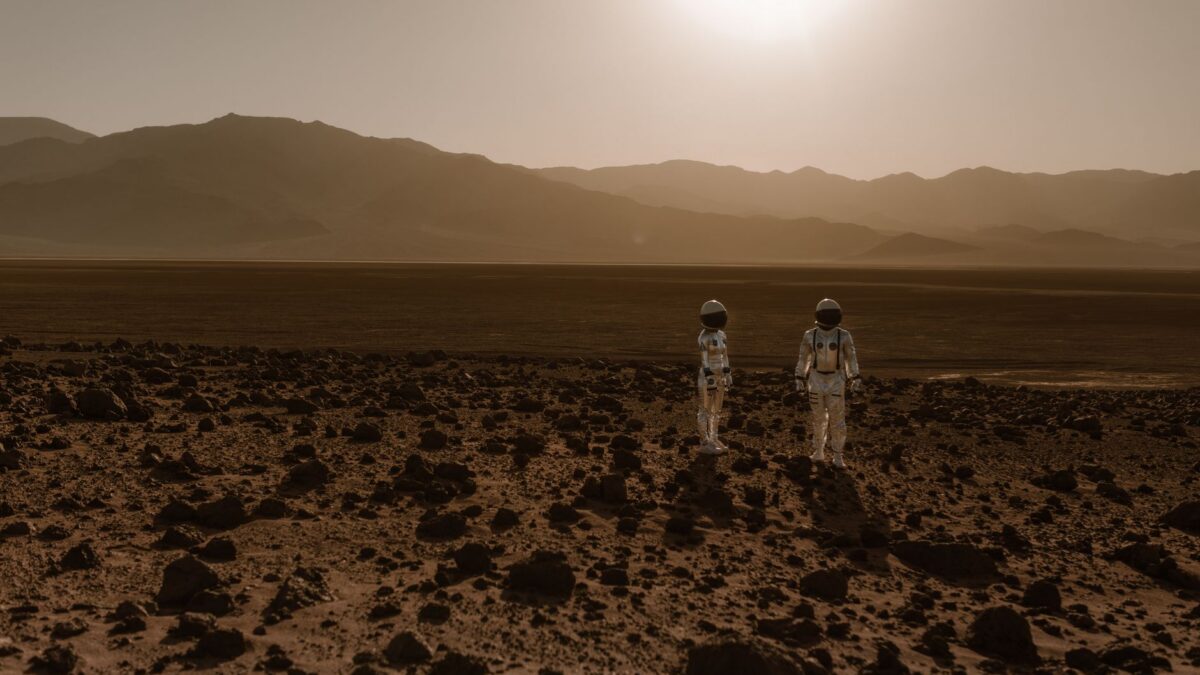
A proposed system called Mars Seed could produce 870 square meters of pressurized habitat from Martian water, air and soil roughly every four Earth years, according to a paper from Pioneer Labs posted on arXiv. Universe Today reported on the design, which weighs 20 metric tons and would need no further supplies from Earth once it is running.
Pioneer Labs is a research institute founded by bioengineer Erika DeBenedictis to develop biological technologies for space exploration. The Astera Institute funded the work, and the paper is available as a preprint without plans for a paid journal.
How Mars Seed would build a habitat
The system would land at a mid-latitude site with flat ground and underground water ice. A rover would unload the hardware and assemble a 40kW nuclear fission reactor, modeled on compact reactors NASA is already developing for Mars and Moon missions. About a month later the reactor should be running, supplying electricity and waste heat.
The heat would feed a Rodriguez well, an ice-drilling method that melts a pocket of underground ice and pumps the water up. It has been proven in Antarctica. A scaled-up version of the urine-recycling system on the International Space Station would recover around 90 percent of the water from each production batch.
Soil is the second input. The paper estimates about four tons of regolith (Martian soil) would be fed into hoppers each day, perhaps collected by machines like NASA’s RASSOR. About 800 kg of it would be stirred into water tanks to dissolve nutrients such as phosphorus and nitrogen. The soil also contains perchlorates, salts that would kill ordinary microbes.
Pioneer Labs evolved a hardy strain of the bacterium Cupriavidus necator, called sPL.001, which grows in a perchlorate-laced broth made from Martian soil simulant on Earth. The bacteria are the engine of the plan.
From carbon dioxide to vinegar to plastic
The third input is the Martian atmosphere. An upgraded version of the MOXIE experiment, which split carbon dioxide into carbon monoxide and oxygen, would supply the gas. Mars Seed treats the carbon monoxide as the useful product. Using a technique inspired by electro-agriculture, it combines the gas with water to make acetic acid, the main ingredient in vinegar.
In four 1,000L fermentation tanks, the bacteria eat that acetic acid along with oxygen and fill up with a bioplastic called polyhydroxybutyrate. The polymer would eventually make up 70% of their body weight. A centrifuge then separates the cells, and the paste is split in two.
- Half is mixed with Martian dirt and extruded by a gantry 3D printer into a corrugated, arched outer shell. Rovers pile about 2m of dirt on top as protection against cosmic rays and micrometeorites.
- The other half is treated with liquid carbon dioxide to extract pure bioplastic, which is melted and spun into an airtight, reinforced inner tent.
The paper gives a build rate of about 75 square meters every 130 days. It also compares the system with launching 20 tons of ready-made plastic building material from Earth, and puts the break-even point at around 1,400 Martian days. Universe Today notes that this matches the two orbital alignment cycles NASA plans to use before sending crews. The 20-ton mass is below the payload limit for Starship and for NASA’s proposed 25-ton Mars landers. For background on the power source, see how nuclear fission reactors work.
How sure is this?
Mars Seed is a design study (D. A. Stork et al., “Mars Seed: A Reference Architecture for Biomanufacturing Habitats from Martian Resources”), and the paper is on arXiv, not in a peer-reviewed journal. The sources describe lab results only for the perchlorate-tolerant bacterial strain, tested in a simulant broth on Earth. Parts of the chain, such as the Rodriguez well and MOXIE’s carbon dioxide splitting, have been demonstrated in Antarctica and on Mars respectively. The full integrated system has not been built or tested. Universe Today says plenty of engineering challenges remain before it could be launch ready.
Source: Universe Today
Site editor: Nikita Sheikin