Comet 11P Reaches the Sun Nov. 9, Passes Earth Nov. 11
Comet 11P/Tempel-Swift-LINEAR reaches perihelion Nov. 9 and its closest Earth approach Nov. 11. Here is what to expect and what telescope it needs.
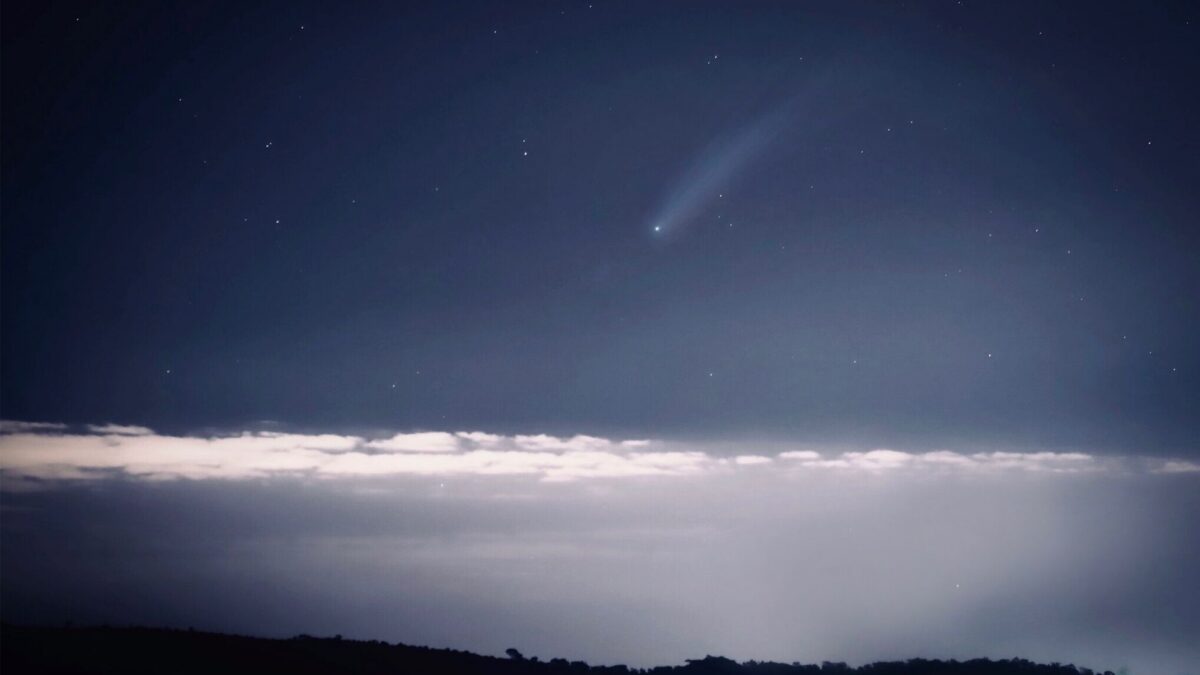
Comet 11P/Tempel-Swift-LINEAR reaches perihelion, its closest point to the Sun, on Nov. 9, 2026, at 1.387 astronomical units (AU). Two days later, on Nov. 11, it passes closest to Earth at 0.4012 AU, or 60.02 million kilometers (37.3 million miles), according to Tech Times. One AU is the average Earth-Sun distance.
The comet is faint. Tech Times gives a predicted peak apparent magnitude of about 13.3, which means a telescope with an aperture of 150mm (6 inches) or larger, or a smart telescope that stacks long exposures. Visibility depends on location and weather.
Why this pass has good geometry
On Nov. 9 the comet sits at a solar elongation of 170°, almost directly opposite the Sun in the sky. It rises around sunset, crosses high overhead near midnight and sets around sunrise, so it is visible for most of the night. Its declination of +26.3° puts it in Taurus, which suits observers in the continental US, Canada and Europe better than those in the southern hemisphere. Tech Times calls it the best alignment the comet has had in the modern observing era.
The report names Nov. 9 through about Nov. 15 as the prime window, with the night of Nov. 11 to 12 the best single chance. It suggests using Aldebaran and the Pleiades as guides, and lists JPL Horizons and several planetarium apps for position data. Because the comet moves against the stars, photographers are advised to align images on the comet itself, not the background stars.
A comet found three times
Ernst Tempel first spotted the comet from Marseille on Nov. 27, 1869. Lewis Swift found it again on Oct. 11, 1880, from Rochester, New York, without knowing it was the same object. Orbital calculations later linked the two sightings.
The comet then went unobserved until Dec. 7, 2001, when the LINEAR survey, run by MIT Lincoln Laboratory with a 1.0-meter (3.3-foot) telescope in New Mexico, detected it as an unidentified object designated P/2001 X3. Prediscovery images from September and October 2001 confirmed its identity, and it received the permanent name that carries all three discoverers.
Between 1900 and 1946 Jupiter reshaped its orbit in four encounters: May 1911 (0.61 AU), July 1923 (0.50 AU), April 1935 (0.56 AU) and November 1946 (1.33 AU). The report says these passes changed the comet’s orbital period and perihelion distance.
What a Jupiter-family comet is
11P belongs to the Jupiter-family comets, short-period comets with orbits under 20 years. Tech Times cites the IAU Minor Planet Center as listing more than 430 numbered members as of 2025. These comets are thought to start in the Kuiper Belt and scattered disc beyond Neptune, drift inward as centaurs, and get captured by Jupiter’s gravity. A measure called the Tisserand parameter sorts them: Jupiter-family comets fall between 2.0 and 3.0, and 11P’s value is 2.839.
What happens to the comet at perihelion
The nucleus is about 1.2 kilometers (0.75 miles) across and very dark, with an albedo of about 0.04. As sunlight warms it, surface ice turns directly to gas. Water ice dominates, with carbon dioxide, carbon monoxide and organic compounds also contributing. The escaping gas carries dust outward and forms the coma, which can reach hundreds of thousands of kilometers across. What a telescope shows is that cloud, not the solid nucleus.
The report notes that ESA’s Rosetta mission to comet 67P/Churyumov-Gerasimenko, another Jupiter-family comet, found comet nuclei to be porous piles of icy pebbles that have changed little since the solar system’s first few million years.
Why it matters for observers
At 1.387 AU the comet stays farther from the Sun than Earth does, so Tech Times says it will not rival bright comets such as Hale-Bopp or Neowise. Brightness is also uncertain. Comets can flare by a magnitude or more over days when fresh ice is exposed, or fall short if their sunward side has already lost its easily released ice. The 13.3 figure is a best estimate. A faint tail may show up in photographs, extending away from the Sun.
The comet’s next perihelion is projected for around early 2032, based on its 5.95-year orbit. The report says the geometry of that return has not been worked out in detail.
Source: techtimes