Camera Traps on Rope Bridges Reveal New Howler Monkey in Brazil
Researchers described a new howler monkey, Alouatta matogrossensis, after it appeared on rope bridge cameras in Brazil. Here is what the study found.
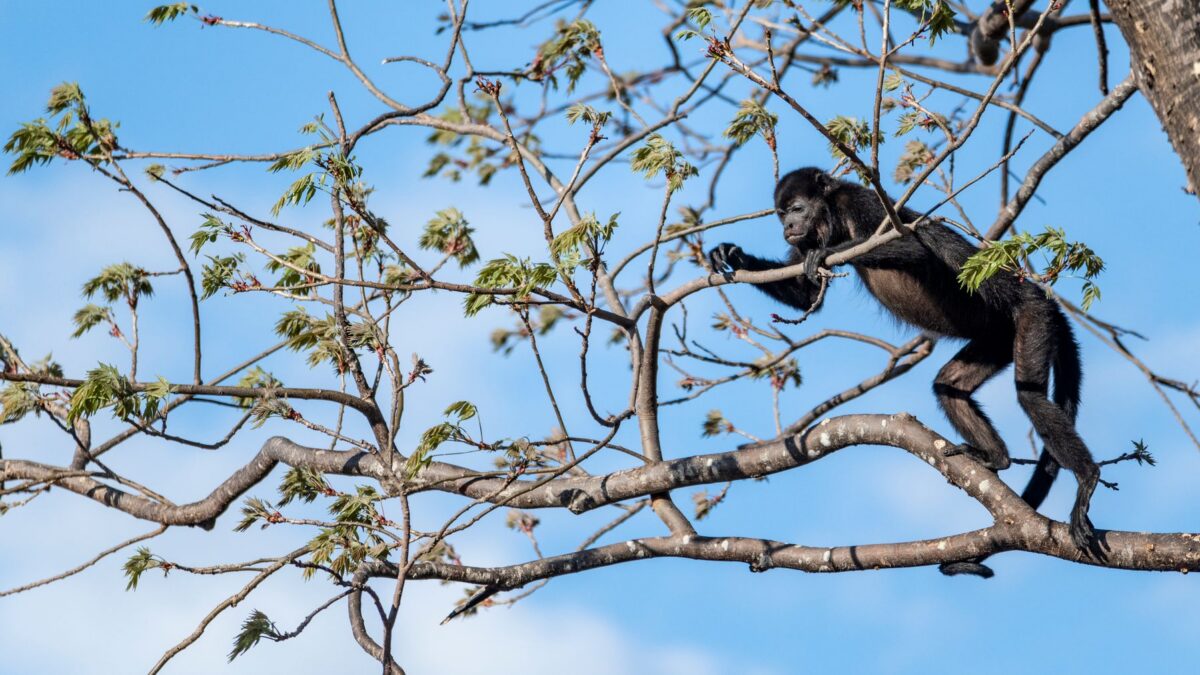
A new species of howler monkey, Alouatta matogrossensis, turned up in camera-trap footage of rope bridges that span roads in Brazil, according to National Geographic. An international team described it in the journal Communications Biology in October. The same paper names a second new howler, Alouatta iroi, which brings the researchers’ count of howler species to 16.
The monkeys live in Mato Grosso, the Brazilian state that gave the species its name, in the southern Amazon Rainforest.
How the monkey was found
Before publishing, the team contacted Projeto Reconecta, an initiative that builds rope bridges so canopy animals can cross roads safely. Among thousands of camera-trap photos taken on the bridges, the researchers picked out the new howler. Capuchins, marmosets and titi monkeys also appear in the images.
Fernanda Abra, a road ecologist and National Geographic Explorer who leads Reconecta, said the project’s team was amazed to be giving safe passage to a new monkey species. The bridge where the animal was photographed is in Alta Floresta.
The evidence for a separate species goes beyond the photos. The study compiles genetic samples collected across the Amazon over decades. They indicate that this population has likely been its own species for more than half a million years, kept apart by rivers on one side and by the Cerrado, a tropical savannah, on the other. The second new species, A. iroi, appears to be around 700,000 years old and was also cut off from a sister population by a river. Its name borrows a word for howler monkey from a Yanomami language.
The closest relative of A. matogrossensis is Alouatta sara, which lives across the border in Bolivia. The new species is a bit darker and redder, but an average person might struggle to tell the two apart. Until now, scientists would probably have assumed the animal in Abra’s photo belonged to the Purus red howler, Alouatta puruensis, a species described as robust and common.
Why it matters for conservation
Howlers are among the largest primates in the Western Hemisphere. Their calls exceed 100 decibels and carry for miles, yet finding this species still took painstaking work.
Co-author Jean Boubli, a primatologist at the University of Salford in the UK, said the monkeys live where the forest is in its worst shape in all of Brazil. Farm expansion in Mato Grosso has historically driven some of the highest deforestation rates in the Amazon, with land cleared for soybeans and cattle pasture. Roads cut animals off from one another, and Abra said growing cities and more cars also mean more primate roadkill.
The species has not been formally assessed by the International Union for Conservation of Nature. Boubli believes it is “either endangered or critically endangered,” judging by the state of the local environment. Treating it as a separate species with a smaller range, rather than part of the Purus red howler, could bring more resources and urgency to protecting it.
Co-author Romina Batista, an evolutionary biologist at the National Institute of Amazonian Research, said the camera images mattered because a project in the region was helping these animals keep gene flow across fragmented areas.
What the bridges have shown so far
Abra said her bridges now serve three recently described monkeys: the critically endangered Alta Floresta titi monkey, first described in 2019, Schneider’s marmoset, discovered in 2021, and now matogrossensis. So far the spans appear to be preventing roadkill deaths.
Boubli has collected primate samples in the Amazon for nearly 30 years and says he is still surprised by the biodiversity he finds. He noted that large, loud monkeys are still being discovered, and wondered what smaller animals such as beetles and butterflies remain unknown.
Source: National Geographic