Armored Amphibian Lived Fully at Sea 237 Million Years Ago
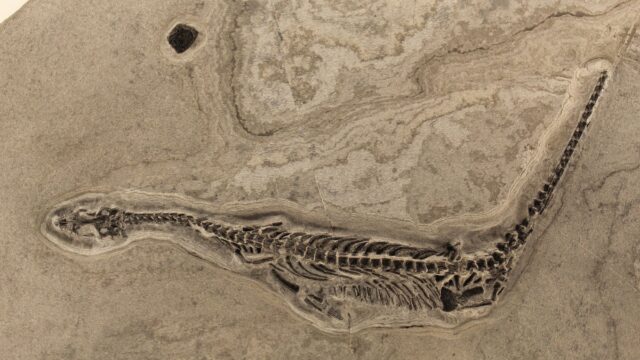
Fossils from China show Gerrothorax maritimus, a nearly three-foot armored amphibian that lived entirely in the sea 237 million years ago.

Researchers have described an amphibian that lived entirely in the ocean 237 million years ago, something no living amphibian is known to do. The animal, named Gerrothorax maritimus, had a broad, flattened body covered in bony armor and measured nearly three feet long, according to a study in Nature Ecology & Evolution.
If the interpretation holds, it is the first known amphibian to have adapted to a fully marine life. The work comes from a team at the University of California, Davis, Peking University and the Geological Museum of Guizhou.
Two skeletons from an ancient sea
The study rests on two exceptionally well-preserved skeletons from the Late Triassic period. Both were found in China’s Guizhou Province, in rock that formed beneath an ocean far from major landmasses, hundreds of miles away from the nearest land.
Because the skeletons are so complete, the team could reconstruct the animal’s shape. Its body mass is probably about the same as a giant salamander’s, said corresponding author Ryosuke Motani of UC Davis. But a giant salamander is long and slender, while this animal was chunky and disc-shaped.
The skull structure and heavy armor point to an ambush predator. Motani said the animal likely waited on the seafloor and sucked in prey that came close, a strategy he compared to the wobbegong, a carpet shark. The armor may also have protected it from large marine predators such as ichthyosaurs.
How scientists know it lived in the sea
The team had to rule out the possibility that the bodies drifted into the ocean from somewhere else. They offered three lines of evidence.
- The skeletons came from sediments laid down in a deep marine setting.
- Even the fingers were preserved. Motani noted that floating carcasses usually dry out and lose limbs before they sink, so these animals probably died close to where they lived.
- Chemical tests on the fossils measured strontium isotopes (different forms of the same element). The results closely matched the values expected for Late Triassic seawater.
The work is based on fossils and chemistry, not on observation of a living animal, so the animal’s lifestyle is a reconstruction from evidence.
A proposed way to handle salt
Among the more than 8,000 amphibian species alive today, none are known to spend their whole lives in the sea, and fewer than 2% can tolerate any salt. Amphibian skin lets water and gases pass through, which is how these animals breathe and take in water. Motani said amphibians do not drink or breathe through the mouth because the skin handles both jobs. The same permeability leaves them exposed to salt water. The crab-eating frog has some salt tolerance, but even it can lose weight in brackish water and has to return to fresh water to recover.
The researchers suggest the armor of Gerrothorax maritimus limited how much water moved through its skin. That could have let it take in seawater through the mouth and absorb it in the digestive tract, with gills removing excess salt. Gills are known in members of the Gerrothorax genus, which is why the team suspects this species managed salt in a more fishlike way. This mechanism is a proposal. The fossils cannot show how the animal’s body actually worked.
Why it matters
Mammals, reptiles and birds all include species that live fully at sea without needing land for food or fresh water. Until now, scientists had not found convincing fossil evidence of an amphibian that did the same. This animal suggests that at least one ancient amphibian got past the limits that keep its living relatives mostly tied to fresh water.
Motani said his group has mostly studied marine reptiles and fish from this part of Guizhou while reconstructing its ancient ecosystem. Now an amphibian is part of that picture, and he called it a very unusual member of its lineage.
The study is peer-reviewed. It was written by Lipin Diao, Ryosuke Motani, Da-yong Jiang, Jiaxu Hao and Shengyu Wang, and its DOI is 10.1038/s41559-026-03209-9. The research was funded by the National Natural Science Foundation of China.
Source: ScienceDaily