How Glaciers Move: Ice Deformation, Sliding and Speed
Glaciers move through slow ice deformation and by sliding over meltwater at the bed. Speeds range from inches a day to several miles a year.
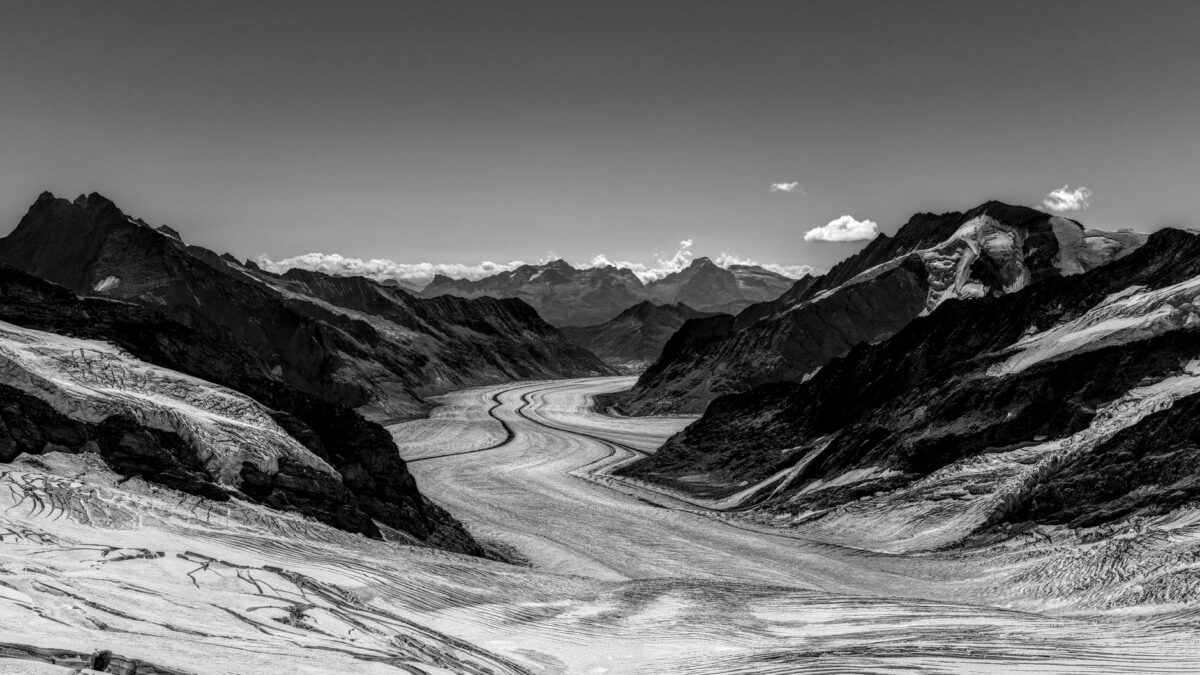
Glaciers move because gravity pulls their ice downhill, and the ice travels in two ways: it deforms slowly from within as its crystals slip past one another, and it slides over the ground on a thin film of meltwater. Most glaciers advance a few dozen to a few hundred feet per year (roughly 10 to 100 meters), while the fastest outlet glaciers in Greenland and Antarctica can flow miles in a year. How much of the motion comes from deformation and how much from sliding depends mainly on ice temperature and on whether water reaches the glacier’s bed.
How does a glacier start to move?
A glacier starts to move when enough ice has built up that its own weight forces it downslope. Snow that survives the summer is buried by new snowfall and compacts into granular firn, which over years turns into dense glacier ice. Once that ice reaches a thickness somewhere around 100 feet (30 meters), the stress inside it is high enough for it to flow. Thinner ice generally stays put.
Flow follows the slope of the ice surface more than the slope of the rock below. The upper part of a glacier, the accumulation zone, gains more snow than it loses. The lower part, the ablation zone, loses more ice to melting than it gains. Gravity carries ice from the first zone toward the second.
What is internal deformation?
Internal deformation is the slow creep of ice under its own weight, in which the crystals inside the glacier change shape and slip along their layers. Over long periods, ice acts like a very thick fluid even though it shatters when struck. Warm ice near its melting point creeps more easily than very cold ice, and thicker ice on a steeper surface creeps faster because the stress on it is larger.
Friction with the bed holds back the lowest ice, so in a glacier that moves mostly by deformation the surface travels faster than the ice beneath it. Glaciers frozen to their beds, called cold-based glaciers, move almost entirely this way.
What is basal sliding, and why does meltwater matter?
Basal sliding is the glacier moving as a whole across its bed, and it speeds up when liquid water is present between the ice and the ground. The water comes from several sources: heat flowing up from the earth, friction as the ice drags over rock, and surface meltwater that drains through cracks and tunnels. A water film lubricates the contact, and high water pressure partly lifts the ice, which lowers friction.
Glaciers whose base sits at the melting point can slide a great deal. Where the bed is soft sediment instead of hard rock, the sediment itself can deform and carry the ice along with it.
How fast do glaciers move?
Glacier speed ranges from slow creep to several miles per year, depending on slope, thickness, temperature and the amount of water at the bed. Typical valley glaciers cover a few dozen to a few hundred feet per year (roughly 10 to 100 meters). Outlet glaciers that drain ice sheets into the sea are far faster, and surging glaciers can run many times above their normal rate for a period before slowing again.
Speed also varies inside a single glacier:
- The center of a valley glacier moves faster than its edges, where the valley walls add friction.
- Thick, steep sections move faster than thin, gently sloping ones.
- Many glaciers speed up in summer, when meltwater reaches the bed, and slow down in winter.
Why do glaciers crack into crevasses?
Crevasses open when the brittle upper layer of a glacier is stretched faster than the ice can deform. They form where the ice flows over a steep step or a bump in the bed, around bends in the valley and along the edges where speed changes sharply. Deeper ice is under more pressure and flows instead of cracking, which limits how deep most crevasses go.
Snow can bridge a crevasse and hide it, so a surface that looks solid may not be. People who travel on glaciers usually do so with trained guides, ropes and rescue gear, and they stay well back from the front of a glacier, where ice can collapse or break off. The National Park Service, which manages glaciated parks in the United States, provides safety information for visitors to its parks.
Can a glacier retreat while its ice keeps moving forward?
Yes. A glacier’s ice flows downslope even while the glacier shrinks, because the position of the front, called the terminus, depends on the balance between the ice arriving and the ice lost. When melting and calving remove more ice at the front than flow delivers, the terminus pulls back while the ice behind it still moves forward. Calving is the breaking off of chunks of ice where a glacier ends in a lake or the sea.
The U.S. Geological Survey monitors several glaciers in Alaska and the western United States to record how they change over time.
How do scientists measure glacier movement?
Researchers track movement with a few standard tools:
- Stakes drilled into the ice and surveyed repeatedly show how far the surface has traveled.
- GPS receivers fixed to the glacier record its position continuously.
- Satellite and aerial images taken at different times show how far features such as crevasses have shifted.
- Radar from satellites can map ice speed over wide areas.
Quick answers
Do glaciers ever flow uphill?
Ice can flow uphill for short stretches, such as over a bump in the bed, because it follows the slope of its surface and the push of thicker ice behind it. Over its whole length a glacier still moves from higher to lower surface elevations.
Are ice sheets glaciers?
Ice sheets are continent-sized masses of glacial ice that flow by the same processes, outward from a thick center toward the coast. Fast-moving ice streams inside them carry much of the ice to the sea.
What is a surging glacier?
A surging glacier alternates between long quiet periods and short bursts of motion many times faster than normal, often caused by changes in water at its bed. After a surge it returns to slow flow.