Fossil Footprints: How Scientists Read Size, Speed and Behavior
Fossil footprints rarely reveal exactly which animal made them, yet trackways show gait, speed and group behavior. Here is how ichnologists read them.
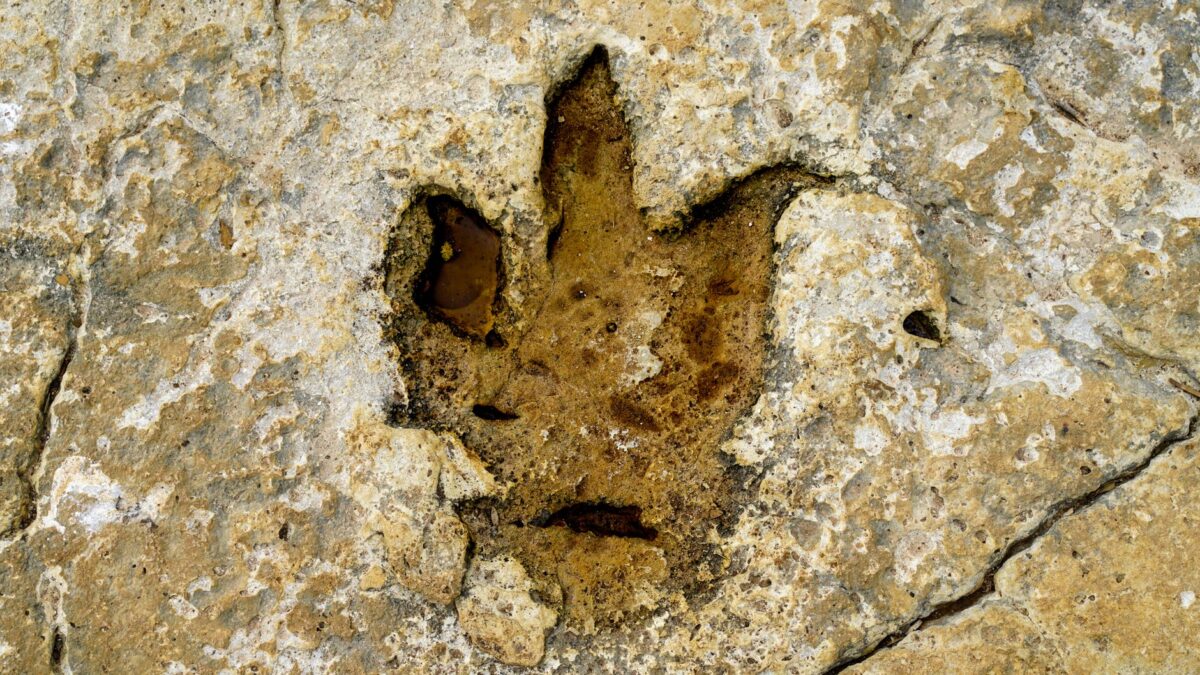
Scientists can rarely say which species left a fossil footprint, because different animals can make prints that look the same. What a track does show well is how the animal moved: whether it walked on two legs or four, how long its stride was, roughly how fast it went, and whether it traveled alone or with others. Researchers sort tracks by shape and by the behavior they record, and they estimate speed from track size and stride length.
What counts as a fossil footprint?
A fossil footprint, also called an ichnite, is one kind of trace fossil. According to the Wikipedia overview of trace fossils, a trace fossil records something a living thing did (a burrow, a bite mark, a footprint, a dropping) without preserving the body itself. Bones, shells and teeth are body fossils instead, the kind of evidence behind finds such as fossil teeth that revealed a giant ancient rodent. The study of traces is called ichnology.
A single print is a track. A series of prints left by one animal is a trackway, and most of what scientists learn comes from trackways. Some ancient trails also preserve tail drags, belly drag marks or a whole body impression.
Why is it so hard to tell which animal made a track?
Makers are almost never found with their tracks, and unrelated animals can leave identical prints. For that reason, track names follow their own system. Researchers give tracks “ichnogenera” and “ichnospecies” names based on shape and implied behavior, kept separate from the names of animals known from bones. Mesozoic dinosaur tracks, for example, carry names such as Grallator, Atreipus and Anomoepus, and none of these labels claims a specific dinosaur species.
Cheirotherium shows how far this can go. Its footprints were first found in 1834 in Thuringia, Germany, and for a long time the animal was known only from its trail, as described in the Wikipedia article on fossil tracks.
How do scientists sometimes match tracks to an animal?
The best case is a rock layer that holds both clear trackways and complete skeletons of the same age. That happened in the Tambach Formation in central Germany, where fine-grained Lower Permian mud preserved unusually detailed prints in 290-million-year-old strata. In the Journal of Vertebrate Paleontology issue of Sept. 12, 2007, Sebastian Voigt, David Berman and Amy Henrici matched the two most common trackways there with the two most common skeletons, both reptile-like plant eaters. The trackway called Ichniotherium cottae was linked to Diadectes absitus, and the trackway named Orobates pabsti to the animal of the same name.
Without that kind of overlap, researchers compare the shape of the print (number of toes, claw marks, the outline of the foot) with the feet of animals known from skeletons in rocks of similar age. When body fossils do turn up near a tracksite, they help narrow the list, as with the new dinosaur species identified from bones found in Surrey.
What can a trackway reveal about size and speed?
Track size gives a rough idea of body size. The biggest dinosaur prints yet found were made by sauropods, the long-necked plant eaters, on what is now the Dampier Peninsula above Broome in Western Australia. Some of those early Cretaceous prints are 1.7 m long.
Speed comes from biomechanics. In 1976, Alexander showed that the walking or running speeds of dinosaurs and other four-limbed animals could be estimated from track size, using scaling relationships with hip height. The method uses the Froude number, a ratio that links speed to leg length, so that animals of different sizes can be compared. Similar math has since been applied to invertebrate trails. In 2024, Wang and colleagues used Froude number scaling to tie the irregularity of the ridges beside furrow-like trails to how fast the trail maker moved. Dinosaur specialists now use trackways to estimate both walking and sprinting speeds, especially for the faster three-toed predators.
What do tracks say about posture and behavior?
A trackway shows whether an animal walked on two feet or four. Tracks of this kind suggest that some pterosaurs used their forelimbs to walk on all fours when on the ground. Several prints of one kind of animal close together can point to herds or packs, and footprints of different species on the same surface can record how those animals interacted. Researchers are investigating evidence of both dinosaur herding and pack hunting from trackways.
Trails that wind and turn carry more information. The trace fossil overview describes studies that analyze the turning angles of a trail to infer how the maker moved and even its body shape, and that read grazing, foraging and escape behavior from the path.
Scientists also class traces by behavior, with five broad modes:
- Domichnia, dwelling structures
- Fodinichnia, tunnels left by animals that eat their way through sediment
- Pascichnia, grazing trails on a soft surface
- Cubichnia, resting impressions
- Repichnia, crawling and walking traces, the group that includes footprints
How does a footprint survive millions of years?
Soft ground has to be firm enough to hold a print and then be buried quickly. One likely scenario is a lake or sea shore that dried to firm mud, took the footprints of a heavy animal, and was then covered by silt in a sudden storm. Trace fossils preserve best in sandstone, and they also turn up in shale and limestone.
Because tracks are almost never moved from where they formed, they record conditions at that exact spot. The U.S. National Park Service notes that trace fossils give clues to ancient salinity, oxygen levels, water energy, food supplies and interactions among organisms. The Wikipedia overview adds a caution: since the same trace can come from many different makers, the most reliable things they reveal are how firm the sediment was and how much energy the environment had.
Which footprint sites are famous?
- In 1800, Pliny Moody, a Massachusetts farmer, found footprints 1-foot (31 cm) long. Scholars at Harvard and Yale thought they came from “Noah’s Raven.” It was the first ichnite found.
- A limestone quarry at Ardley, 20 km northeast of Oxford, England, yielded footprints in 1997 thought to be from Megalosaurus and possibly Cetiosaurus. Replicas lie across the lawn of the Oxford University Museum of Natural History.
- At Laetoli in Tanzania, three hominins walked across powdery volcanic ash that rain then cemented into rock. One walked in another’s footprints, which made the original tracks hard to read.
- Langebaan, South Africa, has the oldest known human prints, set in hardened dune sand roughly 117,000 years ago.
- Near Lake Garnpung in the Willandra Lakes area of New South Wales, Australia, 563 human footprints date from 19,000 to 20,000 years ago.
- Australia’s earliest known trackway of primitive tetrapods, in the Genoa River Gorge, Victoria, dates from the Devonian 350 million years ago.
- At Cal Orck’o near Sucre, Bolivia, paleontologists from Loma Linda University in California reported 16,600 theropod footprints in December 2025, after six years of regular field visits.
In the United States, the National Park Service ranks Copper Canyon, a tracksite inside Death Valley National Park, among the finest collections of trace fossils anywhere.
Quick answers
Is a fossil footprint a body fossil?
No. A footprint is a trace fossil because it records activity. A fossil egg is also a trace fossil, while an embryo preserved inside it counts as a body fossil, according to the National Park Service.
Can a footprint prove which dinosaur made it?
Very rarely. Different animals can leave identical prints, so tracks get their own names, and a firm match needs skeletons and tracks from the same rock layer.
Are fossil droppings and burrows trace fossils too?
Yes. Burrows, borings, feeding marks, root cavities and fossil dung (coprolites) are all trace fossils. Fossil sloth dung, which holds pollen, is known from only 10 caves worldwide, and six of them are in U.S. national parks.
Are fossil tracks still being found?
Yes. The Bolivian count of 16,600 theropod prints was announced in December 2025, and 3D digital scans now let researchers study and share tracks without visiting the site.
Checked against official sources in November 2026. Hours, prices and rules change: confirm on the official page before you go or apply.