Wishbone: Why Birds Have One and Which Dinosaurs Had It First
The wishbone, or furcula, is a pair of fused collarbones that acts as a spring in bird flight. Theropod dinosaurs had it first.
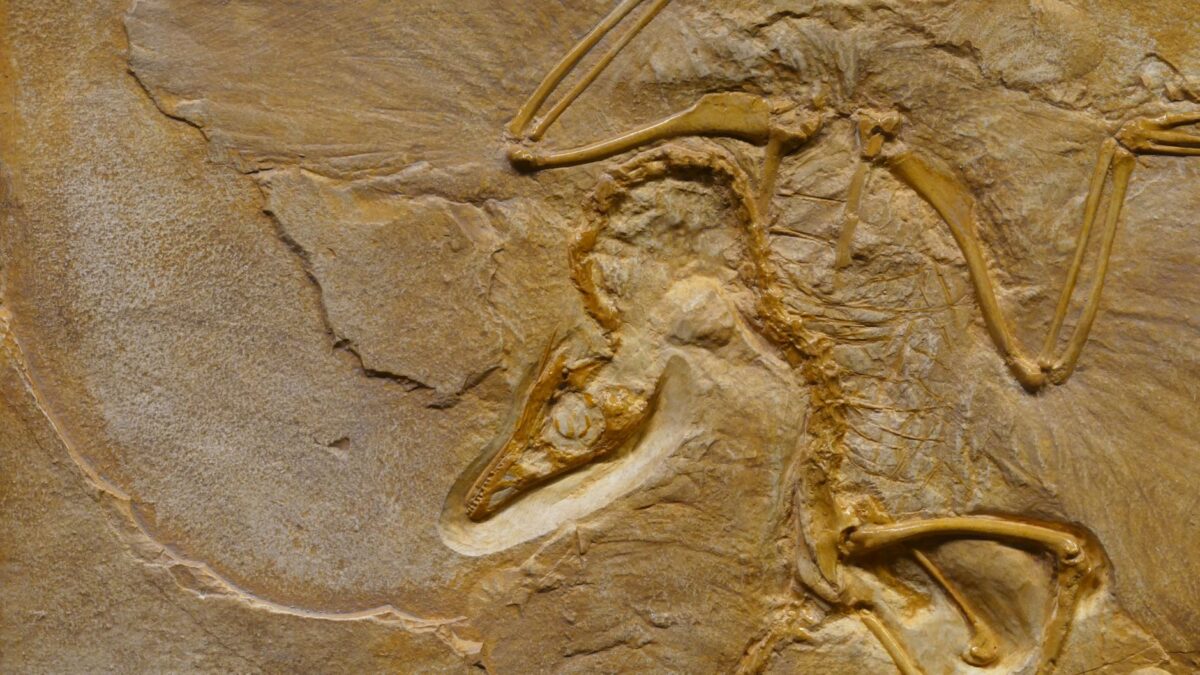
A wishbone, called the furcula by scientists, is a V-shaped or U-shaped bone formed when a bird’s two collarbones fuse together, and nearly all birds have one. In flight the furcula acts as a springy brace between the shoulders. Birds inherited it from theropod dinosaurs, whose furculae are known from fossils roughly 200 million years old.
What exactly is a wishbone?
A wishbone is a single bone made of the two clavicles, or collarbones, joined at their lower ends. It sits at the front of the chest between the shoulders, and ligaments hold it in place. Humans have two separate collarbones. In birds the pair has fused into one piece, and its shape ranges from a narrow V to a broad U depending on the species.
The furcula is part of the shoulder girdle, the set of bones that anchors the wings to the body. It links the left and right sides of that girdle across the chest.
Why do birds have a wishbone?
Birds have a wishbone because flapping flight puts heavy and repeated loads on the shoulders, and the furcula braces them. Studies of flying birds using high-speed X-ray video show the bone bending outward and springing back with each wingbeat. That motion is thought to store and return some of the energy of the stroke.
Researchers have also proposed that the flexing bone helps move air through a bird’s air sacs, which are part of its breathing system. Many species fly long distances each year, and how they find their way is covered in how birds know where to migrate.
Which dinosaurs had a wishbone first?
Theropods had it first. This is the group of mostly two-legged dinosaurs that includes Tyrannosaurus rex and the ancestors of birds. Furculae have been found in early theropods from the Late Triassic and Early Jurassic, including Coelophysis, and in later ones such as Allosaurus, Tyrannosaurus, Velociraptor and the oviraptorids. Archaeopteryx, an early bird from the Late Jurassic, had one too.
Because the bone appears in both non-bird theropods and early birds, scientists treat it as a trait that birds inherited and did not invent. The discovery also settled an old objection. For much of the 20th century, many scientists argued that dinosaurs lacked collarbones, which they used as evidence against birds descending from dinosaurs. Furculae found in theropod fossils removed that objection.
What did a dinosaur use a wishbone for?
Most dinosaurs with a furcula did not fly, so the bone had another job. Scientists think it braced the shoulders and supported the forelimbs, which theropods used for grasping. As feathered forelimbs evolved into wings in some lineages, the same bone took on its role as a flight spring.
Birds are the only dinosaurs that survived the mass extinction about 66 million years ago, an event covered in what killed the dinosaurs. Every living bird with a wishbone carries a bone that its dinosaur ancestors already had.
Do all birds have a wishbone?
Most do, but not all. Some flightless birds have a reduced furcula or lack one, and the same is true of a few other species. Size and shape also vary.
Why do people pull a wishbone apart?
Pulling a wishbone is a holiday custom in the US and UK, usually tied to roast chicken or turkey dinners. Two people each hold one arm of the bone and pull, and the person left with the longer piece gets to make a wish. The custom is often traced to the ancient Etruscans and Romans, and it later spread through England to North America.
The bone must come from a fully cooked bird. The USDA recommends cooking poultry to a safe minimum internal temperature of 165°F (74°C), and hands and surfaces should be washed after touching raw poultry; the USDA Food Safety and Inspection Service publishes the guidance. People who want a stronger snap usually clean the bone and let it dry for a day or more, since a dry bone is brittle.
Quick answers
Is the wishbone the same as the collarbone?
Yes, in a sense. The wishbone is a pair of collarbones fused into one bone. In people the two collarbones stay separate.
Why does a wishbone break unevenly?
A dried wishbone is brittle and cracks at its weakest point. Because the two arms are rarely identical in thickness, the break usually falls off center, leaving one piece longer than the other.
Did Tyrannosaurus rex have a wishbone?
Yes. Furculae have been reported in Tyrannosaurus rex skeletons, as in many other theropods. They are one of the traits that link these dinosaurs to birds.