How Smart Are Octopuses? What the Evidence Actually Shows
Octopuses are the brainiest invertebrates, with a nervous system spread through eight arms. Here is what experiments have shown, what is still anecdote, and why such clever animals live only a few years.
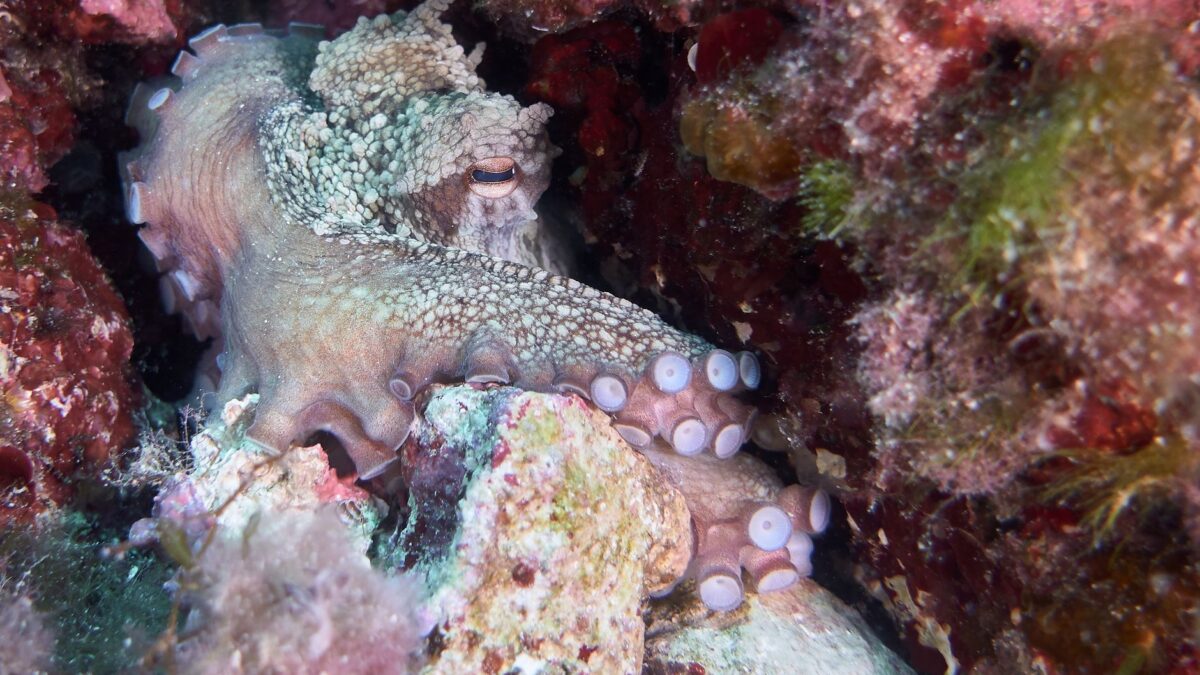
Octopuses are the most intelligent invertebrates known. A common octopus has around 500 million neurons, roughly as many as a dog, and the Natural History Museum in London says about two-thirds of them sit in its arms rather than its brain. In experiments, octopuses have solved mazes, opened containers and told apart individual people, and in the wild one species carries coconut shells to use as a portable shelter.
Some of the most famous octopus stories, though, are anecdotes rather than tested results. Sorting the two helps show what octopus intelligence really looks like.
How is an octopus brain different from ours?
An octopus has a central brain wrapped around its esophagus, plus large clusters of nerve cells in each of its eight arms. The Natural History Museum describes this as one central brain with a “mini brain” in each arm. The arms can taste and touch, and they can carry out movements such as reaching and grasping with little input from the center.
Researchers at the Okinawa Institute of Science and Technology, who study how octopuses control their arms, put it as an octopus with one brain and eight very clever arms. The central brain still sets goals and can steer the arms when needed. The Natural History Museum also notes that octopuses have the largest brain-to-body ratio of any invertebrate.
Octopuses evolved this nervous system separately from vertebrates. Our last common ancestor with them was a simple animal that lived hundreds of millions of years ago, so octopus intelligence evolved along a separate path from ours.
What have experiments shown about octopus intelligence?
Lab and field studies have shown several kinds of flexible behavior. The table separates published results from popular stories.
| Behavior | Evidence | How solid |
|---|---|---|
| Guiding an arm through a maze to food using sight | Laboratory experiment, published 2011 | Peer-reviewed study |
| Carrying coconut shells for later shelter | Field observations in Indonesia, published 2009 | Peer-reviewed study |
| Telling apart a “kind” and an “unkind” keeper | Seattle Aquarium study with giant Pacific octopuses | Small study |
| Opening jars and containers, solving mazes | Repeated in many labs and aquariums | Well documented |
| Raiding a neighboring tank and returning | Stories from labs and aquariums | Anecdote |
The 2011 maze study tested whether the brain could direct an arm toward food when the arm’s own chemical senses could not lead it there. Most octopuses learned to steer an arm through the maze by looking, showing that the central brain does take charge when a task needs it.
The Seattle Aquarium study, described by the Natural History Museum, used two keepers in identical uniforms: one fed the octopuses and the other touched them with a bristly stick. Within about two weeks the animals responded differently to each person. It was a small study, but it fits many keepers’ reports that octopuses treat familiar people differently.
Do octopuses use tools?
Yes, in at least one well-documented case. In 2009, researchers from Museum Victoria in Melbourne reported in the journal Current Biology that veined octopuses (Amphioctopus marginatus) off Indonesia collect discarded coconut shell halves, clean them out with jets of water, carry them across the seafloor and assemble them into a shelter when they stop.
The authors argued that this counts as tool use because the octopus carries the shells for later use, even though carrying them slows it down and makes it more exposed to predators. Some scientists define tools more narrowly, so not everyone accepts the label. The Natural History Museum also describes young blanket octopuses carrying stinging tentacles from Portuguese man o’ war, apparently as weapons.
How does octopus camouflage work?
Octopuses change color and texture in a fraction of a second using thousands of chromatophores, small elastic sacs of pigment in the skin, along with structures that reflect light. Muscles in the skin also raise small bumps called papillae, so a smooth octopus can turn rough and spiky to match rock or coral.
Some species go further. The mimic octopus, discovered in 1998, can imitate the shape and movement of lionfish, flatfish and sea snakes. In 2005, researchers described two species that walk on two arms with the other six held up, keeping their disguise while they move away.
Fast, accurate camouflage needs the nervous system to read the surroundings and control thousands of skin cells, which is one reason researchers link it with octopus intelligence. Some deep-sea relatives of octopuses use light instead of color to hide; see our guide to bioluminescent animals.
Why do octopuses live such short lives?
Most octopuses breed once and die soon after. The giant Pacific octopus, one of the largest and longest-lived species, lives about three to five years, according to the Monterey Bay Aquarium. Smithsonian’s National Zoo notes that both males and females die after breeding.
Females usually stop eating while they guard their eggs and die around the time the young hatch. The record for brooding belongs to a deep-sea octopus, Graneledone boreopacifica, which researchers from the Monterey Bay Aquarium Research Institute watched guard her eggs for 53 months in Monterey Canyon, according to the Natural History Museum. It is the longest brooding period known for any animal.
Because young octopuses hatch without parents to teach them, nearly everything an octopus learns it works out for itself in a short life. That makes their problem-solving all the more striking. It also sets them apart from the slow-growing animals in our list of the longest-living animals.
Are octopus escape stories true?
Some are, but most are anecdotes reported by aquarium staff rather than tested observations. Octopuses have no bones, so they can squeeze through surprisingly small gaps, and aquariums secure octopus tanks with tight lids for that reason.
The Natural History Museum retells one lab story of an octopus that left its tank, ate fish in a neighboring tank and returned. Stories like this are consistent with what experiments show about octopus curiosity and flexibility, but a single story cannot tell us how common the behavior is.
Bottom line
Octopuses are the brainiest invertebrates, with about 500 million neurons in a common octopus, two-thirds of them in the arms. Experiments show they solve mazes, open containers, recognize individual people and, in one species, carry shells as tools. Many famous escape stories are anecdotes. Their intelligence is all the more striking because most species live only a few years.
FAQ
Do octopuses have nine brains?
Loosely speaking. They have one central brain and a large cluster of neurons in each of eight arms, which some writers count as nine brains. Scientists usually describe it as one brain with a highly independent nervous system in each arm.
Are octopuses smarter than dogs?
The question has no clean answer. A common octopus has a similar number of neurons to a dog, but the two minds evolved separately for very different lives, and their tests are not comparable.
How many hearts does an octopus have?
Three. The Natural History Museum says one pumps blood around the body and two push it through the gills. Their blood is blue because it uses copper-based hemocyanin to carry oxygen.
Can octopuses recognize people?
Evidence suggests they can. In a Seattle Aquarium study, giant Pacific octopuses reacted differently to two keepers in identical uniforms, depending on how each one had treated them.