What Lives in the Deep Sea, From the Twilight Zone to the Trenches
Below 200 meters the ocean turns dim, cold and crushing, yet it is full of life. A zone-by-zone guide to the animals scientists have found there and the tricks that keep them alive.
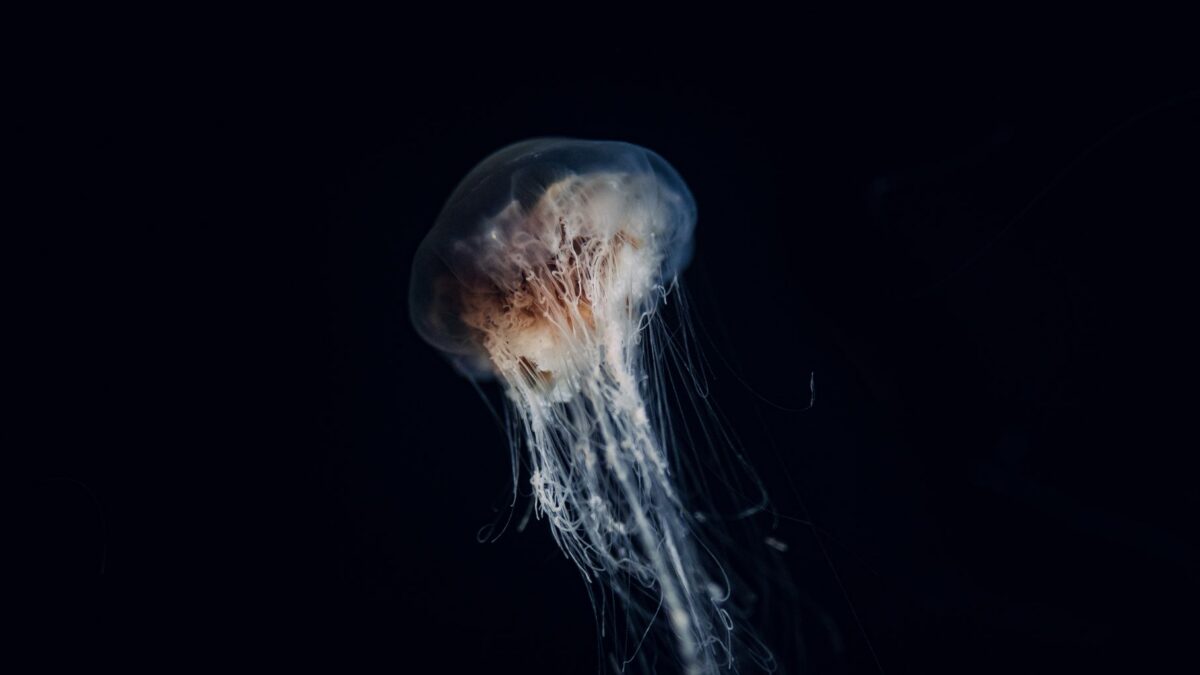
The deep sea, the ocean below about 200 meters (660 feet), is home to anglerfish that fish with glowing lures, giant squid, tube worms living off volcanic vents, and snailfish swimming more than 8 km down. NOAA says the deep ocean is mostly dark, near freezing and under enormous pressure, and that people have seen only a tiny fraction of its floor.
Scientists divide the ocean into layers by depth and light. Each has its own set of animals and its own ways of surviving.
How is the deep sea divided into zones?
Oceanographers usually split the water column into five zones. The depth ranges below come from NOAA’s guide to the layers of the ocean; the boundaries are approximate and vary by place.
| Zone | Depth | Conditions | Animals found there |
|---|---|---|---|
| Sunlight (epipelagic) | 0-200 m (0-660 ft) | Most of the ocean’s light | Plankton, most familiar fish, dolphins |
| Twilight (mesopelagic) | 200-1,000 m (660-3,300 ft) | Faint blue light, temperature drops fast | Small fish with big eyes, shrimp, squid, many glowing animals |
| Midnight (bathypelagic) | 1,000-4,000 m (3,300-13,100 ft) | No sunlight, about 4°C (39°F) | Anglerfish, giant squid range, hunting sperm whales |
| Abyssal (abyssopelagic) | 4,000-6,000 m (13,100-19,700 ft) | Pitch dark, near freezing | Few animals; sea cucumbers and other bottom dwellers |
| Hadal (hadalpelagic) | 6,000 m to about 10,994 m (36,070 ft) | Trenches; over 8 tons per square inch at the bottom | Snailfish (upper part), amphipods, isopods, sea cucumbers |
NOAA notes that about three-quarters of the deep-ocean floor lies in the abyssal zone, and that pressure at 4,000 m already tops 5,850 pounds per square inch. Our guide to how deep the ocean is covers the record depths and how they are measured.
What lives in the twilight zone?
The twilight zone, from about 200 to 1,000 m, is busy with small fish, shrimp, squid and jellies. Sunlight there is very faint, and NOAA says this is where animals begin producing their own light, called bioluminescence. Many fish have large eyes that point upward, likely to spot prey outlined against the dim glow from above.
Many twilight zone animals swim up toward the surface at night to feed and sink back down at dawn to hide in the dark. Light is used everywhere here: to hunt, to signal and to hide the animal’s silhouette from predators below. We explain how that glow is made in our guide to bioluminescent animals.
Which animals live in the midnight zone and below?
Below 1,000 m there is no sunlight at all, and many animals have soft bodies, slow metabolisms and big mouths for rare meals.
Deep-sea anglerfish are the classic example. The Monterey Bay Aquarium Research Institute (MBARI) says they live from about 300 to 4,000 m. The first ray of the female’s dorsal fin is a fishing pole tipped with a sac of glowing bacteria, the esca, which draws in small fish and crustaceans. Females reach softball size, while males stay a few centimeters long, and in some species the male permanently fuses to the female’s body.
Giant squid live in this dark water too, and were seen alive only recently. On June 19, 2019, a NOAA-funded expedition filmed one in the Gulf of Mexico at about 759 m (2,490 feet), roughly 100 miles southeast of New Orleans. The squid was at least 3 to 3.7 m (10 to 12 feet) long. NOAA Ocean Exploration says it was the first giant squid filmed in US waters and only the second filmed alive anywhere; the camera, called Medusa, used red light that many deep-sea animals cannot see.
NOAA notes that sperm whales dive into the midnight zone to hunt, which makes them some of the few air-breathing visitors to this depth.
What lives at hydrothermal vents?
Hydrothermal vents, hot springs on the seafloor along volcanic ridges, support whole communities that do not depend on sunlight. Scientists diving in the submersible Alvin found the first ones on the Galápagos Rift in 1977, surrounded by clams and tube worms that nobody expected.
The food chain at vents starts with chemosynthesis: bacteria and archaea use minerals and chemicals in the vent fluid to make energy. Giant tube worms up to about 2.4 m (8 feet) long have no mouth or gut. According to the Smithsonian Ocean portal, they host bacteria inside their bodies and supply them with chemicals in exchange for food. Woods Hole Oceanographic Institution, which operates Alvin, says hundreds of new species have since been described from vents.
What is the deepest animal ever found?
The deepest fish ever recorded is a snailfish filmed at 8,336 m (27,349 feet) in the Izu-Ogasawara Trench south of Japan in 2022. The University of Western Australia led the expedition with the Tokyo University of Marine Science and Technology, using baited cameras. The fish was a juvenile of the genus Pseudoliparis, and its species is uncertain because no specimen was caught.
NOAA Ocean Exploration says fish probably cannot live much below about 8,200 to 8,400 m. Animals found deeper, down to the bottom of the Challenger Deep, are invertebrates such as amphipods, sea cucumbers and single-celled foraminifera.
How do deep-sea animals survive the pressure and dark?
Deep-sea animals survive with bodies built for the conditions rather than armor against them. Pressure crushes air spaces, so many deep fish, including snailfish, have no gas-filled swim bladder. Their bodies are mostly water, which barely compresses, and many are soft or jelly-like.
Their chemistry adapts too. A 2014 study in the journal PNAS found that fish carry more of a molecule called TMAO the deeper they live, which helps their proteins keep working under pressure. The authors calculated that at about 8,200 m a fish would need so much TMAO that its body fluids would match seawater, which may explain why no fish has been found deeper than about 8,400 m. This is a proposed explanation, supported by measurements on snailfish, rather than a settled rule.
In the dark, animals rely on light they make themselves, on long sensitive fins and whiskers, and on slow lives. With food scarce, many grow slowly, move little and eat whatever drifts by, including “marine snow,” the steady fall of dead plankton and waste from above.
How much of the deep sea has been explored?
Very little. NOAA Ocean Exploration says that as of April 2026, 28.7% of the global seafloor had been mapped with modern high-resolution sonar, and that people have directly seen less than 0.001% of the deep-ocean floor. Each expedition still finds animals that have never been described, which is one reason scientists think most of Earth’s species are still unnamed.
Bottom line
The deep sea is the largest living space on Earth, and it is full of life adapted to dark, cold and pressure: glowing twilight fish, anglerfish with bacterial lures, giant squid, vent tube worms that live off chemicals, and snailfish more than 8 km down. Only about 29% of the seafloor has been mapped in detail as of April 2026, so the list of known deep-sea animals keeps growing.
FAQ
Are there monsters in the deep sea?
There are large animals, such as giant squid, but most deep-sea animals are small. Female anglerfish, which look fearsome in photos, are often about the size of a softball.
How cold is the deep ocean?
Below about 1,000 m, NOAA says the water stays near 4°C (39°F), and the abyssal and hadal zones are close to freezing. Water near hydrothermal vents is the exception and can be extremely hot.
Why are so many deep-sea animals red or black?
Red light does not reach the deep sea, so a red animal looks black there and is hard to see. That is also why the Medusa camera used red light, which many deep-sea animals cannot detect.
Can people visit the deepest point in the ocean?
A small number of people have reached the Challenger Deep in crewed submersibles. Most deep-sea research uses robotic vehicles and camera landers, which can stay down longer and go where crews cannot.