The Wood Wide Web: Do Trees Really Share Food Through Fungi?
The idea of trees feeding their seedlings through underground fungi caught the public imagination. A 2023 review argues the evidence is thinner than the story.
The “wood wide web” is the popular name for networks of mycorrhizal fungi whose threads can connect the roots of several trees underground. The partnership itself is solid science: fungi deliver water and minerals to roots in exchange for sugars. The bigger claims, that trees routinely share food through these links or nurse their own seedlings, are not well supported, according to a 2023 review in Nature Ecology and Evolution.
So the picture is half settled and half open. The fungi are real and important. What travels through the network, and how much it matters to a forest, is still debated.
What are mycorrhizal fungi?
Mycorrhizal fungi live in partnership with plant roots, and most plants on land have them. A 2018 survey in New Phytologist estimated that about 72% of vascular plant species form arbuscular mycorrhizas, where fungal threads enter root cells, while about 2% form ectomycorrhizas, where the fungus wraps the root tip in a sheath. Orchids and heathers have their own types. Only about 8% of species were found to be entirely without mycorrhizal partners, mostly specialists such as carnivorous and parasitic plants.
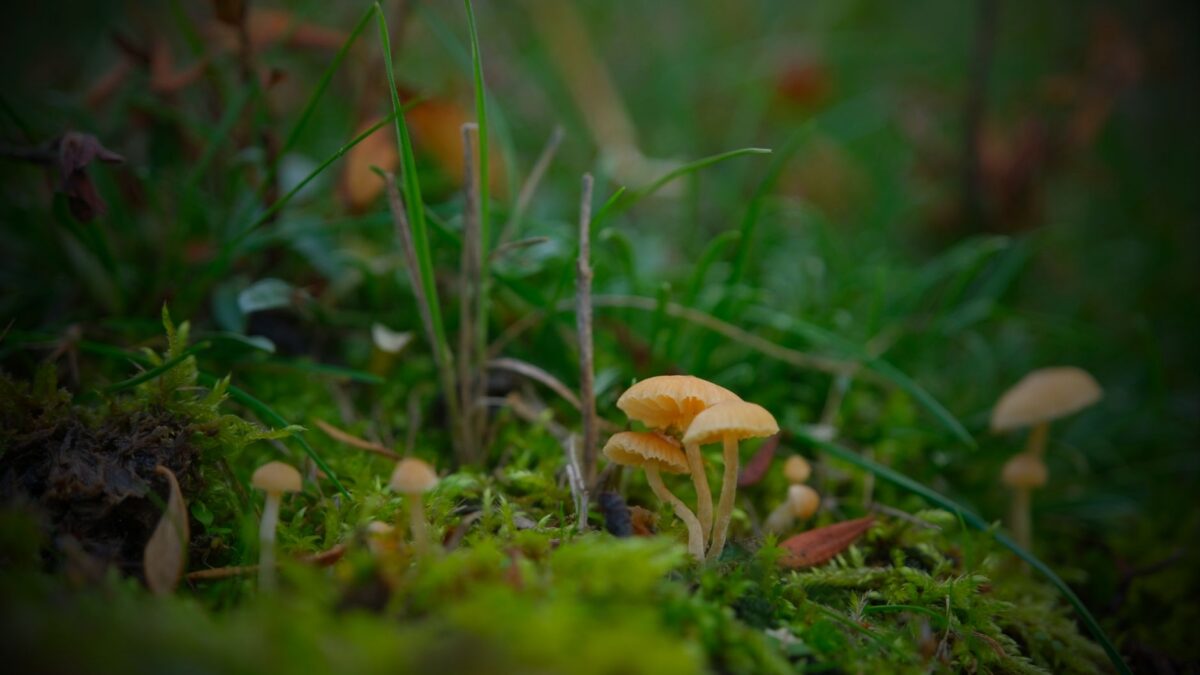
Ectomycorrhizal fungi are the ones most often linked to the wood wide web. They partner with many temperate and northern trees, such as pines, firs, oaks and birches, and some of them produce the mushrooms seen on the forest floor in autumn.
What do the fungi and trees trade?
The basic trade is minerals for sugar. Fungal threads, called hyphae, are far thinner than roots and spread through soil much more widely, so they can reach phosphorus, nitrogen and water that roots alone would miss. The fungus passes some of these to the plant. In return, the plant sends the fungus sugars made by photosynthesis, which the fungus cannot make for itself.
| Partner | Gives | Gets |
|---|---|---|
| Tree or other plant | Sugars and other carbon compounds from photosynthesis | Phosphorus, nitrogen, other minerals and water |
| Mycorrhizal fungus | Minerals and water gathered by its hyphae | A steady carbon supply |
This exchange is well documented across many plants and is one reason fungi matter so much to soil and forest health.
What did the 1997 isotope study find?
The idea of a shared network took off with a 1997 paper in Nature by Suzanne Simard and colleagues, titled “Net transfer of carbon between ectomycorrhizal tree species in the field.” Working in British Columbia, the team labeled young paper birch and Douglas fir trees with different carbon isotopes, forms of carbon that can be traced. They then checked how much of each tree’s labeled carbon turned up in the other.
They reported that carbon moved in both directions and that Douglas fir came out ahead, a net gain from birch, with more transfer to firs growing in shade. The study used isotopes as tracers, the same basic principle behind carbon dating, though here the carbon was added on purpose rather than left to decay.
The result was striking and widely cited. Later work and the debate around it focused on two questions: did the carbon actually travel through fungal links rather than through soil, and was the amount large enough to matter to the trees?
Why do some scientists say the claims are overstated?
In 2023, Justine Karst, Melanie Jones and Jason Hoeksema reviewed the field evidence in a paper in Nature Ecology and Evolution. They looked at three popular claims:
- Networks are widespread in forests. They judged this insufficiently supported, because field results vary too much and are too limited to generalize.
- Resources moving through networks help seedlings grow. Also insufficiently supported. Results vary widely and often have other explanations, such as carbon moving through soil.
- Mature “mother trees” preferentially send food and warning signals to their own offspring. They found no peer-reviewed, published evidence for this claim.
The authors also looked at how studies are cited. They found that unsupported statements about these networks in the scientific literature had doubled over the previous 25 years, and that positive results were cited more than neutral or negative ones. Their conclusion was that the evidence is too sparse and unsettled to guide forest management yet.
What is solid and what is still debated?
Most researchers agree on the basics and argue about the rest. A fair summary:
- Solid: most land plants partner with mycorrhizal fungi; fungi trade minerals and water for plant sugar; one fungus can colonize the roots of more than one plant.
- Shown in some studies, disputed in scope: labeled carbon can move from one plant to another, but the route and the amount are contested.
- Not demonstrated: trees recognizing and feeding their own offspring, and forests acting as one cooperating superorganism through fungal links.
Plants do signal to each other in other, better documented ways, such as through chemicals released into the air. We cover that evidence in how plants communicate.
Bottom line
Mycorrhizal fungi are real and vital partners for most land plants, trading minerals and water for sugar, and their threads can link more than one tree. A 1997 Nature study reported net carbon transfer from birch to Douglas fir, which launched the wood wide web idea. A 2023 review found that wider claims, especially about mother trees feeding offspring, lack strong field evidence, so the network’s real role in forests remains an open question.
FAQ
Where does the name wood wide web come from?
The phrase became popular around the 1997 Nature study on carbon transfer between birch and Douglas fir. It is a catchy label for common mycorrhizal networks, not a scientific term with a fixed definition.
Do all trees have mycorrhizal fungi?
Nearly all trees do, but not all with the same type. Many temperate trees such as pines and oaks form ectomycorrhizas, while many tropical trees and maples form arbuscular mycorrhizas.
Are mother trees real?
Large old trees clearly shape the forest around them through shade, seeds and soil. The specific claim that they recognize their offspring and send them extra food through fungi has no peer-reviewed evidence, according to the 2023 review.
Can fungal networks warn other plants about insects?
A few experiments, mostly in pots and greenhouses, have suggested that signals can pass between plants linked by fungi. These results have not been shown to work in forests, and the 2023 review found no published evidence for trees sending defense signals to offspring.