Bees Make a Polyethylene-Like Plastic That Rots Away in Soil
A solitary bee lines its nest with a plastic similar to polyethylene, yet it breaks down in soil within a year, researchers report in PNAS.
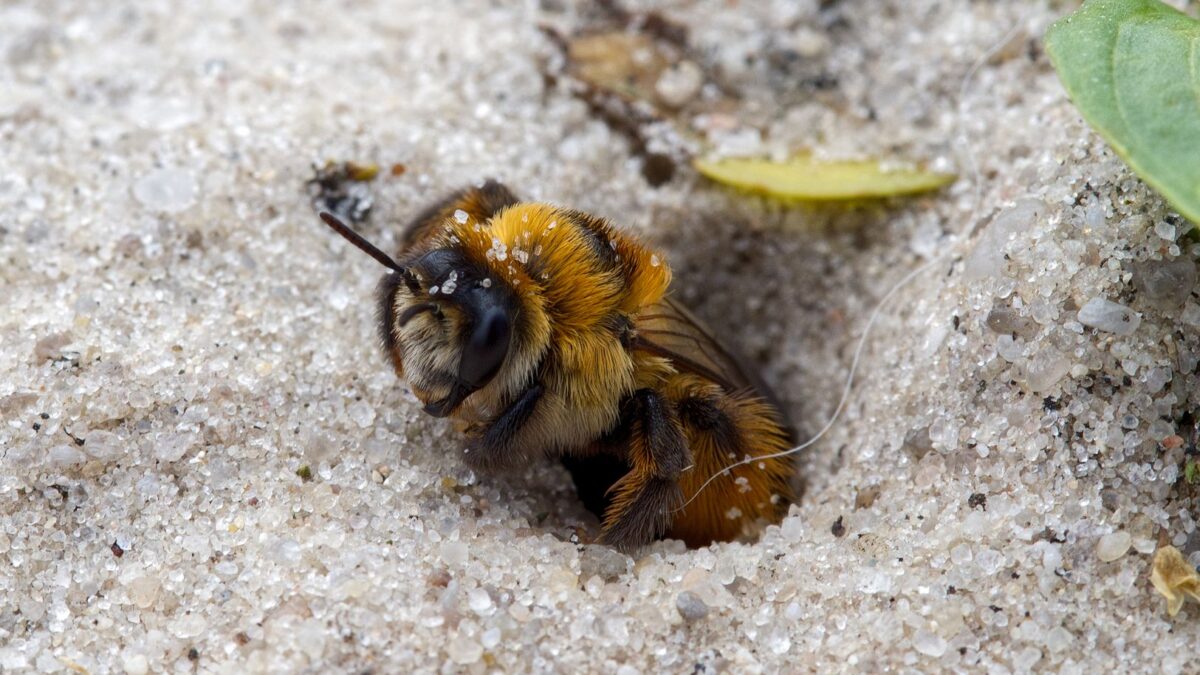
The cellophane bee (Colletes inaequalis) lines its underground nest with a polyester that resembles polyethylene, yet the material breaks down in soil, according to a study in Proceedings of the National Academy of Sciences covered by Chemistry World. In soil, the share of polyester in bee nests fell from 73% to 40% by weight within four months.
The contrast with human-made plastic is sharp. Around one third of the plastic produced worldwide is polyethylene, which can last in the environment for decades or even centuries.
How the researchers examined the nest lining
Entomologist Laura Russo of the University of Tennessee in Knoxville says the lining looks and feels like cellophane when new: crinkly, shiny and strong. Over time it fragments and crumbles. Russo, Jonathan Coote, a sustainable biomaterials researcher at Virginia Tech, and colleagues took an interest because nest material does not seem to pile up, even though these bees can nest together in their thousands and return to the same sites for decades.
Their chemical analysis found chains of carbon-carbon bonds with an ester group (a chemical link that defines polyesters) every 18 to 22 carbons. The polymer is crosslinked, about 60% crystalline and water-repellent, with the same tightly packed crystal arrangement seen in manufactured polyethylene.
A plastic that should resist decay and does not
Chemists have tried to build polyethylene-like polyesters with long carbon stretches joined by esters, but those materials often degrade poorly. Coote explains that their crystals tuck the ester links away, so water and living organisms cannot reach them. By chemical structure alone, he says, the bee lining should behave the same way.
It does not. X-ray scattering showed little sign of the higher-order crystal organization found in synthetic versions, which form layered crystals that assemble into spheres tens to hundreds of micrometers across. The Virginia Tech team suggests the crosslinking may be responsible. In their reading, the crystals are broken into small, disordered nano-crystallites that expose more surface area and leave the esters open to attack. The team also found evidence of enzymes breaking down polyesters in bee nests.
What is still unknown
Coote says the group now wants to find out which factor matters most: the crystal structure, the way crystals are organized, or enzyme activity.
The bee’s manufacturing process is also unsolved. The polymer starts as macrocyclic lactone monomers, rings of carbon and oxygen made in a gland next to the stinger. Such compounds are hard to join into polymers in the lab. Coote says the layers of the nest go down so quickly that the process resembles 3D printing, and identifying the enzyme that drives the polymerization would be worthwhile.
Why it matters
Taylor Nelson, an environmental chemist at the University of Konstanz in Germany, says the work does not point toward farming bees for bioplastics. He sees lessons in the enzymes that build and break down the polymer. “Enzymes could be useful catalysts for recycling plastics,” he says, and nests where bees already degrade these polyesters may be a good place to search for one suited to polyethylene-like materials.
The study is by J. P. Coote and colleagues in Proceedings of the National Academy of Sciences, 2026 (DOI: 10.1073/pnas.2607098123).
Source: Chemistry World