Euclid Telescope Release Finds 15,000 Gravitational Lens Candidates
ESA's Euclid telescope released 13 months of data with about 15,000 strong gravitational lens candidates and 60 million possible quasars.
The European Space Agency’s Euclid space telescope has released its first major batch of survey data, and astronomers sorting through it have found around 15,000 candidates for strong gravitational lenses and 60 million possible quasars, according to Sky & Telescope. The release covers about 13 months of observations and 1.7 petabytes (1.7 million gigabytes) of data.
It includes images of more than 900 million galaxies and spectra of more than 160 million sources. The results are candidates, and the telescope’s first cosmology results are still to come.
How big the release is
Euclid has now covered 1,900 square degrees of sky, an area as large as 9,500 full Moons. The release contains raw data, calibrated images, catalogs, spectra and mosaics covering large swaths of sky.
Last year’s preliminary release covered 63 square degrees, about 300 full Moons, gathered in one week of observations. The new release covers roughly 30 times that area and holds about 35 times as many galaxies. “These are far more than beautiful pictures,” said Carole Mundell, ESA’s Director of Science.
Finding the lenses
A strong gravitational lens forms when the gravity of a foreground galaxy bends the light of a more distant galaxy into arcs or rings. Only about one galaxy in several thousand acts as one. The new catalog is about 30 times larger than the one from last year’s release and, according to ESA, bigger than all earlier strong-lens catalogs combined.
The team found the 15,000 candidates among more than 1 billion stars and galaxies by combining machine learning, inspection by experts and thousands of citizen scientists who scanned Euclid images through the Space Warps project on Zooniverse. Valeria Pettorino of ESA, Euclid’s project scientist, said the sky coverage and image resolution make it possible to study lenses as a population rather than as isolated systems. Natalie Lines of the University of Portsmouth, a member of the Euclid Consortium, said the team forecast more than 10 years ago that Euclid would transform lens discovery.
What is still unconfirmed
The 15,000 lenses and 60 million quasars are candidates, not confirmed objects. Research on the new data has only begun. Eight papers are on the arXiv preprint server, which means they have not been through peer review, and more are expected. A special issue of Astronomy & Astrophysics in June 2026 held 41 papers based on early-release data, including a catalog of 380,000 galaxies classified by shape.
The full first data release, DR1, is set for mid-2027. It will add more raw data and more processed products, such as weak gravitational lensing information (a subtler form of lensing) and calculations of how galaxies and clusters fit into the cosmic web. Pettorino said those higher-level products need more time to be scientifically validated, so Euclid’s first cosmology results are not expected before then.
What this means for the dark universe
Euclid’s main goal is a 3D map of the universe that reveals dark matter and dark energy. Dark matter is invisible but bends the light of background galaxies, and measuring tiny distortions in the shapes of millions of galaxies lets scientists chart where it lies along the filaments and clusters of the cosmic web. Dark energy is the unknown cause of the accelerating expansion of the universe. Euclid’s spectra give the distances of faraway galaxies, which lets astronomers compare how galaxies were arranged at different cosmic epochs and trace dark energy’s effect on expansion.
The release covers about 14% of the sky Euclid will survey. Over six years the telescope will map about 14,000 square degrees, roughly one third of the whole sky, avoiding the dusty plane of the Milky Way. It will image around 1.5 billion distant galaxies across roughly 10 billion years of cosmic history, and will revisit three narrow Deep Fields for more sensitive images.
A comet and a planet search
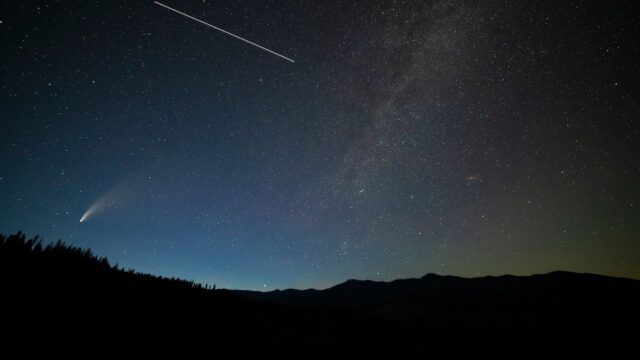
Some results were unplanned. A few weeks ago Euclid found a new comet that happened to cross one of its Northern Deep Fields. At another point the telescope turned away from its survey fields to watch more than 60 million stars in the galaxy’s central bulge for 26 hours, searching for exoplanets.
Euclid launched in July 2023 and observes from the L2 Lagrangian point, about 1.5 million kilometers from Earth on the side facing away from the Sun. Pettorino said the telescope and its instruments are performing extraordinarily well.
Source: Sky & Telescope