Kīlauea Lava Fountains Top 660 Feet in Episode 56, USGS Says
Kīlauea's Episode 56 lava fountains reached at least about 660 feet on Nov. 5. Here is how USGS geologists measure fountain height from cameras.
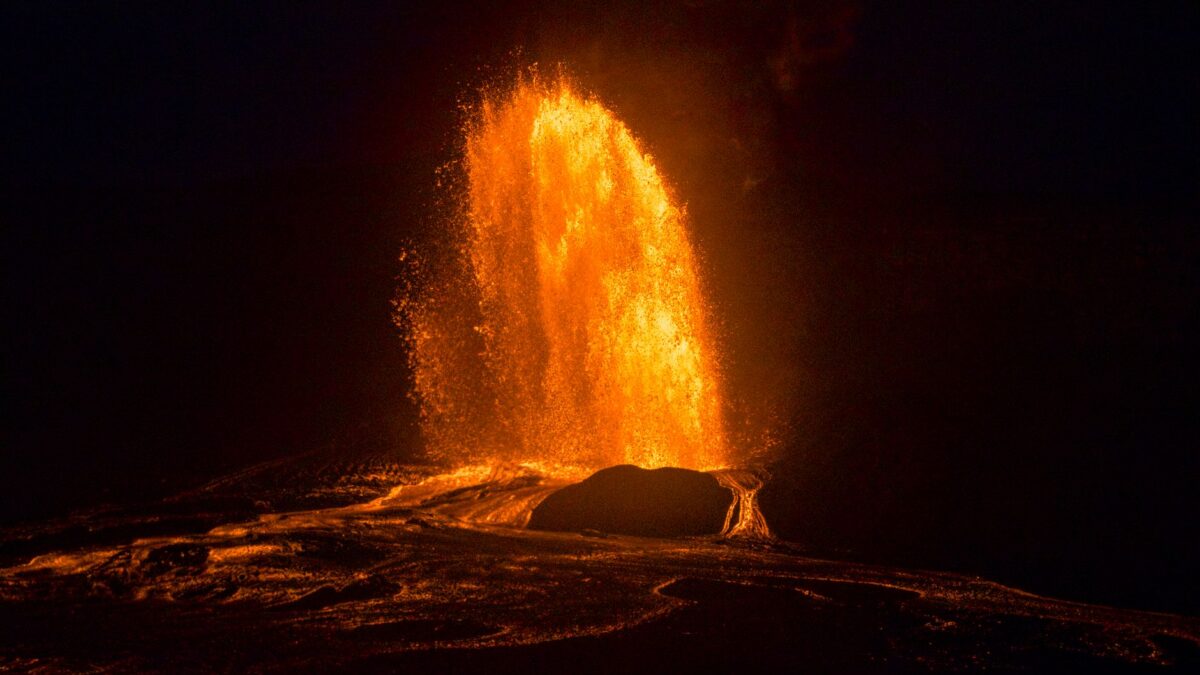
Lava fountains at Kīlauea climbed to at least about 660 feet on Nov. 5 during Episode 56 of the volcano’s summit eruption, according to the U.S. Geological Survey’s Hawaiian Volcano Observatory. The episode began shortly after noon and stopped abruptly just after 6 p.m., after about 6 hours of fountaining inside the summit caldera.
That makes 56 fountaining episodes in the past 2 years. In this week’s “Volcano Watch” column, observatory scientists explained how they turn camera images into a height in feet, a figure that has ranged from a little over about 300 feet in the weakest episodes to more than about 1,500 feet in the tallest.
A quick estimate from the webcams
The observatory produces two kinds of height numbers. The first is a live estimate for status reports and daily updates. While an episode is underway, staff watch webcams such as the K2cam at Uēkahuna Bluff and lay a rough scale over the picture. That scale comes from the camera’s field of view (how wide an angle it sees) and its distance from the vent.
How the careful measurement works
The second number takes longer and is meant for scientific analysis. After an episode ends, geologists hike to the caldera rim and swap the data cards in a network of timelapse cameras. These cameras run 24/7 and save one frame every minute.
The cameras have fixed lenses with no zoom, so the view stays the same from frame to frame. Before deployment, each camera photographs a checkerboard grid from several angles in the lab. Software then works out its exact field of view and how much the lens bends straight lines, an effect called distortion.
Back from the field, the team trims the image set down to the fountaining episode alone. A geologist then goes through the frames by hand and clicks on the top of the fountain in each one, building a list of pixel positions. For 500 to 800 images, that can take an hour or so.
Subtracting the vent’s pixel position gives the fountain’s height in pixels. To convert pixels to meters or yards, the team needs to know how much ground one pixel covers. That depends on the lab-measured field of view and on the distance from camera to vent, which they get from GPS coordinates and aerial mapping of the vent area.
Why the official heights look conservative
Observers on the rim often report taller fountains than the official figures. The reason is where the measurement stops. Geologists measure only to the top of the solid fountain body, the part dense enough to block the view behind it. Above that is a spray of scattered glowing particles, which the eye tends to count but the observatory leaves out.
The observatory said artificial intelligence or machine learning might speed the work up, but the top of a fountain is often a judgment call or hidden from view. For now, scientists trust the manual clicks most, and an AI project for this imagery is still in progress.
What it means for tracking the eruption
Consistent height numbers let scientists compare one episode with another over an eruption that has run since Dec. 23, 2024. Heights for the first 50 episodes are now out in a recently published USGS data release, and the observatory said it will keep measuring as long as the episodic eruption continues.
Kīlauea’s alert level stayed at Watch as of early evening Nov. 5. Sulfur dioxide output at the summit was elevated, and northeast winds were expected to carry gas and volcanic material southwest of Halemaʻumaʻu Crater. The observatory saw nothing unusual along the East Rift Zone or Southwest Rift Zone.
Mauna Loa stays quiet
Neighboring Mauna Loa is not erupting, and its alert level is Normal. Its summit region recorded 66 earthquakes in October, up from 53 in September, a change the observatory said is within the typical range of the past 2 years. Minor inflation of the volcano, a sign of slow swelling, is continuing. No felt earthquakes were reported in the Hawaiian Islands over the past week.
Source: Big Island Now