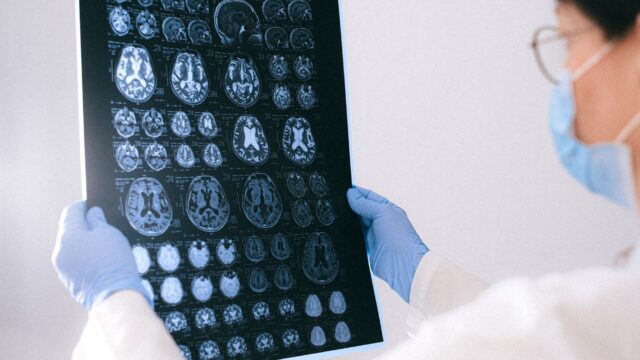
Wernicke’s Area Also Helps Produce Speech, Study of 28 Patients Finds
A Science study of 28 epilepsy surgery patients finds Wernicke's area fires about a quarter second before speech, not just during listening.

A nickel-size patch of the brain’s Wernicke’s area fires about one-fourth of a second before a person speaks, according to a study published in the journal Science on Nov. 19. For roughly 150 years, textbooks have taught that the region, located just above the left ear, handles only the understanding of spoken and written language. The new work indicates it also helps produce speech.
The finding was reported by Smithsonian Magazine, which drew on press briefing remarks covered by Scientific American, Science News and National Geographic. It may explain a long-standing puzzle: people with damage to Wernicke’s area sometimes speak in fluent-sounding gibberish, a pattern described as “word salad.”
How the team recorded the speaking brain
The researchers recruited 28 people who were undergoing brain surgery for epilepsy. Grids of either 128 or 256 electrodes were placed on the brain to record the activity of neurons, the nerve cells that carry signals. The participants stayed awake and repeated and listened to words and sentences.
Neurons in a subzone called the left posterior superior temporal gyrus (lpSTG) were active while patients listened. They also fired shortly before the patients spoke. The strength of that activity depended on the length and complexity of the word. “It’s more active when you’re about to say the word caterpillar than when you’re about to say the word cat,” said study co-author Matthew Leonard, a cognitive neuroscientist at the University of California, San Francisco (UCSF).
About half of the participants also received electrical stimulation to the lpSTG. They could no longer understand spoken questions from the researchers. They also lost the ability to start talking or spoke in word salad, making errors similar to those seen in Wernicke’s aphasia, a language disorder caused by damage to Wernicke’s area. When the stimulation stopped, comprehension and speech returned.
“What we saw was not what the textbook predicted,” said co-author Edward Chang, a UCSF neurosurgeon.
Background: two areas, two jobs
In the 1870s, German neurologist Carl Wernicke noticed that people with damage to this area struggled to comprehend words. Speech production was assigned to a separate site, Broca’s area, near the left temple. Those assigned roles are foundational in biology textbooks, which the study suggests will need revision, according to Smithsonian.
Possible uses for speech technology
Most clinical trials of brain-computer interfaces (BCIs), devices that read brain signals, focus on people who lost speech because of paralysis. Per Scientific American, that approach does not work for people with aphasia, because their intended speech signals never reach the motor regions that move the mouth. A BCI for them would need to decode intended speech from undamaged parts of the lpSTG.
The team built experimental implants for two participants with paralysis. In testing, the devices detected both what the individuals heard and what they wanted to say.
How sure is this?
The work is published in Science, a peer-reviewed journal. The sample is small and consists of epilepsy patients, whose brains may differ from those of people without the condition. The stimulation experiment involved about half of the 28 participants, and the BCI test involved two people with paralysis.
Leigh Hochberg, a neurologist at Mass General Brigham who was not part of the study, said he was not entirely surprised. He told National Geographic that assigning a single function to a circled part of the brain is likely “a substantial oversimplification.”
Chang suggested that the subzone, which turns heard words into spoken ones, “may be part of what makes us human.” Smithsonian notes that other primates lack a region resembling Wernicke’s area, which could help explain why they have not evolved speech. That idea has not been tested in this work.
Related brain research is covered in our piece on what happens in the brain during sleep.
Source: Smithsonian Magazine
Site editor: Nikita Sheikin