Brain Activity Score Tracks Alzheimer’s Risk in 1,300 Healthy Adults
A Stanford brain-scan score predicted cognitive decline in healthy adults aged 55 to 70. How the study worked, what it found and what remains untested.
Patterns in how brain regions communicate at rest predicted which healthy adults aged 55 to 70 would later lose cognitive ground, according to a Stanford Medicine study of more than 1,300 people published Nov. 4 in Science Advances. In follow-up records stretching up to 12 years, people whose brain activity looked more like that of Alzheimer’s patients were more likely to decline, build up amyloid-beta plaques and receive an Alzheimer’s diagnosis.
The researchers say their score predicted conversion to Alzheimer’s disease as well as or better than established biomarkers such as amyloid-beta and tau, and did so at an earlier point. It is not a diagnostic test, and no treatment based on it has been tested.
Building a score from two extremes
The team started with adults aged 75 and older at opposite ends of cognitive aging. One group had Alzheimer’s disease. The other group were super agers: people at least 75 whose memory test results were typical of a 45-year-old and whose executive function was normal for their age. Depending on the definition, roughly 10% of older adults may qualify, according to Stanford Medicine.
Most earlier studies compared super agers with older adults who scored normally on cognitive tests. Yu Zhang, an assistant professor of psychiatry and behavioral sciences and the study’s senior author, said that comparison group is mixed. Some people with normal scores already carry amyloid-beta plaques or other age-related changes, and others do not. His team instead compared super agers with Alzheimer’s patients of about the same age.
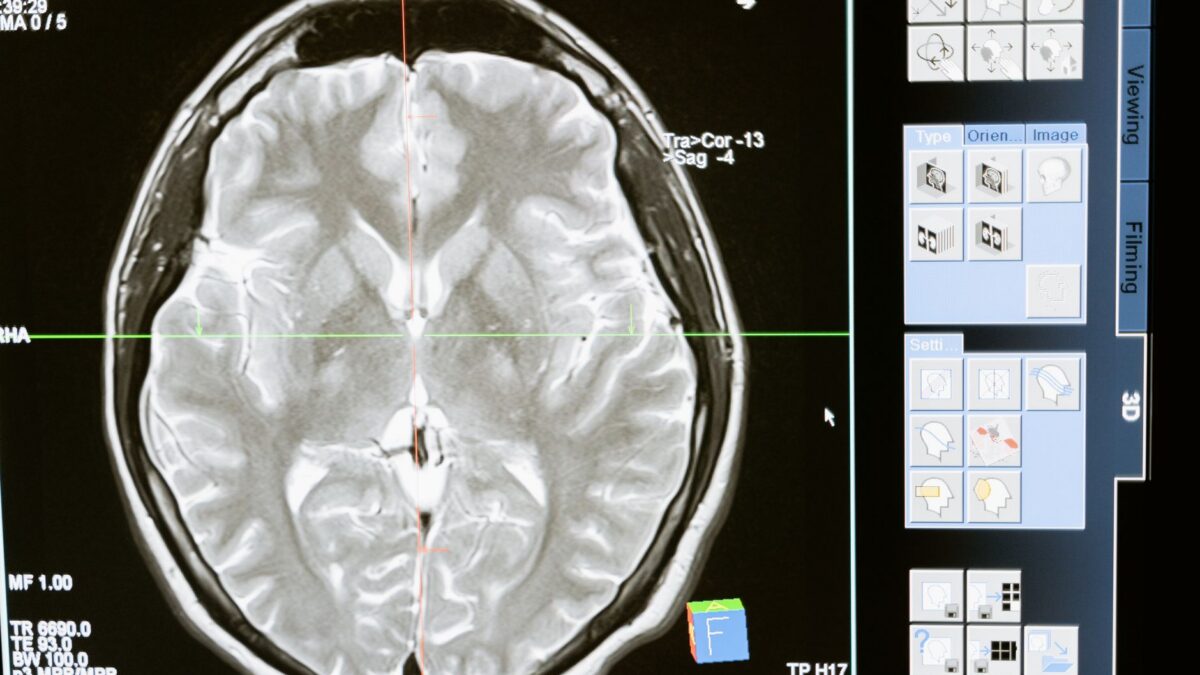
They used resting-state functional MRI, which records brain activity while a person lies quietly in a scanner, from 180 super agers and 110 people with Alzheimer’s disease. The scans came from several research programs, including the Open Access Series of Imaging Studies, the Harvard Aging Brain Study and the Alzheimer’s Disease Neuroimaging Initiative. Some regions were more active in one group and others less, and the relationships between regions (called functional connectivity) formed patterns that told the groups apart. The resulting Alzheimer’s resilience-vulnerability connectome, or ARC, score separated super agers from Alzheimer’s patients with about 85% accuracy.
Testing the score on people without symptoms
The researchers then scored more than 1,300 cognitively healthy adults aged 55 to 70. At the start, people with high and low scores did about equally well on cognitive tests. Most participants were followed for about five to six years, and some for as long as 12.
Over that time, people with more Alzheimer’s-like scores declined faster on standard tests of memory, attention and executive function. Those with the most super-ager-like patterns generally declined the slowest. Lead author Kanhao (Alex) Zhao, a postdoctoral scholar in psychiatry, said adding the ARC score to existing biomarkers improved prediction further. The score showed some correlation with brain age, another measure built from functional MRI data, but Zhang said ARC gives more specific information about vulnerability or resistance to decline.
What this means for Alzheimer’s research
The standard markers appear fairly late in the disease. Amyloid-beta and tau “are observable at relatively late stages of the disease,” Zhang said. A measure based on brain activity could flag risk earlier, and activity patterns, unlike these proteins, may eventually be possible to change.
Zhang has named cognitive training and transcranial magnetic stimulation as possible ways to shift activity toward the resilient pattern. The second method uses magnetic pulses to influence brain activity and has shown potential in people treated for depression. Neither approach has been tested for preventing cognitive decline, and the researchers do not know whether changing brain activity would alter the course of Alzheimer’s disease.
Limits and next steps
The researchers say the ARC score is not meant to diagnose Alzheimer’s and should be treated as a possible tool for tracking cognitive health and estimating risk. A person’s score can change over time. The share of people with super-ager-like scores generally falls with age, and brain injuries and neuropsychiatric conditions can also affect the pattern. Follow-up periods also differed between the datasets used.
Zhang’s team is preparing a trial that will measure ARC scores before and after cognitive training. “We have to intervene at an early stage,” he said. Researchers from Children’s National Hospital, the University of Texas at Austin, Lehigh University, Penn State College of Medicine, New York University Grossman School of Medicine and the University of California, Los Angeles also took part.
Source: ScienceDaily