Pinhole Projection for a Solar Eclipse: Safe Viewing Without Glasses
Pinhole projection lets you watch the partial phases of a solar eclipse without eclipse glasses. How to use your hands, a colander, a card or a box viewer.
You can watch the partial phases of a solar eclipse without eclipse glasses by projecting the Sun’s image onto a surface and looking at that image, never at the Sun. With your back to the Sun, let sunlight pass through a small hole (a hole in an index card, the gaps between your fingers, the holes of a colander) and look at the little crescent Suns that land on the ground, a wall or a sheet of paper.
The American Astronomical Society’s eclipse team and NASA both describe projection as a safe indirect method. NASA’s older eclipse safety pages call it the safest and most inexpensive way to view the partly eclipsed Sun, because nobody is looking at the Sun itself.
Why can’t you just look at a partial eclipse?
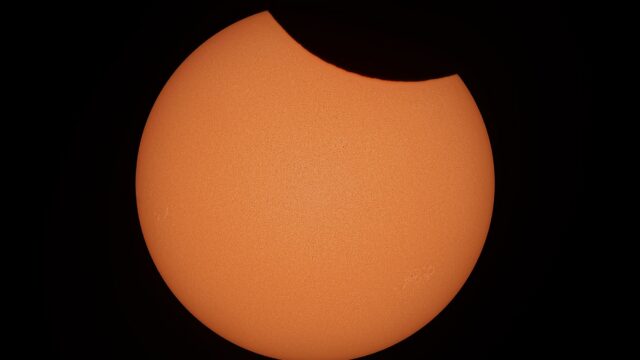
A partial eclipse never has a safe moment for the naked eye, because some of the bright Sun is always showing. According to NASA Science, the only time to look directly without protection is the brief total phase of a total eclipse, when the Moon covers the Sun’s bright face completely. Outside the path of totality, and during every partial or annular eclipse, you need either a proper solar filter or an indirect method.
The danger is real even when most of the Sun is hidden. A NASA eclipse safety page from Goddard Space Flight Center explains that even with 99% of the Sun’s surface covered, the remaining crescent can still burn the retina, though the light outside may look like twilight. The retina has no pain receptors, so the damage is not felt, and vision problems may only appear hours later. The same page notes that most people who have suffered eclipse eye injuries were children and young adults. Ordinary sunglasses do not help, however dark they are.
How do you make a pinhole projector with your hands?
Your hands are the simplest projector, and they need no equipment at all. The AAS describes the method this way:
- Stand with the Sun behind you.
- Spread the fingers of both hands slightly and hold your arms out.
- Lay the fingers of one hand across the fingers of the other to make a waffle or grid pattern. Many people find this easier with palms facing up.
- Look down at the shadow of your hands on the ground.
The small gaps between your fingers act as pinholes. During the partial phases you will see a grid of tiny crescent Suns. During the ring phase of an annular eclipse, the images become small rings.
What household objects work as projectors?
Anything with many small holes will cast many small images of the Sun. The AAS and NASA mention these:
- A pasta colander
- A loosely woven straw hat
- A perforated spoon
- Perforated board (perfboard)
- A single hole punched in an index card, with a second card, a wall or the ground as the screen
Leafy trees do the same thing for free. On a sunny eclipse day, look at the shade under a tree with broad leaves: the tiny gaps between overlapping leaves throw hundreds of crescent images onto the ground. Goddard’s page says the screen should sit about a meter behind a single pinhole to get an image large enough to see easily, so hold your card well away from the hole.
How do you build a box eclipse viewer?
A box projector gives a sharper, shaded view and is easy to make at home. NASA lists the materials as a cardboard box, a white sheet of paper, tape, scissors and aluminum foil.
- Cut a hole in one side of the box and tape a piece of aluminum foil over it.
- Punch a small pinhole in the foil.
- Tape the white paper inside the box, on the side opposite the foil, to act as the screen.
- Cut a second hole in the box that you can look through to see the paper.
- Stand with the Sun behind you so sunlight enters through the pinhole and lands on the paper.
During the partial phases a crescent Sun appears on the paper. You look into the box at the image, with the Sun at your back the whole time.
What mistakes should you avoid?
The one rule that matters most: never look at the Sun through the pinhole. Pinhole projection means sending light through the hole onto a surface and looking at the surface. Both the AAS and NASA repeat this warning.
- Do not look at the Sun through a camera, binoculars or a telescope without a proper solar filter fitted to the front. NASA warns this causes severe eye injury instantly.
- Do not look through binoculars or a telescope while wearing eclipse glasses. The concentrated light can burn through the glasses’ filter.
- Watch children closely, especially if a projector could be turned toward the face.
- Remember your skin. NASA advises sunscreen, a hat and protective clothing, since watching a whole eclipse can mean hours in direct sunlight.
If you do buy eclipse glasses, they must meet the ISO 12312-2 standard; our guide on checking eclipse glasses and finding safe suppliers covers the details.
Can you project the Sun with binoculars or a telescope?
Yes, but the AAS reserves this for experienced observers. Optical projection with binoculars or a small telescope gives bigger, brighter and sharper images than a pinhole. The risks are that strong sunlight can damage the instrument and that someone may look into the bright beam coming out of the eyepiece. The AAS says to try it only if you are an experienced astronomical observer, using your own equipment, and staying with it at all times to supervise.
For groups, there are safer designs. The Sun Funnel is a rear-screen projection device that attaches to a telescope, so many people can watch at once without anyone near the beam; the AAS links a free PDF guide to building one, written for people who already know how to use a telescope for solar observing. Ready-made projection scopes also exist: the AAS puts the Sunspotter at around $500 and aims it at clubs, schools, museums and planetariums, while the Solarscope, sold in wood and cardboard versions, is priced around $200.
Does pinhole projection work during totality?
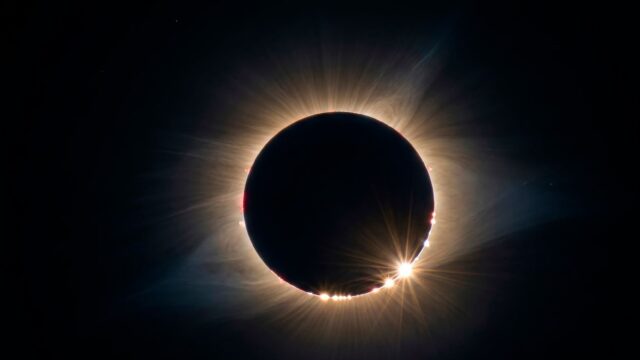
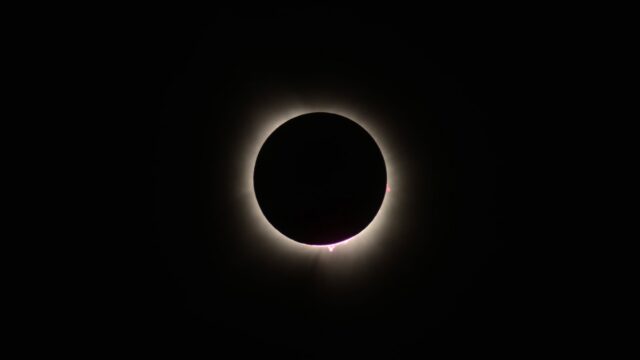
No. The AAS notes that during the total phase of a total eclipse the projected image is too faint to see. Inside the path of totality, when the Moon completely covers the Sun and the sky suddenly darkens, it is safe to look directly at the eclipsed Sun. As soon as any bright part of the Sun returns, go back to a filter or a projector. If you are watching from a place that only gets a partial eclipse, such as Seville, Granada and Almería, there is no moment of totality at all, so projection or a certified filter is needed the entire time.
Quick answers
Is a pinhole projector really safe?
Yes, as long as you look at the projected image and never through the hole at the Sun. Keep the Sun behind you.
How big should the pinhole be?
Small. NASA’s examples use a hole punched in an index card or a pinhole in aluminum foil. A screen about a meter away gives an image that is easy to see.
Do I need one pair of eclipse glasses per person?
No. The AAS guide to viewing an eclipse safely points out that the partial phases move slowly, so a quick glance every few minutes is enough and a few viewers can be shared among a large group. Projection lets everyone watch at once.
What if it is cloudy?
Projection needs direct sunlight, so clouds will hide the images. Our article on cloud odds along the eclipse path looks at where skies tend to be clearest.
Checked against official sources in November 2026. Hours, prices and rules change: confirm on the official page before you go or apply.
Site editor: Nikita Sheikin