Solar Retinopathy: Symptoms, Recovery and When Eclipses Are Safe
Solar retinopathy is damage to the retina from looking at the sun. Symptoms, recovery time, and the one eclipse moment safe to view without filters.
Solar retinopathy is injury to the retina, mostly the macula at the center of vision, caused by looking at the sun without proper protection. It can leave a blurred or dark spot in the middle of your sight, often in both eyes, and many people recover within about two months, though some damage is permanent. The only time it is safe to look at the sun with bare eyes is during totality, the brief part of a total eclipse when the moon covers the sun’s face completely.
What does looking at the sun do to the retina?
Bright light sets off chemical reactions inside the retina’s rods and cones that damage their ability to respond, and in extreme cases destroys them. NASA’s eclipse safety page explains that the eye passes a large share of solar radiation between 380 and 1400 nm through to the retina. When someone stares at the sun repeatedly or for a long time, heat from visible and near-infrared light can add a burn on top of the chemical damage and leave a small blind area.
The popular idea that the sun simply burns the retina is only part of the picture. The Wikipedia article on photic retinopathy notes that looking at the sun through a 3-mm pupil raises retinal temperature by only 4 °C, too little to cook tissue, so most of the harm appears to be photochemical: light drives oxidation reactions in the exposed cells. The same kind of injury can come from lasers and arc welders, which is why the condition is also called photic retinopathy or retinal phototoxicity.
Why doesn’t it hurt while it happens?
The retina has no pain receptors, so the damage occurs without any warning sensation. According to NASA, the effects on vision do not show up for at least several hours after the exposure. Someone can watch a partial eclipse, feel fine, and notice the problem only later that day or the next morning.
What are the symptoms of solar retinopathy?
The main sign is a change in central vision. People report:
- a spot in the visual field that does not fade after a reasonable time
- blurring
- eye pain or headaches
Both eyes are usually affected, though it can be one. For someone who normally sees 20/20, vision commonly drops to about 20/40 or 20/60, and it can be better or much worse than that.
An eye doctor may see nothing at first, or slight swelling of the macula. Within a few days the injured point often turns yellow or white, then reddish over the following weeks, sometimes with pigment around it. Mild cases may show no visible change at all. Holes and lasting lesions in the retina are possible, and the outlook is worse when the pupils were dilated or the exposure lasted longer.
Does vision come back?
Often it does. Most people diagnosed with photic retinopathy regain full sharpness of vision within two months, according to the references collected on Wikipedia. Recovery has been recorded in as little as one month and, in other cases, took more than one year. Severe cases can take longer or never fully recover. How long the light hit the eye and how bright it was both affect the chance and pace of recovery.
There is no treatment known to reliably speed healing. Doctors have sometimes tried corticosteroids for the early swelling, with unclear results. The American Academy of Ophthalmology warns that looking at the sun without the right protection, even briefly, can damage the retina permanently and can cause blindness.
NASA adds that most people who suffer eclipse-related eye injuries are children and young adults, so supervision matters at school and family viewing events.
When is it safe to look at an eclipse without protection?
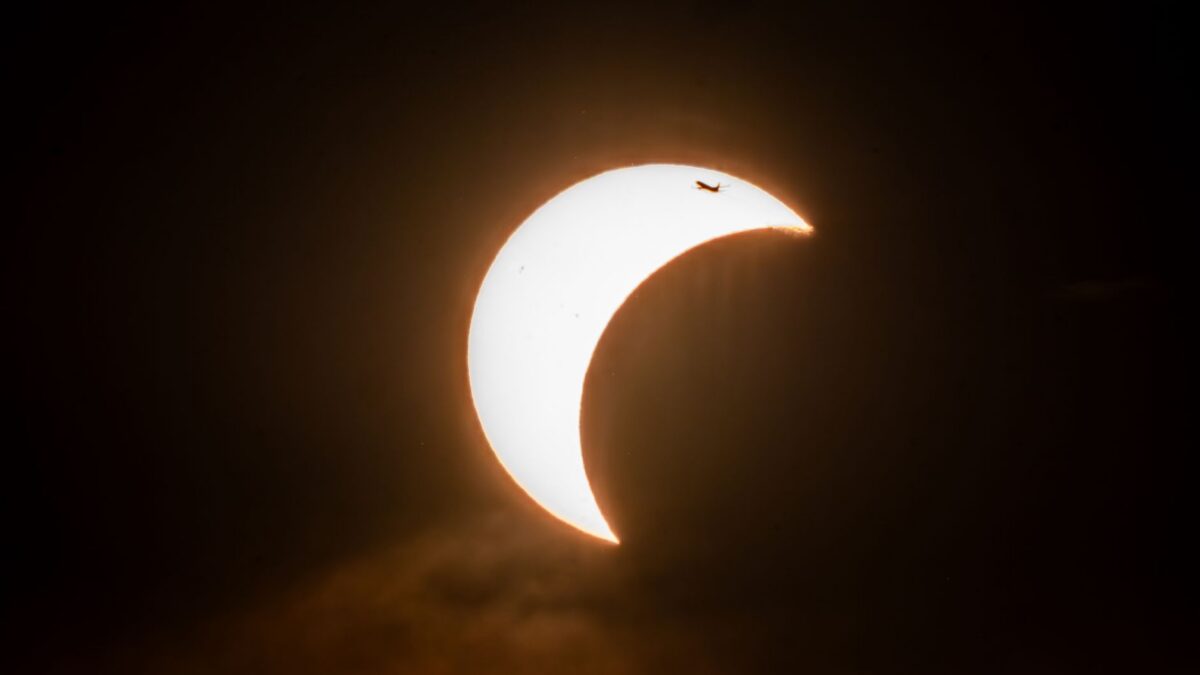
Only during totality. A total eclipse runs over a couple of hours: about 1 hour of partial phase as the moon slides across the sun, then totality, then another partial phase of about an hour. Totality itself lasts only 1 to 2 minutes at a given spot, according to the AAO. The sky turns to deep twilight, the corona appears around the moon, and bright stars and planets come out.
- Wear eclipse glasses or a handheld solar viewer through the whole partial phase.
- Remove them only once the moon completely covers the sun’s bright face and it suddenly gets dark.
- Put the filter back on as soon as the bright sun starts to reappear, even slightly.
A partial eclipse, an annular eclipse, and the partial phases of a total eclipse are never safe to watch with bare eyes. NASA notes that even with 99% of the sun’s surface covered, the remaining thin crescent is bright enough to burn the retina, although the light around you looks like twilight. If you plan to travel for one, our pages on the path and best places for next August’s total eclipse and eclipse times and coverage in Madrid and Barcelona show where totality happens and where only a partial eclipse is visible.
Which filters protect your eyes?
Ordinary sunglasses, even very dark ones, and homemade filters are not safe, the AAO says. Direct viewing requires special-purpose solar filters in eclipse glasses or handheld viewers that meet the international standard ISO 12312-2. NASA’s technical guidance says a safe solar filter lets through less than 0.003% (density~4.5) of visible light from 380 to 780 nm and no more than 0.5% (density~2.3) of near-infrared from 780 to 1400 nm. NASA also lists shade number 14 welder’s glass and aluminized mylar made specifically for solar observing. Space blankets and gardening mylar do not qualify, and neither do X-rays or photo negatives with images on them.
Before using any filter, the AAO advises you to:
- check it for scratches or damage and throw it away if you find any
- read and follow the instructions that came with it, and help children use it correctly
- put it over your eyes before looking up, then look away before taking it off
- never look through an unfiltered camera, telescope or binoculars, even while wearing eclipse glasses, because the concentrated light will ruin the glasses’ filter
Projection avoids looking at the sun at all. A pinhole or small opening casts an image of the sun onto a screen placed at least a meter behind it, and gaps between overlapping leaves or interlaced fingers do the same thing. Binoculars or a small telescope on a tripod can throw an enlarged image onto a white card, as long as nobody looks through the device.
Quick answers
Can a few seconds of looking at the sun cause damage?
Yes. The AAO says that viewing the sun without proper protection for even a short time can permanently damage the retina.
How soon do symptoms appear?
According to NASA, visual effects appear at least several hours after the damage, and there is no pain during exposure because the retina has no pain receptors.
Can solar retinopathy be treated?
No treatment has been shown to reliably speed recovery. Many cases improve on their own within about two months, while severe ones may not fully heal.
Are sunglasses enough for a partial eclipse?
No. Only filters that meet ISO 12312-2, or indirect methods such as pinhole projection, are safe during any partial phase.
Checked against official sources in November 2026. Hours, prices and rules change: confirm on the official page before you go or apply.
Site editor: Nikita Sheikin