Laser Sails Hit Drag at 75% of Light Speed, Study Finds
A preprint finds scattered light starts slowing laser-driven solar sails near 75% of light speed. See how the effect works and what the study left out.
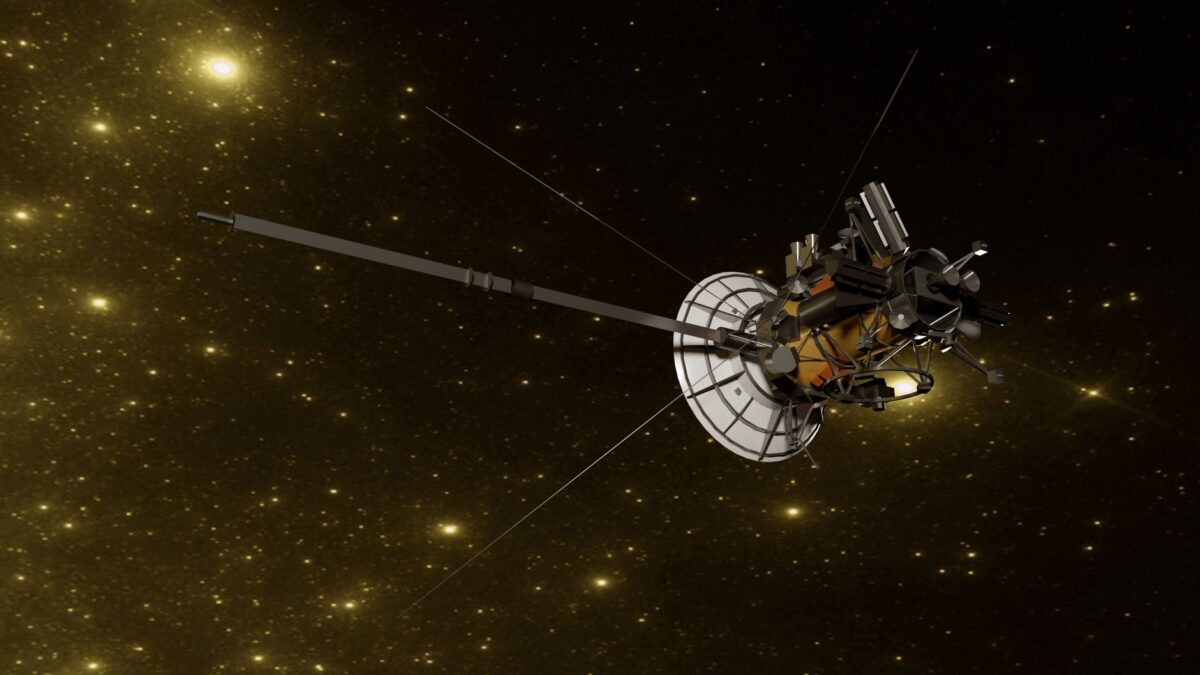
Once a laser-driven solar sail reaches about 75% of the speed of light, part of the light bouncing off it begins to push backward, according to a paper by Chao Shen and Jiaze Li of the Harbin Institute of Technology in China. The calculation, reported by Universe Today and ScienceDaily, adds a new source of resistance to designs for probes meant to cross the gaps between stars.
The laser still produces a net forward force at that speed, so the sail keeps gaining speed. It just gains it less efficiently.
How a sail and a laser are supposed to work
Light has no mass but carries momentum. When it hits a surface it gives a tiny shove called radiation pressure. In the vacuum of space a large, light reflective sheet can build up speed from that shove over time. Some interstellar proposals replace sunlight with powerful lasers aimed at the sail to reach a large fraction of light speed. Breakthrough Starshot, which pictured tiny spacecraft pushed toward nearby stars, is one such concept.
What the researchers calculated
The team worked out how a rapidly accelerating sail exchanges momentum with light in three ways. The first is incident light, the raw momentum of photons striking the sail. The second is specular reflection, where photons bounce off cleanly. The third is diffuse scattering, where the sail absorbs photons and re-emits them in random directions. In the authors’ breakdown, incident light gives the strongest push, followed by specular reflection, then diffuse scattering.
As the sail moves away from the laser, the Doppler effect stretches the incoming light to lower frequencies, the same way a passing ambulance siren changes pitch. Redshifted light transfers momentum less effectively, so the thrust from all three contributions falls as speed climbs.
Around 75% of light speed, a second effect appears. Relativistic aberration, a shift in the apparent direction of light caused by motion, concentrates the diffusely scattered light in the sail’s forward direction from the viewpoint of an observer at rest on Earth. Light emitted forward carries momentum forward, so the sail recoils backward. Diffuse scattering, the weakest of the three, turns from a help into a drag.
How sure is this?
The work is a theoretical calculation, not an experiment, and it is available on the arXiv preprint server (Relativistic Lightsail Propulsion Dynamics, DOI 10.48550/arXiv.2606.04052). The sources do not say it has been peer-reviewed. Nobody has built or tested a sail at anything close to these speeds.
The study also leaves out several things. It does not model drag from interstellar gas and dust, which could matter at extreme velocities. It skips the heating that a very powerful laser would cause in a thin sail, which could damage or melt the material. It treats the sail as an idealized mirror, while a real one would need to reflect laser light efficiently and stay lightweight, durable and stable. The curvature of spacetime was also simplified out.
Materials that might turn the effect around
Engineers are already studying metamaterials and photonic crystals, which are engineered to interact with particular wavelengths of light in ways ordinary reflective surfaces cannot. According to the report, careful control of how light scatters from such a sail might produce forces that correct its orientation and position, helping it stay aligned with the laser during acceleration. That would turn some of the relativistic effects into an advantage.
For now, a complete sail system able to reach another star remains far from being built or tested. The new result gives designers one more physical effect to account for in the forces light exerts on a fast-moving sail.
Source: ScienceDaily
Site editor: Nikita Sheikin