LHCb Sees Evidence of a Particle Decay Once in 10 Billion
LHCb at CERN reports 3.2 sigma evidence that a B0 meson decays into two muons, a process predicted about once in 10 billion decays. Here is what it shows.
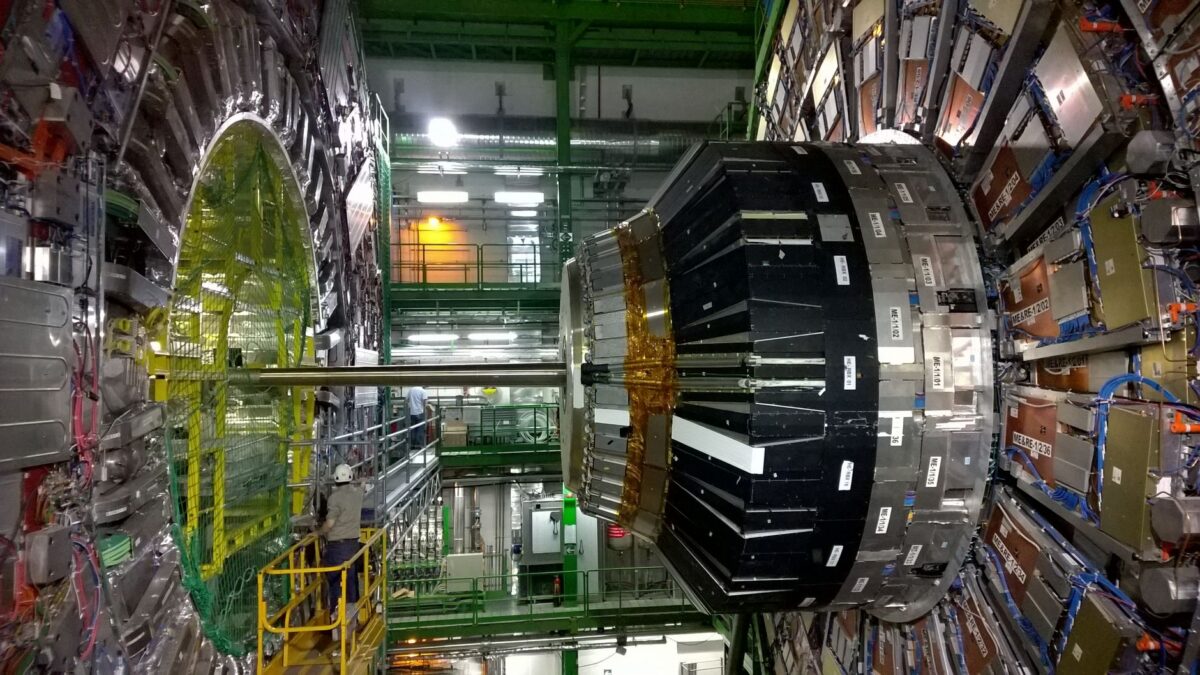
The LHCb experiment at CERN has found evidence, at a statistical significance of 3.2 standard deviations, that a beauty particle called the B0 meson can decay into a muon and an antimuon. The process is expected roughly once in every 10 billion beauty particle decays, and physicists have searched for it for more than 40 years, according to CERN and Physics World.
It is the first time a single experiment has gathered this much evidence for the decay. It is not yet a discovery, which in particle physics requires 5 standard deviations.
What was measured
A B0 meson is made of a quark and an antiquark held together by the strong nuclear force. This one pairs a beauty antiquark with a down quark. It lives about 1.5 trillionths of a second and, when created at the Large Hadron Collider (LHC), travels about 5 mm before it decays.
Muons are heavier cousins of the electron. Because the decay produces just two particles, the Standard Model, the leading theory of known particles and forces, can predict its rate very precisely. The related B0S meson, which has a strange quark in place of the down quark, decays this way about three times in every billion decays. The B0 version was expected to be about 30 times rarer, according to LHCb spokesperson Tim Gershon of the University of Warwick.
A 2015 combined analysis of LHCb and CMS data first observed the B0S decay and saw hints of the B0 decay, but later measurements using data through 2018 did not confirm those hints.
How the signal was found
The new analysis uses proton collisions recorded in 2024 and 2025. Physics World reports that this data set should hold only about 26 B0 decays alongside some 235 B0S decays, buried under muon pairs from unrelated processes. The team trained a machine-learning algorithm to pick out telltale signs, such as two muons emerging from a single point a few millimeters from the collision.
CERN says the detector was upgraded and began taking data in 2024 at five times the rate it achieved from 2010 to 2018, and it is also better at identifying particle types. In a plot of the combined mass of the muon pairs, the B0S decays form a prominent peak and the B0 decays a small bump beside it.
The 2024 and 2025 data alone give a significance of 3.0 standard deviations for the B0 decay. Adding LHCb data from 2011 to 2018 raises it to 3.2. At 3 standard deviations, the chance that random fluctuations would produce a signal at least this extreme is about 0.3%.
With the earlier data included, about 3.3 in every billion B0S mesons and roughly 1.1 in every 10 billion B0 mesons decay into muon pairs, Physics World reports. Both figures are in line with the Standard Model. The analysis also gives the most precise B0S measurements to date.
Marco Santimaria, who co-led the 19-scientist analysis team, said the work demands extreme precision to separate the muons from the background.
Why it matters
Quantum effects let heavy particles influence the rates of rare decays even when those particles are too massive to be produced directly at the LHC. A rate that departs from the Standard Model prediction would be indirect evidence of unknown particles. So far the rates match, and Gershon says the results rule out models in which these decay rates would change significantly. Physics World adds that this constrains theories meant to explain anomalies in other B-meson decays.
LHCb also measured an “effective lifetime” for B0S mesons decaying into muon pairs. A B0S meson flips between matter and antimatter, and in the Standard Model only the longer-lived of its two states decays this way. New physics could shorten that lifetime even if the decay rate looked normal. The measured value is 1.6 trillionths of a second, which agrees with the Standard Model. Robert Fleischer of the Free University of Amsterdam, who was not involved in the study, called the results very impressive and said he had waited a long time for such news.
What comes next
The paper has been submitted to Physical Review X and is available on arXiv, so it has not completed peer review. If future data reach 5 standard deviations, CERN says the B0 decay would become the rarest beauty particle decay ever observed.
The High Luminosity LHC is scheduled to begin operating in 2030, and CERN says a further LHCb upgrade is planned for the middle of the following decade. Together they could raise the data collection rate by another factor of ten. Physics World reports that the second upgrade is in doubt after UKRI, the UK research funder, withdrew funding for UK involvement in building the detector in December 2025. Gershon said the collaboration hopes this result will help persuade UKRI to find a way for the UK to take part fully.
Sources: ScienceDaily, Physics World