What Is Antimatter? How CERN Makes It, Traps It and Drops It
Every particle has a mirror twin with opposite charge, and the two destroy each other on contact. Here is what antimatter is, how CERN traps single atoms of it and what dropping it revealed.
Antimatter is made of particles that match ordinary particles in mass but carry the opposite electric charge, such as the positron (an anti-electron) and the antiproton. When a particle meets its antiparticle, both are destroyed and their mass turns into energy. The Big Bang should have made equal amounts of both, yet our universe is almost entirely matter, a mystery physicists have not solved.
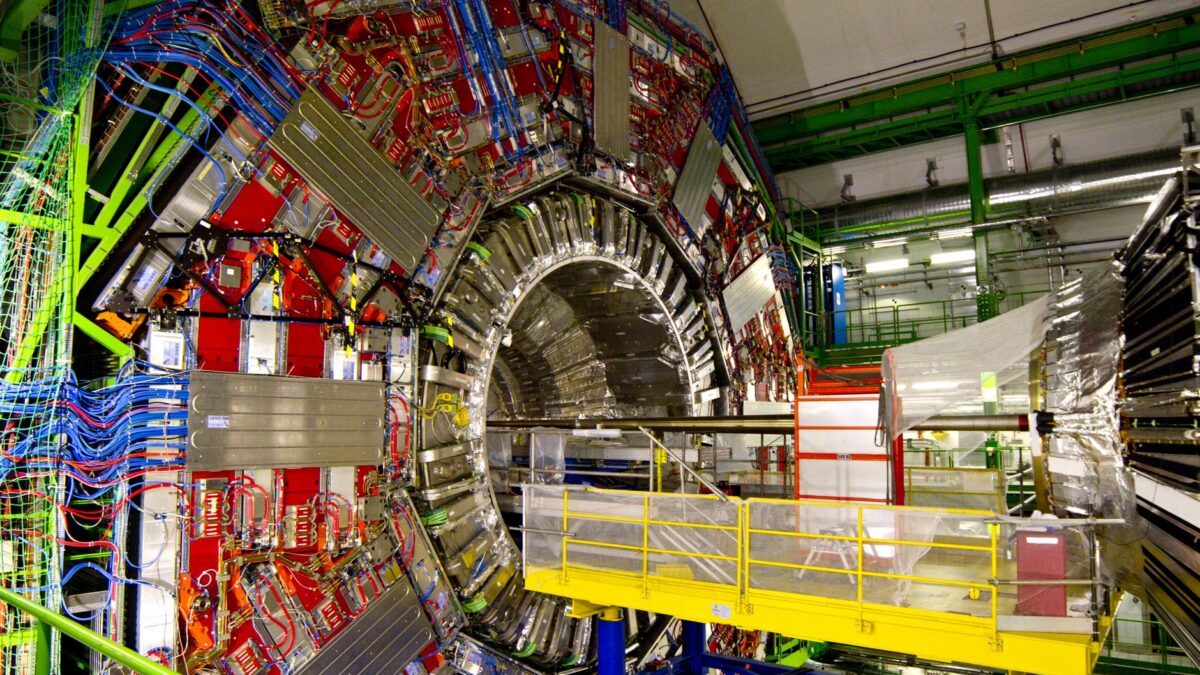
At CERN near Geneva, physicists slow antiprotons in a ring called the Antiproton Decelerator, pair them with positrons to build antihydrogen atoms, and hold those atoms in magnetic traps so they never touch the walls. In 2023 they switched off the trap and watched the atoms fall. They fell down, like ordinary matter.
What exactly is antimatter?
Every known matter particle has an antiparticle with the same mass and opposite charge. An electron has a negative charge; its antiparticle, the positron, has a positive one. A proton is positive; an antiproton is negative. Put an antiproton and a positron together and you get antihydrogen, the simplest anti-atom.
The idea came from theory first. CERN recounts that in 1928 the physicist Paul Dirac wrote an equation combining quantum theory and special relativity that implied a particle like the electron but with opposite charge. In 1932 Carl Anderson found that particle, the positron, in cosmic rays.
| Particle | Charge | Antiparticle | Antiparticle charge |
|---|---|---|---|
| Electron | Negative | Positron | Positive |
| Proton | Positive | Antiproton | Negative |
| Neutron | Neutral | Antineutron | Neutral (opposite internal makeup) |
| Hydrogen atom | Neutral | Antihydrogen atom | Neutral |
What happens when antimatter touches matter?
They annihilate. The particle and antiparticle disappear and their mass is converted into energy, carried away mostly by photons and other short-lived particles. Matter and antimatter are also created together in pairs when enough energy is concentrated, as happens in particle collisions.
CERN notes that annihilation turns mass into energy far more completely than nuclear reactions do, about 50 times more efficiently than fusion. That is why antimatter shows up in science fiction as starship fuel. In reality, CERN says, the amounts that can be made are far too small to be a practical energy source. Fusion itself is covered in our explainer on how nuclear fusion works.
Positrons do have one everyday use: PET scanners in hospitals detect the gamma rays produced when positrons from a tracer annihilate with electrons in the body.
How does CERN make and trap antimatter?
CERN makes antiprotons by smashing a beam of protons into a metal target, then catches some of the antiprotons that fly out. Those antiprotons are far too fast to study, so the Antiproton Decelerator and a second, smaller ring called ELENA slow them down before handing them to experiments in what CERN calls the Antimatter Factory.
The hard part is storing them. Antimatter cannot touch any container, so experiments hold charged antiparticles in electric and magnetic fields inside a near-perfect vacuum. To make antihydrogen, the ALPHA experiment mixes antiprotons with positrons, and because the resulting atoms are neutral, it holds them in a specially shaped magnetic field that grips their tiny magnetism. ALPHA has kept antihydrogen atoms trapped for many hours.
The quantities are minute. According to CERN, antiprotons from the decelerator can be turned into antihydrogen at up to about 3,000 atoms an hour. Even if a whole year of output could be gathered and annihilated at once, CERN says, it would release only a few thousandths of a joule.
Does antimatter fall up or down?
It falls down. In 2023 the ALPHA collaboration reported in Nature (doi.org/10.1038/s41586-023-06527-1) the first direct observation of gravity acting on antimatter. Using a tall, vertical trap called ALPHA-g, the team held antihydrogen atoms and then slowly released them, recording where each atom annihilated against the walls.
More atoms escaped downward than upward, which rules out repulsive “antigravity” for antihydrogen. The measured acceleration was about 0.75 times normal gravity, with uncertainties large enough to include the ordinary value. The precision is still too low to say whether antimatter falls at exactly the same rate as matter, and the team is working on more precise measurements.
Why test something that seemed obvious? General relativity says all objects fall the same way regardless of what they are made of. Antimatter offered one of the few places where that principle had never been checked directly.
Why is there more matter than antimatter in the universe?
No one knows yet. Physics predicts that the Big Bang made matter and antimatter in equal amounts, which should have annihilated each other completely and left a universe of light. Instead a small excess of matter survived. CERN describes the leftover as roughly one extra particle of matter for every billion pairs that annihilated.
Physicists have found small differences in how certain particles and antiparticles behave, but the known differences are too small to explain the imbalance. Experiments at CERN compare antiprotons and antihydrogen with protons and hydrogen in extreme detail, looking for any mismatch in mass, charge, magnetism or the colors of light they absorb. So far they match within the measurement precision.
The universe holds other unexplained ingredients too; see our explainer on what dark matter is, which is a separate puzzle from antimatter.
Bottom line
Antimatter is real, well understood in theory and made routinely at CERN, but only a few atoms at a time. It annihilates on contact with matter, falls down under gravity as far as experiments can tell, and leaves physicists with one of their biggest open questions: why the universe kept matter and lost almost all of its antimatter.
FAQ
Is antimatter dangerous?
The amounts made in labs are far too small to pose any risk. CERN’s yearly output of antihydrogen would weigh a tiny fraction of a trillionth of a gram.
Does antimatter exist in nature?
Yes, in small amounts. Positrons are produced in some types of radioactive decay and in cosmic-ray collisions in the atmosphere, but they annihilate quickly when they meet ordinary matter.
Is antimatter the same as dark matter?
No. Antimatter interacts with light and annihilates with matter, while dark matter is invisible and detected only through gravity. They are unrelated puzzles.
Could antimatter power a spaceship?
In principle annihilation releases enormous energy, but producing even a gram of antimatter is far beyond current technology. CERN says production is far too small for practical energy use.