Pop-Up Turkey Timer: How It Works and Why to Double-Check
A pop-up turkey timer is a spring-loaded stem released by a melting metal alloy. Learn how it works, when it pops and why a thermometer check still matters.
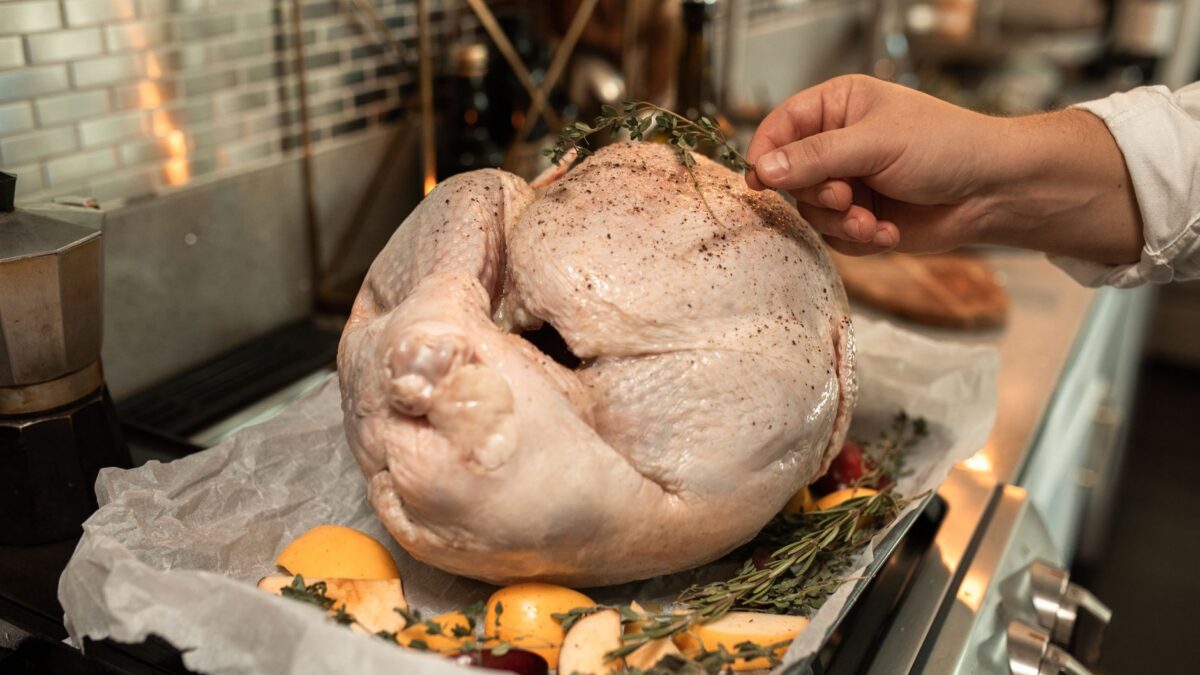
A pop-up turkey timer is a small spring-loaded plastic stem held down by a heat-sensitive metal alloy. When the meat around it gets hot enough, the alloy softens, the spring is released and the stem pops up. The trigger temperature is set at the factory and differs between brands, so the USDA Food Safety and Inspection Service advises checking the bird with a food thermometer as well. The safe minimum internal temperature for turkey is 165°F (74°C).
How does a pop-up turkey timer work?
A pop-up timer works like a one-use thermal switch. Inside the plastic housing, a compressed spring pushes against a stem. A small plug of alloy, similar in spirit to solder, holds the stem down while it is solid.
Alloys melt over a narrow temperature range that depends on the metals mixed together. Manufacturers pick a recipe that softens at their chosen temperature. Once the plug gives way, nothing holds the spring back, and the stem rises and stays up. That is why the timer cannot be reset: the melted alloy does not return to its original shape.
The timer is pushed into the thickest part of the turkey breast, usually before the bird goes into the oven. Only the tip with the alloy sits inside the meat, so the device reads the temperature at that one spot.
When does a pop-up timer pop?
A pop-up timer pops when the meat around its tip reaches the temperature the alloy was built to melt at. That number is fixed by the maker and is commonly in the range of roughly 165°F to 185°F (74°C to 85°C), depending on the product. Some are set above the 165°F food safety minimum, which can leave a breast drier than it needs to be by the time the stem rises.
The clock time varies far more than the temperature. Oven accuracy, turkey size, starting temperature, stuffing, how often the oven door is opened and whether the bird is covered all change how long it takes the breast to get there. A roasting time printed on a package is an estimate, and the timer reacts to actual heat instead.
Is a popped timer proof that the turkey is safe?
A popped timer is a good sign for the breast, but it does not confirm the whole bird is safe. It measures one point. Dark meat in the thighs and the area around the cavity usually heats more slowly than the breast, so the breast can be ready while other parts are still below 165°F (74°C).
The timer is also a single, inexpensive part that can sit in the wrong place or fail. For those reasons, the USDA guidance is to confirm doneness with a food thermometer even when the timer has popped. The FoodSafety.gov site, run by the US government, gives the same 165°F (74°C) target for poultry.
Where do you check a turkey with a thermometer?
Check the temperature in three places: the thickest part of the breast, the innermost part of the thigh and the innermost part of the wing. All three should read at least 165°F (74°C). Here is a simple routine:
- Use a digital instant-read thermometer, and make sure the tip is clean.
- Insert it into the thickest part of the breast, away from the bone, which gets hotter than the meat.
- Repeat in the innermost part of the thigh, near but not touching the bone.
- Repeat in the innermost part of the wing.
- If any spot reads lower, return the turkey to the oven and check again after a short time.
If the turkey is stuffed, the center of the stuffing should also reach 165°F (74°C). Many cooks prefer to bake stuffing in a separate dish for that reason, since it is easier to heat evenly.
Once the turkey is done, let it rest before carving, commonly about 20 to 30 minutes. The meat keeps firming up and the juices settle during that time.
Why does a timer sometimes fail to pop, or pop too early?
A timer that never pops usually sits in the wrong place or is faulty. If the tip is pushed into a pocket of fat, or lands against a cooler part of the bird, the alloy may not get hot enough when the rest of the breast is done. A stem that was stuck from the beginning, or one that was jostled when the turkey was handled, can also behave unpredictably.
A timer that pops early is more often a sign of a hot oven surface or a tip that sits near the edge of the breast, where the meat heats faster. Basting or opening the oven door can shift temperatures around the tip too.
When the timer and the thermometer disagree, go by the thermometer. The thermometer gives a number, and the timer gives only a yes or no at one point.
Quick answers
Can you reuse a pop-up timer?
No. Once the alloy melts and the stem rises, the timer cannot reset. Each turkey needs a new one, or no timer at all.
Do you have to leave the timer in the turkey?
No. The timer is optional, and it is safe to remove it or to cook a turkey without one. Cooks who use a thermometer often pull the plastic out before roasting, and the bird cooks the same.
Why is the timer in the breast and not the thigh?
The breast is the part of a turkey that tends to dry out first, so the timer is placed there to signal when to stop. Because the thigh is slower to heat, a thermometer reading in the thigh is still needed.
What temperature should turkey reach?
Turkey, whole or ground, should reach 165°F (74°C) as measured with a food thermometer. This applies to stuffing cooked inside the bird as well.