Why Do Cranberries Float? Air Pockets and Flooded Bog Harvests
Cranberries float because air pockets inside make each berry less dense than water. Learn how growers use flooded bogs to harvest them and why berries bob.
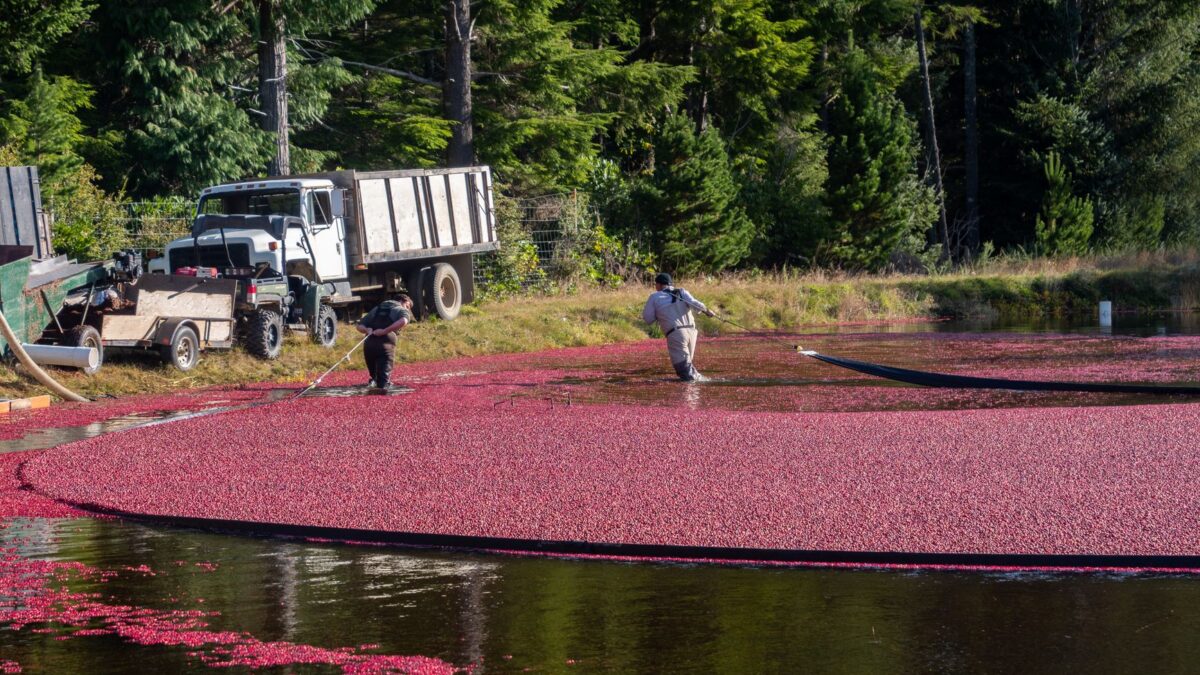
Cranberries float because each berry contains pockets of air, which make it less dense than water. Any object that is less dense than the liquid around it is pushed upward by buoyancy until it rests at the surface. That is why a bag of fresh cranberries bobs in a bowl of water, and why growers can flood a field and watch the crop rise.
The same trait explains the familiar photos of crimson bogs. Growers flood the field only at harvest, shake the berries loose from the vines and let them rise to the surface, where they are easy to gather. Once the water drains, the vines stay put and produce a crop again the following year.
What makes a cranberry less dense than water?
A cranberry has hollow chambers inside, usually four, that hold air around the seeds. The flesh and skin are mostly water and plant tissue, which on their own are close to the density of water. The trapped air lowers the overall density of the whole berry below that of water, so it floats.
Density is mass divided by volume. A berry with the same mass spread over a larger volume (because of the air inside) is less dense. Buoyancy follows from Archimedes’ principle: water pushes up on a submerged object with a force equal to the weight of the water it displaces. When that upward force exceeds the berry’s own weight, the berry rises. The same idea of density at work is explained in why ice floats on water.
Do cranberries grow in water?
No. Cranberries grow on low, trailing, woody vines in beds called bogs or marshes. These beds are built in layers of sand, peat and gravel with drainage, because the vines need acidic, moist soil but do not tolerate sitting in water all year. The fields are flooded only at certain times, and the harvest flood is one of them.
How does a wet harvest work?
In a wet harvest, growers follow a short sequence:
- The bog is flooded with several inches to a foot or so of water, enough to cover the vines.
- Machines called water reels, sometimes nicknamed egg beaters, churn through the water and shake the berries free from the vines.
- The loosened berries float up and form a thick red layer on the surface.
- Floating booms corral the berries into one corner of the bog.
- Conveyors or pumps lift the berries out of the water and into trucks.
Floating makes the job faster than picking by machine on dry ground, since the berries gather themselves in one place. Wet-harvested berries are generally used for juice, sauce, dried cranberries and other processed products, because the churning and soaking make them less suited to selling fresh.
What is a dry harvest, and why is it different?
Berries sold fresh in bags are typically picked dry. A machine with a comb-like head moves over the vines and pulls the berries off, and they are collected without being soaked. Dry picking is slower and the fruit needs to stay intact, but it avoids the water exposure that shortens shelf life.
Why else are bogs flooded?
Harvest is not the only reason. Growers use water on bogs for other tasks, including protecting the vines from winter cold and from frost, and managing some pests. These uses are standard practice in cranberry growing, though how often and how deep varies by region and grower.
How can you see the effect at home?
Place a handful of fresh cranberries in a bowl of water. Whole, firm berries bob at the surface. The air chambers also explain a kitchen habit: when cranberries are heated in a pot, the air inside expands, and the skins split with a small pop. Cooks use that sound as a sign the berries are cooking down for sauce.
As with any fresh produce, rinse berries under running water before use and discard any that are moldy, in line with FoodSafety.gov guidance on handling fresh fruit. For background on how fruit crops are grown and classified in the United States, the U.S. Department of Agriculture is the main federal source.
Quick answers
Do all cranberries float?
Most firm, whole berries do, because of the air chambers inside. Damaged or crushed berries lose some of that trapped air, and berries that are soft or bruised are usually removed during sorting.
Are cranberries grown underwater?
No. The vines grow in drained beds, and flooding is a temporary step used at harvest and for some protection tasks.
Why are cranberries red when they float on a bog?
The red color comes from pigments in the skin of ripe berries. Floating does not change it. It simply brings the whole crop to the surface, where the color is easy to see from above.
Does floating mean a cranberry is fresh?
No. Floating is a result of the berry’s internal air pockets and says little about how fresh it is. Firmness and color are better signs when you buy berries.