CT Scan Turns Up Five 1,500-Year-Old Bronze Vessels, Not Three
Five rare bronze vessels about 1,500 years old, found near Germany's Schlei inlet, go on public view. How a CT scan found two extra pieces in a soil block.
A CT scan of a soil block lifted from a field in northern Germany revealed five bronze vessels about 1,500 years old, where archaeologists had expected three. The rare set is going on public display in Schleswig for the first time, exactly one year after Danish amateur metal detectorists found it near Schaalby, close to the Schlei inlet, HeritageDaily reported, citing the German broadcaster NDR.
The Schleswig-Holstein State Archaeological Office has called the collection a spectacular find of exceptional importance for the wider Baltic Sea region.
How the vessels came out of the ground
After the detectorists’ equipment picked up metal in the ground, archaeologists did not dig right away. They left the fragile objects in place through the winter, and a specialist team came back in early April.
Given the age and condition of the bronze, the team used block recovery. Rather than lifting each vessel on its own, they cut out the whole section of surrounding soil in one piece. The job took two days and let the finds travel without extra risk of damage.
The scan that changed the count
Researchers at the Fraunhofer Institute in Lübeck ran the block through computed tomography (CT), a layered X-ray scan, before any restoration began. The scanner built up images in slices four millimeters apart. Those images showed five vessels, two more than the archaeologists had thought were inside.
The block then went back to Schleswig, to the restoration workshop at Gottorf Castle. There conservator Tina Heintkes-Willers freed each vessel from the earth around it. “You don’t get to work on objects like that very often,” she said. All five were fully uncovered by September.
What was found
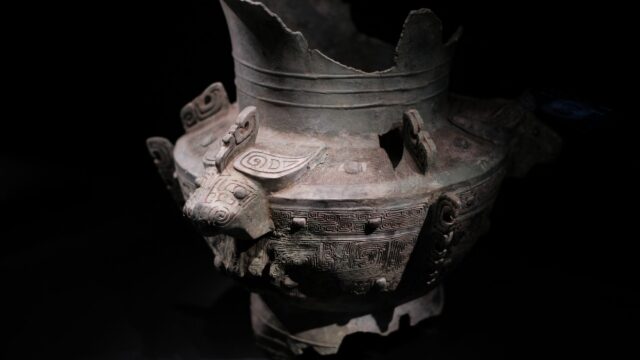
The set includes bowls and cauldrons, some with fine decoration, and a bronze sieve in unusually good condition. Experts at the State Archaeological Office date the objects to between the 3rd and 5th centuries AD, spanning the Roman Imperial and Migration periods.
Several vessels show old repairs. Archaeologists read that as a sign the owners prized them and kept using them after they were damaged.
Why it matters
Finds like this are very rare in Schleswig-Holstein. Heritage authorities say the only comparable one in the state came from Burg, in the Dithmarschen district, where a Roman bronze cauldron turned up in 1869. Angelika Abegg-Wigg, curator at Gottorf Castle’s Museum of Archaeology, described the Schaalby set as extraordinary for the state and unique for the Baltic Sea region.
Bronze vessels of this type were prestige objects at the time, which is one of the few things archaeologists can say with confidence. Why they ended up in the ground is still unclear. They may have been part of a burial offering, or Germanic communities in the area may have hidden them on purpose as a hoard.
Where to see them
The vessels will be on show at the AP Møller School in Schleswig for Archaeology Day on Saturday, in a small exhibition open from 9am until 6pm. Film of the excavation, the block recovery and the restoration will also be screened.
The school is a temporary stop. Once renovation work at Gottorf Castle is finished, the vessels are expected to move to Museum Island in Schleswig as part of the museum’s new permanent archaeology exhibition.
Source: HeritageDaily