Hippos, Ostriches and 5,511 Stone Tools Found at Lost Saudi Desert Lake
A 125,000-year-old lakeshore in Saudi Arabia held hippo fossils and 5,511 stone tools. What the Science study found about life in a once-green Arabia.
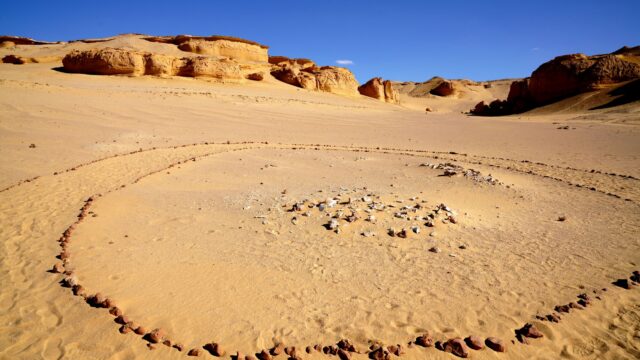
Archaeologists working in southern Saudi Arabia have found 5,511 stone tools, along with the bones of hippopotamuses, ostriches and extinct long-horned buffaloes, on the shore of a lake that dried up long ago. The site, Uruq al-Julaybah in Mundafan, preserves a landscape about 125,000 years old, from a time when parts of the Arabian Peninsula held freshwater lakes and grassland.
The study, published in the journal Science, was led jointly by the Saudi Heritage Commission, King Abdullah University of Science and Technology (KAUST) and Griffith University in Australia, with an international team of specialists.
A lake the size of a city in today’s desert
The finds date to the Last Interglacial, a warm stretch between ice ages when Arabia was much wetter than it is now. Researchers sometimes call this period “Green Arabia.”
Using satellite terrain modeling, the team rebuilt the shape of the ancient lake. It covered roughly 340 square kilometers and, at its largest, was up to 29 meters deep. Sediments, landforms and the remains of water-dwelling life suggest the lake held fresh water fairly steadily and was ringed by plants and open grassland.
The researchers recorded more than 500 plant and animal fossil specimens from over 130 spots across the site. Besides hippos and ostriches, they found camels, Arabian oryx and gazelles.
What the stone tools reveal
The 5,511 artifacts counted from the main study area were all larger than two centimeters, and more than 98 percent were made of flint. The toolmakers used Levallois techniques, a method in which a stone core is prepared in advance so that a flake of a planned shape can be struck off it.
Microscopic and chemical tests on the tools turned up plant residues, including traces from species that may be toxic. Resin and woody tissue on some pieces suggest they were fixed to wooden shafts, possibly as weapon tips. According to the study, the toxic plant compounds could be some of the earliest evidence in Saudi Arabia that such plants may have been used in hunting. The authors present this as a possibility, not a confirmed practice.
Other residues show that people processed tubers, shrubs and palm leaves, likely for food and for practical work such as handling plant fibers. The palm-related plant evidence is among the earliest found in the region.
Why it matters
Most prehistoric sites in Arabia yield scattered traces: a few tools here, some bones there. At Uruq al-Julaybah, tools, animal fossils and plant remains sit together in one securely dated layer. That lets researchers piece together several parts of daily life on the same shoreline: making tools, preparing hunting gear, butchering animals and working with plants.
“This site gives us a rare and richly detailed view,” said Chris Clarkson, a co-lead scientist and professor of archaeology at Griffith University’s Australian Research Centre for Human Evolution. He added that having animal remains, stone tools and plant material in a single dated context is what makes the discovery significant.
Frans van Buchem, a KAUST professor of geology and the other co-lead scientist, credited the collaboration of many different specialists for producing such a complete picture of the distant past.
Arabia as a route, not a barrier
The results add to a growing body of work showing that Arabia was a place early humans lived in, rather than only a desert wall between Africa and Eurasia. In wetter phases, chains of lakes and grassland could have given groups moving through the peninsula the water, food and materials they needed.
Faisal Al-Jibreen of the Saudi Heritage Commission, a specialist in Paleolithic archaeology who took part in the research, said the Mundafan finds help explain how humans, animals and the ancient environment of southern Saudi Arabia were connected. Laurence Hapiot, a co-author and head of heritage research at KAUST, said building heritage science in the kingdom would let researchers draw large stories from very small traces.
Source: HeritageDaily