Annular vs Total Solar Eclipse: Why the Ring Never Gets Dark
An annular eclipse stays bright because the Moon is too small to cover the Sun, so glasses stay on throughout. Totality is the only exception.
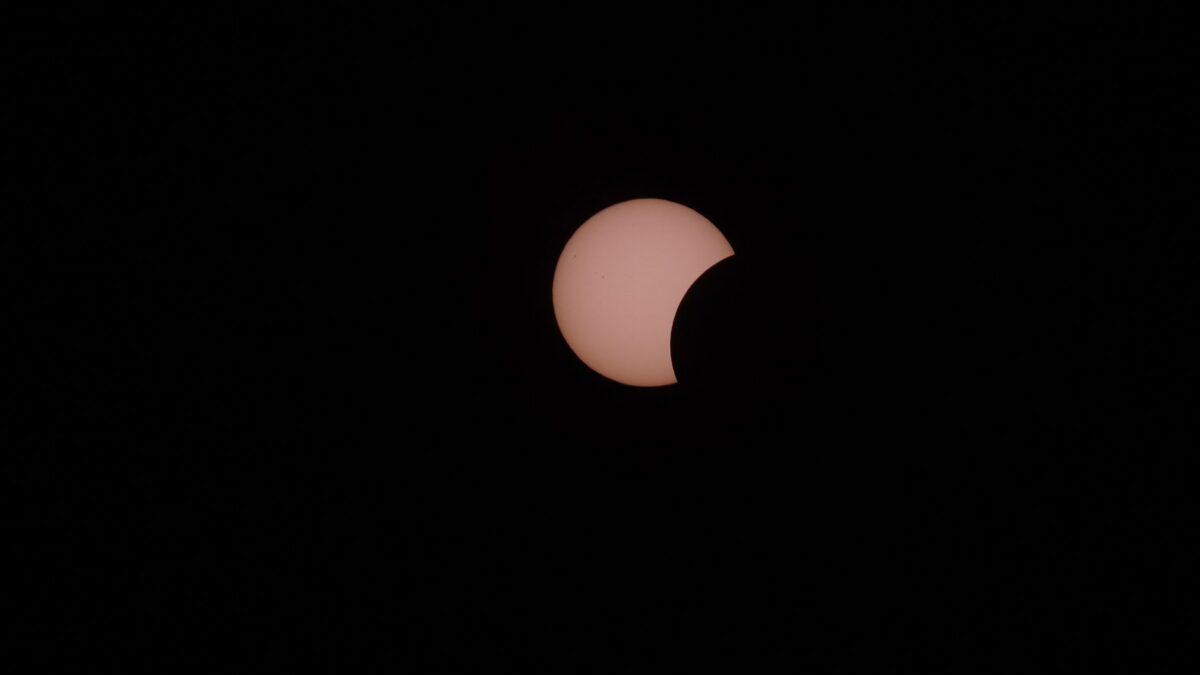
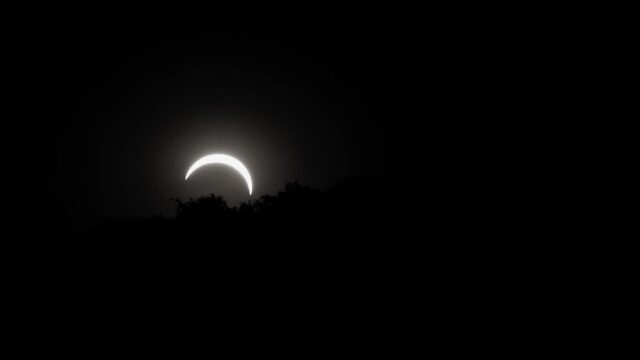
An annular eclipse never gets dark because the Moon is too far away to cover the whole Sun, so a ring of sunlight stays visible around its edge. That ring is why glasses must stay on for every minute of it. In a total eclipse the Moon hides the entire Sun, and only then is it safe to look without a filter.
What makes an annular eclipse different from a total one?
The difference is the Moon’s distance. NASA explains that an annular eclipse happens when the Moon passes between the Sun and Earth while it is at or near its farthest point from us. From there the Moon looks smaller than the Sun, so it appears as a dark disk on a larger bright one, which gives the look of a ring around the Moon.
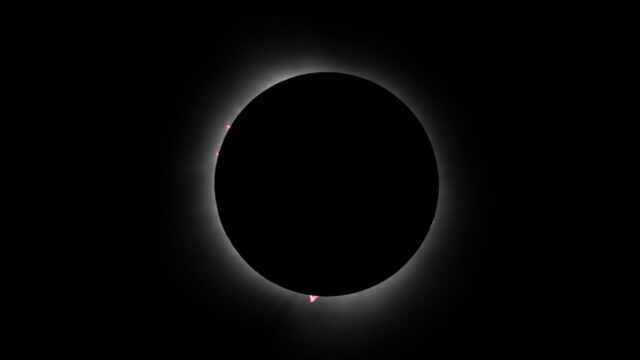
A total eclipse needs the opposite. Time and Date notes that the Moon is about 400 times closer to Earth than the Sun is, which makes the two look roughly the same size in our sky. Only when the Moon is near perigee, its closest point, does its disk look big enough to cover the Sun entirely.
Why does the ring of fire never get dark?
Because the Sun is never fully covered. Even at the maximum point, the outer edge of the Sun is still shining, and that sliver of sunlight is nearly as dangerous as an uneclipsed Sun. The sky dims somewhat, but nothing like the dusk of totality.
The shadow geometry explains the rest. A new Moon casts three kinds of shadow on Earth: the umbra, the penumbra and the antumbra. Annularity is visible only where the antumbra falls. At maximum the width of that path is typically around 150 km (93 mi), although it varies a lot. At the center of the zone you see a perfect ring. Near the edge the ring looks broken, and for a moment you may see Baily’s beads, small blobs of light that appear because sunlight passes through gaps among the mountains and valleys on the Moon’s edge.
How long does each type last?
Annular eclipses can last over 3 hours in places where annularity is visible. The ring phase alone can run from less than a second to over 12 minutes. Totality is far shorter: from a few seconds up to 7.5 minutes. The longest total solar eclipse of the 21st century so far took place on July 22, 2009, with totality lasting 6 minutes and 39 seconds.
Most of the event looks the same for both types. In most places and for most of the duration, an annular eclipse looks like a partial eclipse. The same is true for total eclipses outside the narrow path of totality.
Why must you keep your glasses on the whole time during an annular eclipse?
Since the Sun is never completely blocked, there is no moment when it is safe to look. The American Astronomical Society states that during all phases of a partial or annular eclipse, looking directly at the Sun is safe only through special-purpose solar filters that meet the ISO 12312-2 international standard. Time and Date adds that the Sun’s radiation can burn the retinas and cause permanent damage or even blindness.
The same rule applies outside the path of totality during a total eclipse, and at any other time when no eclipse is happening at all. NASA says the only time viewers can briefly remove their eclipse glasses is the short window when the Moon completely blocks the Sun during totality.
When is it safe to take glasses off during a total eclipse?
Only inside the path of totality, and only while the Sun is fully covered. The AAS advises removing the filter when the Moon completely covers the bright face and it suddenly gets quite dark. As soon as the bright Sun begins to reappear, put the viewer back on. Time and Date warns that even a small amount of direct sunlight can damage your eyes, so you should know how long totality lasts at your location.
What you see in that window explains why people travel for it. Time and Date lists shadow bands about a minute before totality, then the diamond ring about 10 to 15 seconds before and after, then the corona, the Sun’s outer atmosphere, which can exceed 1 million °C (1.8 million °F). A reddish glow from the chromosphere shows for a few seconds right after totality. None of this appears in an annular eclipse.
What counts as a safe viewer?
Ordinary sunglasses do not, even very dark ones, because they let through far more sunlight than is safe. The AAS recommends eclipse glasses or handheld viewers conforming to ISO 12312-2, and it gives a few checks:
- Inspect the filter before use and discard it if it is scratched, punctured, torn or damaged.
- If you wear eyeglasses, keep them on and put the eclipse glasses over them.
- Look away from the Sun before taking the filter off.
- Do not look through an unfiltered camera, telescope or binoculars, and do not stack eclipse glasses over such optics.
- Supervise children using solar filters.
Glasses less than 10 years old, tested to the standard and undamaged can be reused. The AAS calls older warnings about a 3 minute limit or a 3 year age limit outdated for recently made, conforming viewers in excellent condition.
If you have no viewer, project the Sun instead. The AAS describes crossing the spread fingers of both hands to throw a grid of small crescents onto the ground, or using a colander. The step-by-step version is in our guide to pinhole projection. Never look at the Sun through the pinholes. For cameras, filters and exposure choices, see photographing a solar eclipse.
Which eclipses are coming up?
Time and Date lists the next annular solar eclipse for Feb. 6, 2027, and the next total solar eclipse for Aug. 2, 2027. Our guides to the August 2027 path and best places and to the annular eclipse in Portugal and Spain cover timing in specific cities. Visibility depends on your location and the weather.
Where to check
NASA’s eclipse pages and the American Astronomical Society’s eye-safety page keep the viewing rules and supplier guidance current. Time and Date maintains the eclipse calendar and local timing.
Based on the sources linked above, November 2026.
Site editor: Nikita Sheikin