How Earthquakes Are Measured: Magnitude vs Intensity
Why the Richter scale was retired, what a jump from magnitude 6 to 7 really means, and how your own report of shaking ends up on a USGS map.
Earthquakes are measured in two ways. Magnitude is a single number for the size of the quake at its source, and the US Geological Survey (USGS) now uses moment magnitude rather than the old Richter scale. Intensity describes how strongly the ground shook at each place, on the Modified Mercalli scale from I to X and above. Each whole step in magnitude means about 32 times more energy released.
That is why one earthquake has one magnitude but many intensities. A magnitude 6.7 can rattle dishes in one town and crack walls in another, depending on distance, depth and the ground underneath.
What is the difference between magnitude and intensity?
Magnitude measures the earthquake itself; intensity measures its effects at a location. The USGS puts it simply on its page about magnitude, energy release and shaking intensity: magnitude is the size of the earthquake, while intensity varies from place to place, mostly with distance from the fault rupture.
Depth and geology change intensity a great deal. The USGS compares the 1994 Northridge earthquake (M6.7) with the 2001 Nisqually earthquake (M6.8). Northridge was smaller but felt more intensely, because it struck 3 to 11 miles deep while Nisqually was 30 to 36 miles down. During the 1989 Loma Prieta earthquake, bedrock shook least and soft mud shook most.
Why was the Richter scale replaced?
The Richter scale works well only for small, nearby earthquakes, so seismologists replaced it with moment magnitude for most quakes. Charles Richter and Beno Gutenberg defined local magnitude (ML) in 1935 for California earthquakes recorded on a particular instrument, the Wood-Anderson seismograph, within 600 km of the quake.
The problem is large earthquakes. Magnitudes based on the height of seismogram waves can overestimate or underestimate the true size of big ruptures, the USGS explains. Moment magnitude (Mw) is calculated from the physics of the fault instead: the rigidity of the rock times the area that slipped times the average distance it moved. The USGS treats ML as authoritative mainly for small events below about M4.0, and computes a moment magnitude for every M5.0 and larger earthquake worldwide.
News reports still say “Richter scale” out of habit. For a large quake, the number quoted is almost always a moment magnitude.
How much stronger is each step in magnitude?
Each whole number up the scale means waves ten times taller on a seismogram and about 32 times more energy, according to the USGS. The steps multiply, so a magnitude 7 releases roughly 1,000 times the energy of a magnitude 5.
| Magnitude difference | Wave height on a seismogram | Energy released (approx.) |
|---|---|---|
| 1 step (e.g. 5 to 6) | 10 times | 32 times |
| 2 steps (e.g. 5 to 7) | 100 times | 1,000 times |
| 3 steps (e.g. 5 to 8) | 1,000 times | 32,000 times |
Decimal steps matter too. A 6.5 releases nearly six times the energy of a 6.0, which is why the difference between a “moderate” and a “strong” quake can look small on paper. The USGS uses a magnitude 5.3 as its example of a moderate earthquake and a 6.3 as a strong one, and calls quakes of magnitude 8 or more great earthquakes.
How often do big earthquakes happen?
Large earthquakes are common worldwide. The USGS table of global earthquakes for 2000 to 2021 averages out to the counts below; the yearly figures swing widely around them.
| Magnitude | Average per year, 2000–2021 | Range in a single year |
|---|---|---|
| 8.0 and above | About 1 | 0 to 4 |
| 7.0 to 7.9 | About 14 | 6 to 23 |
| 6.0 to 6.9 | About 137 | 104 to 185 |
| 5.0 to 5.9 | About 1,600 | 1,201 to 2,276 |
The largest earthquake ever recorded was a magnitude 9.5 in Chile on May 22, 1960, according to the USGS. The largest in the US was the magnitude 9.2 Prince William Sound earthquake in Alaska on March 28, 1964 (UTC).
What is the Modified Mercalli Intensity scale?
The Modified Mercalli Intensity (MMI) scale ranks shaking at a location from I to X and above, written in Roman numerals. It has no mathematical formula; it is a ranking of observed effects. The lower levels describe how people feel the shaking, and the higher levels are based on damage to buildings, which is why structural engineers usually help assign intensities of VIII or more.
| Intensity | USGS shaking label |
|---|---|
| I | Not felt (except by a very few people in favorable conditions) |
| II to III | Weak |
| IV | Light |
| V | Moderate |
| VI | Strong |
| VII | Very strong |
| VIII | Severe |
| IX | Violent |
| X and above | Extreme |
The USGS describes intensity as a more meaningful measure for most people than magnitude, because it says what actually happened where they were.
How does “Did You Feel It?” work?
“Did You Feel It?” is a USGS web form where anyone can report what they felt during an earthquake. The answers are turned into intensity values and plotted on a map within minutes. Intensity data used to be gathered with postal questionnaires; today most of it comes from these online reports, combined with readings from seismic stations.
The maps show patterns that instruments alone can miss. After the M6.0 Napa, California, earthquake of August 24, 2014, the reports traced how shaking spread across the Bay Area. Filing a report after a quake, even a weak one, adds a data point.
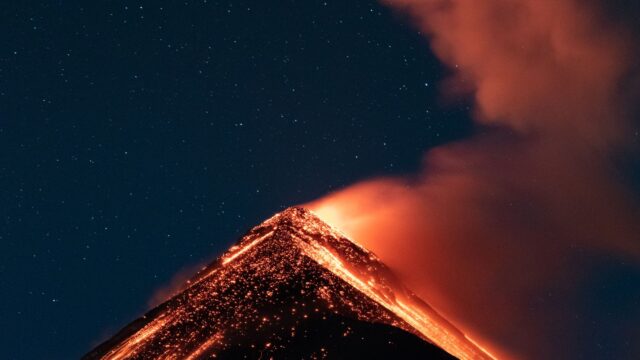
Earthquakes are also closely watched at volcanoes, where swarms of small quakes can mean magma is moving; see why volcanoes erupt. Our guide to supervolcanoes covers what the USGS monitors at Yellowstone.
Bottom line
Magnitude is the size of an earthquake at its source, measured today as moment magnitude; each whole step means ten times the wave height and about 32 times the energy. Intensity, on the Modified Mercalli scale, is the shaking you feel where you are, and it depends on distance, depth and local ground. The USGS builds intensity maps from instruments and from public “Did You Feel It?” reports.
FAQ
Is the Richter scale still used?
Rarely. The USGS uses local (Richter) magnitude mainly for small quakes below about M4.0 and moment magnitude for larger ones. Headlines often still say “Richter scale” by habit.
Is a magnitude 7 twice as strong as a magnitude 6?
No. A magnitude 7 produces waves about ten times taller on a seismogram and releases about 32 times more energy than a magnitude 6.
Why do different agencies give slightly different magnitudes?
Early magnitudes come from the first seismic waves and are refined as more data arrive. Different methods and station networks can give small differences, often a tenth or two.
What is the largest earthquake ever recorded?
The magnitude 9.5 earthquake in Chile on May 22, 1960, according to the USGS. The largest in the US was the magnitude 9.2 Alaska earthquake of 1964.