How Whales Communicate: Humpback Songs, Blue Whale Calls and Codas
Under water, sound carries far better than light. Here is what scientists know about humpback song, blue whale calls and sperm whale codas, and what is still unknown about their meaning.
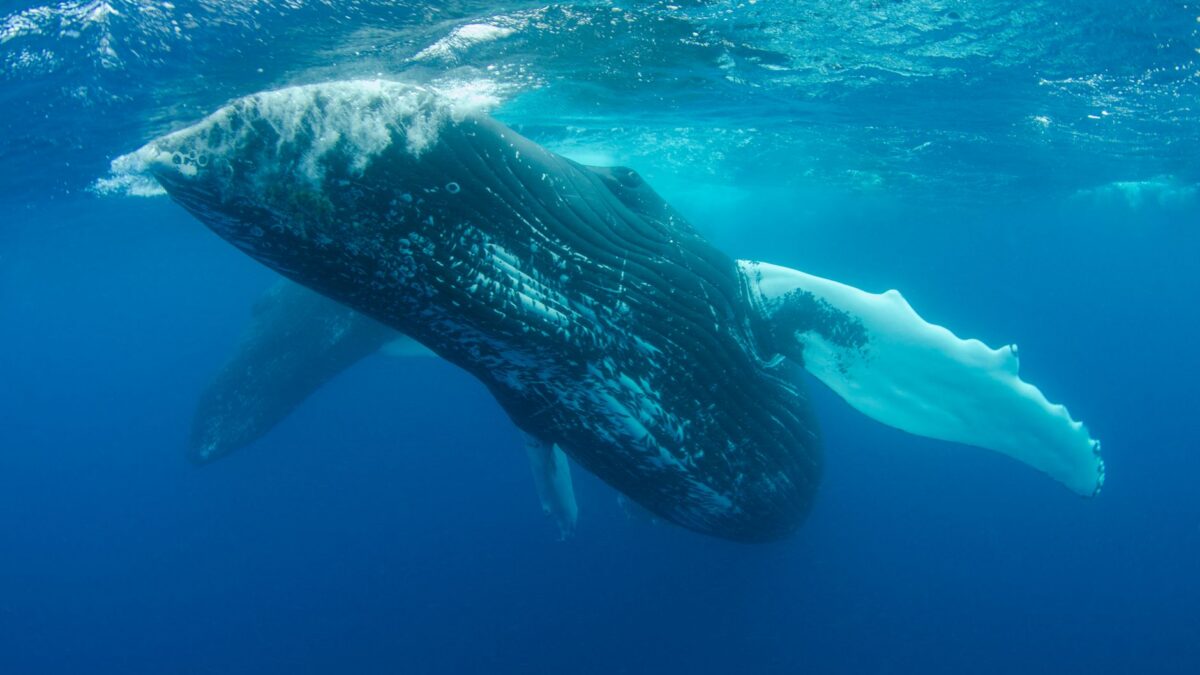
Whales communicate mainly with sound, because sound travels far better than light through seawater. Male humpback whales sing long, structured songs that change over time and can spread from one population to another. Blue whales make low-frequency calls that NOAA says other whales may hear up to 1,000 miles away in the right conditions, and sperm whales talk in patterned bursts of clicks called codas.
Scientists can record and map these sounds in detail. What the sounds mean is a much harder question, and for most calls it is still open.
Why do whales use sound instead of sight?
Sunlight fades to almost nothing below a few hundred meters, and murky water limits sight even near the surface. Sound, on the other hand, travels long distances in water, especially at low frequencies. NOAA describes a layer of the ocean called the SOFAR channel, where changes in temperature and pressure trap sound and guide it like a pipe, so signals can carry for hundreds of miles.
Whales use sound for at least three jobs: keeping in touch with others, finding mates, and, for toothed whales such as sperm whales and dolphins, finding prey and obstacles with echolocation. Some sounds may serve more than one purpose.
Why do humpback whales sing?
Only male humpback whales sing, and the song is linked to courtship and mating, according to the University of Queensland team that has studied it in the South Pacific for decades. A humpback song is not a single call. It is a sequence of sounds arranged into repeated phrases and themes, and a singing male repeats the whole song over and over.
All the males in one population sing roughly the same song at the same time. The song changes over time, and the males change it together. Exactly why males sing, whether to attract females, to compete with other males, or both, is still debated among researchers.
How do humpback songs spread across the ocean?
Humpback songs can travel between populations like popular music. A 2011 study in the journal Current Biology, led by researchers at the University of Queensland, analyzed recordings from six South Pacific populations over 11 years, from eastern Australia to French Polynesia. The team found 11 distinct song types that typically started in the eastern Australian population and spread east, island group by island group, usually taking about two years to cross the region, according to the university’s release.
The researchers linked the west-to-east direction to population size: eastern Australia has the largest group, so its song may carry more weight. How exactly a song jumps between groups is not known. A few males may move between populations, or whales may hear new songs on shared migration routes or feeding grounds. Researchers treat it as a form of cultural transmission: whales learning songs from other whales rather than inheriting them.
Long migrations are part of the story. We look at how whales and other animals find their way across oceans in how animals navigate.
How loud and far do blue whale calls travel?
Blue whales, the largest animals known, are also among the loudest animals on the planet, according to NOAA Fisheries. Their calls are long, low pulses, groans and moans. The NOAA Fisheries species page says these sounds can be heard by other whales up to 1,000 miles away under the right ocean conditions.
The low pitch is the reason. Low-frequency sound loses very little energy as it travels, so a call made in one part of an ocean basin can be picked up far away. NOAA hydrophones listen for these calls around the world.
What are sperm whale codas?
Codas are short, patterned bursts of clicks that sperm whales exchange when they are together, a bit like Morse code. Sperm whales also make other clicks to echolocate while hunting in the deep sea.
In 2024, a team working with Project CETI and the Dominica Sperm Whale Project published an analysis of 8,719 codas recorded from families of the Eastern Caribbean clan off Dominica. The paper, in Nature Communications, found that codas vary in four features that can be combined: rhythm, tempo, “rubato” (small stretches in timing) and “ornamentation” (an extra click added to a known coda). The authors call this combination a sperm whale “phonetic alphabet.”
That label describes structure, not meaning. The Project CETI release says the communicative function of many codas remains unknown. Different sperm whale clans also use different sets of codas, which researchers treat as a kind of vocal identity.
| Whale | Main sounds | What scientists know |
|---|---|---|
| Humpback whale | Long songs (males); calls in groups | Songs change over time and spread between populations |
| Blue whale | Very low, long calls | Among the loudest animals; may be heard up to 1,000 miles away (NOAA) |
| Sperm whale | Echolocation clicks and codas | Codas combine rhythm, tempo, rubato and ornamentation; meaning largely unknown |
How do scientists record whale sounds?
Researchers listen with hydrophones, underwater microphones that can be lowered from boats, moored on the seafloor for months, or carried by autonomous gliders. NOAA Fisheries runs passive acoustic monitoring programs that use arrays of hydrophones to track where and when different species are calling.
For close-up work, scientists attach suction-cup tags that record sound, depth and movement from a single whale for hours, then float free to be collected. Matching sounds with behavior, such as who is calling, who answers and what the group does next, is how researchers try to work out meaning. Machine learning now helps sort through recordings too large for people to review by ear.
Human noise is part of what they measure. Ship engines, sonar and construction add low-frequency sound to the same range that large whales use, and NOAA studies how that noise affects marine life.
Bottom line
Whales communicate with sound because it travels far under water. Male humpbacks sing changing songs that can spread across an ocean in about two years, blue whales send low calls that may carry up to 1,000 miles, and sperm whales exchange click codas with a combinable structure. Scientists can describe these sounds in detail, but what most of them mean is still unknown.
FAQ
Do female humpback whales sing?
No. Studies of humpback song report that only males sing the long, structured song. Females and calves make other calls and social sounds.
Do whales have names?
There is no confirmed evidence that large whales use individual names. Some studies of dolphins point to signature whistles, but for sperm whale codas, researchers have not shown that any coda labels a single animal.
Can people hear whales without equipment?
Sometimes. Divers and snorkelers in humpback breeding areas often report hearing song in the water. Most whale sounds, though, are studied through hydrophone recordings.
Where can I listen to real whale recordings?
NOAA and its national marine sanctuaries publish recordings from their hydrophones online, including humpback song and blue whale calls. Some research groups also stream live underwater audio.