Aerial Photos Reveal Interlocking Stone Circles in Saudi Arabia
Aerial photos show overlapping rings of volcanic rock on Saudi Arabia's Red Sea coast. Their age and purpose are still unknown.
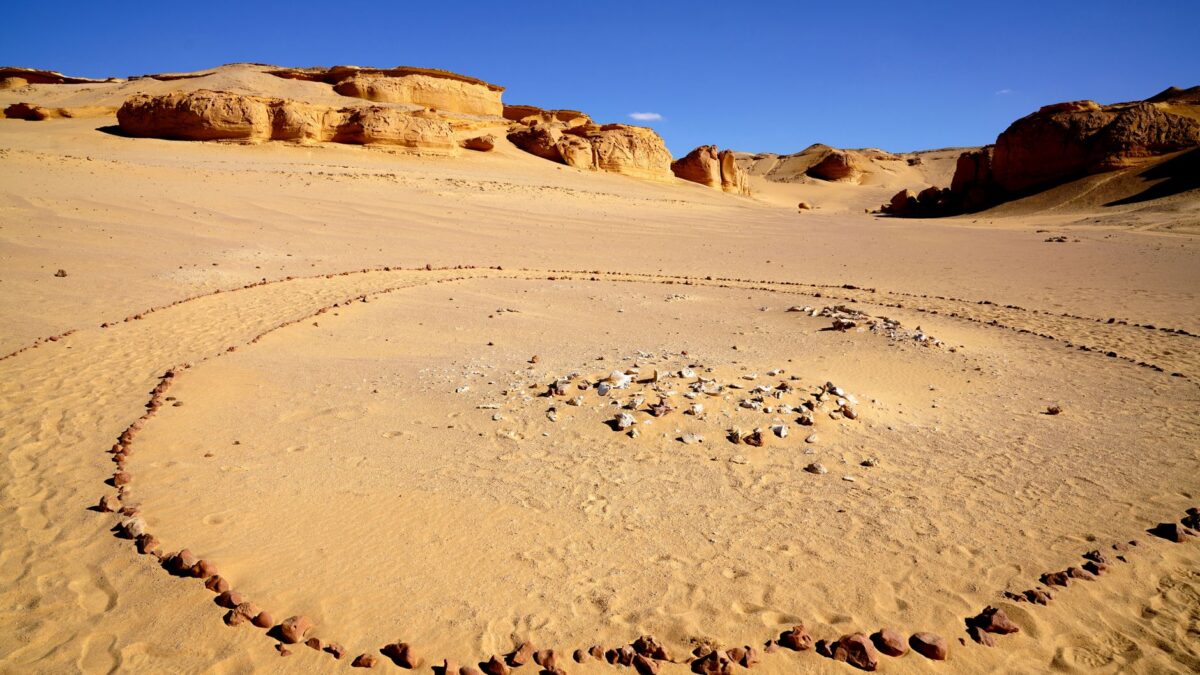
Photographs taken from the air show a group of overlapping stone rings in southwestern Saudi Arabia. Their builders, their age and their purpose are all unknown, according to a HeritageDaily report that draws on Arab News.
The site is near Hali, in Al-Qunfudhah Governorate along the Red Sea. The rings vary in size and were laid out with volcanic rock from the surrounding area. Where they cross one another, they form geometric designs on the ground.
How the circles were spotted
Standing among the stones, a visitor would struggle to see the designs. From the air the layout is obvious, and that is how the formations came to attention. Nobody has reported digging at the site or dating it, so the whole picture so far rests on images of what lies on the surface.
Dr. Mohammed Al-Marhabi, a historian and researcher, spoke to the Saudi Press Agency. In his view the stones were put in place on purpose and did not land in these positions by chance.
What the circles might have been for
Al-Marhabi does not think the rings are leftovers of homes or graves. His suggestion is that people built them to follow the seasons, the weather or the motions of stars and other bodies in the sky.
He also raised the possibility that local customs of tracking the seasons and keeping calendars could shed light on the site. Whether those customs relate to the circles is unsettled, and no evidence yet backs the idea of a sky, weather or seasonal function.
Hali belongs to the Tihamah region of Makkah Province, where people have lived for a long time. A fertile valley there once fed communities on the Red Sea coastal plain, and the area had historical ties to Makkah.
How other Saudi stone structures compare
Ancient stonework is already well documented in the country, although monuments that look alike were not always built for the same reasons. Around AlUla in the northwest, excavators found round stone foundations dating to the sixth and fifth millennia BC. Each spans roughly four to eight metres and belonged to a Neolithic house. Standing stone slabs braced wooden posts, and those posts carried the roof. The diggers also recovered tools, animal bones and jewellery, plus signs that people made crafts and traded.
Further north at Khaybar Oasis, a team unearthed Al-Natah, a Bronze Age village covering around 2.6 hectares. People lived there between approximately 2400 and 1500 BC. Narrow paths joined its living quarters to its burial areas, some buildings seem to have risen above a single storey, and a large stone wall ringed the oasis.
No evidence ties the Hali rings to the Neolithic houses at AlUla. Set side by side, though, these finds show the range of stone building in ancient Arabia.
Why it matters
If the rings prove to be a form of ancient architecture not recorded elsewhere on the Arabian Peninsula, they would add a new type of formation to the region’s archaeology. That has not been established.
Fieldwork is the next step. Archaeologists would need to examine the site closely to learn when the rings went up and whether they had a practical use, a symbolic meaning or a link to watching nature. Scientific dating after excavation is the only way to give them an age.
Source: HeritageDaily