How Eclipse Times Are Predicted: Delta T and Lunar Mountains
Eclipse paths are predicted to within 0.4 kilometers, but Delta T and lunar mountains can shift contact times by seconds. Here is how the math works.
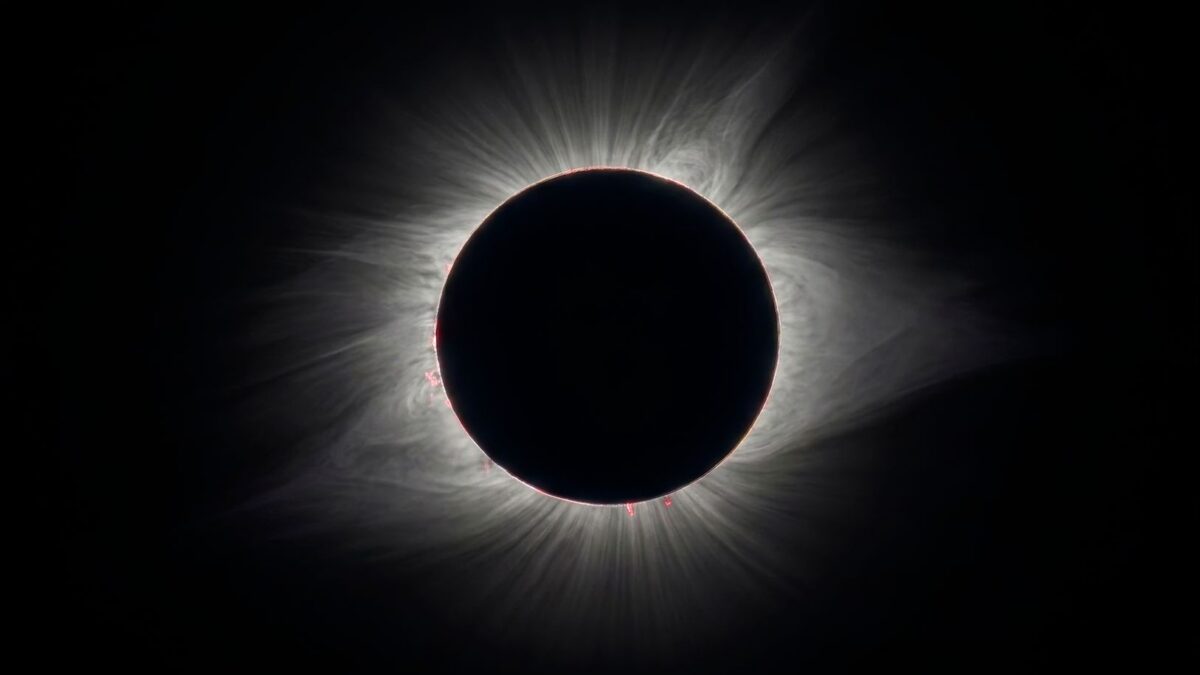
Eclipse predictions are built from three layers: a geometric model of the Moon’s shadow, a correction for Earth’s slowing spin, and, for the finest timing, a map of the Moon’s edge. The first two fix where the shadow lands. The third explains why a published contact time can still miss by a few seconds.
The orbits themselves are not the weak point. According to NASA’s eclipse site, the Jet Propulsion Laboratory ephemeris known as DE405 gives Sun and Moon positions with errors below 0.1 arc-seconds, which lets astronomers place the path of a solar eclipse on Earth’s surface to 0.4 kilometers or better.
What are Besselian elements?
They are a compact set of values that describe how the Moon’s shadow moves, a method developed in the 1820s by the German mathematician and astronomer Friedrich Bessel and later improved by William Chauvenet, as the Wikipedia article on Besselian elements explains. Instead of tracking the shadow in space, the method follows it on a “fundamental plane”: a plane through Earth’s center that sits perpendicular to the line joining the centers of the Sun and Moon.
This choice keeps the arithmetic simple. On that plane the outline of the shadow is always a circle, with no perspective distortion. Only a comparatively small number of values is needed to describe its motion. The next step projects the shadow cone onto the real Earth, using the planet’s shape, its rotation and the observer’s latitude, longitude and elevation. The result is the path of the umbra (the darkest shadow) and the penumbra (the lighter outer shadow), and from them the circumstances at any chosen town.
What is Delta T, and why does it matter?
The Besselian elements settle the geometry of an eclipse, but which longitudes see it depends on how far Earth has turned. Astronomers compute eclipses in Terrestrial Time, an atomic time scale that works like an ideal clock. People live by Universal Time, which follows Earth’s rotation. Delta T (written ΔT) is the gap between them: Terrestrial Time minus Universal Time, as Wikipedia’s entry on ΔT defines it.
Earth’s spin is slowing because the Moon’s gravity creates tidal friction. NASA’s Delta T page puts the lengthening of the day at about 0.002 seconds per day per century. That sounds trivial, yet a real Earth would fall about one minute behind a fictional Earth turning at a constant rate after just one century. Wikipedia lists a second, opposing effect: melting ice sheets ended their weight on polar land, which is still rebounding and pulling mass toward the spin axis.
The size of the gap has been measured and, for the distant past, reconstructed. ΔT was about 64 seconds in 2002. Since early 2017 it has stayed within half a second of 69 seconds. Going back, NASA gives smoothed values from historical eclipse records, based on work by Morrison and Stephenson published in 2004:
- Year 1500: 200 seconds, a longitude shift of 0.8°
- Year 1000: 1570 seconds, 6.5°
- Year 0: 10580 seconds, 44.1°
- Year -500: 17190 seconds (4 hours 47 minutes), 71.6°
The longitude shift is the point for predictions. A wrong ΔT moves the whole eclipse path east or west on the map. NASA notes that Earth’s rotation also fluctuates over decades, possibly because of fluid motions in the core, climate and sea-level changes, and that these effects cannot be predicted with current knowledge. For that reason, values far in the past or future are extrapolated and grow more uncertain the further out they go.
How do the Moon’s mountains change the timing?
With the orbits and ΔT in hand, the largest remaining error comes from the Moon’s own edge. Seen in profile, the lunar limb is rugged, and some features depart from a perfectly round Moon by about ±3 arc-seconds. According to NASA, that is nearly ±6 kilometers, using 1.863 km per arc-second at the Moon’s mean distance of 384,400 km.
Most calculations use a mean lunar radius that averages peaks and valleys together. That is acceptable for many purposes, but it adds uncertainty of several seconds to contact times and to the length of totality or annularity. The effect is largest near the edges of the path, where the geometry is most sensitive.
How accurate can a prediction get?
NASA describes the standard fix. In the 1950s C.B. Watts of the U.S. Naval Observatory measured heights along the Moon’s edge in thousands of photographs, and the resulting limb charts were later digitized. Corrections for the datum’s slight ellipticity and for libration (the Moon’s apparent rocking) can be applied. With Watts data, predicted and observed contact times and durations agree to better than 0.5 seconds. Without the correction the error can reach 2 to 3 seconds, and more near the path limits.
Newer data from the Kaguya and Lunar Reconnaissance Orbiter missions can improve contact times and durations to about 0.2 seconds. NASA adds that such corrections are mostly needed for scientific timing work, which is why general eclipse tables often skip them.
How big is the catalog these methods produce?
The NASA publication Five Millennium Canon of Solar Eclipses applies this machinery from -1999 to +3000. It lists 11,898 eclipses of the Sun in that span: 4,200 partial, 3956 annular, 3173 total and 569 hybrid. It states that the largest uncertainty in its predictions comes from fluctuations in Earth’s rotation, expressed as ΔT.
When you read local times for a specific eclipse, such as our London times and nearest totality guide or the Luxor totality times, the figures come from this kind of calculation. Totality length can differ by a second or two between sources depending on which lunar limb data they use.
Where to check
NASA’s eclipse pages at Goddard keep the ΔT tables, limb-profile notes and the Five Millennium Canon current.
Based on the sources linked above, November 2026.
Site editor: Nikita Sheikin