Why the Aug. 2, 2027 Eclipse Is So Long: Saros 136 Explained
Totality on Aug. 2, 2027 lasts up to 6 minutes 23.2 seconds. A large Moon, a far Sun and the Saros 136 series explain why, with the series records.
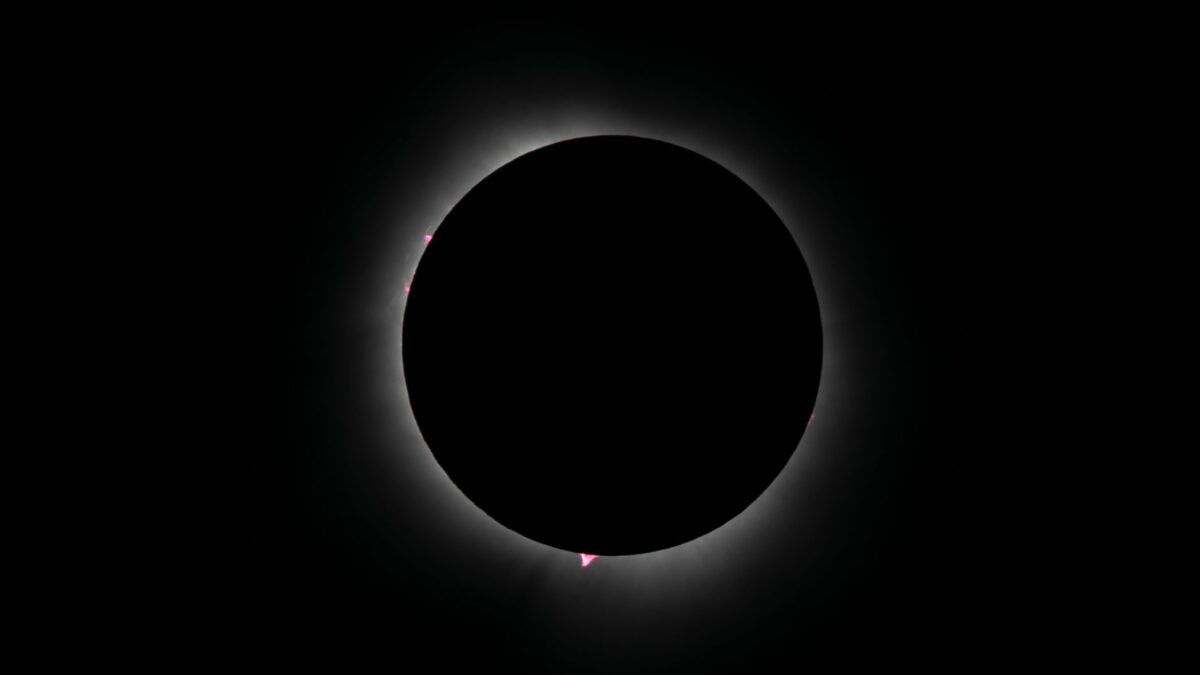
The total solar eclipse of Aug. 2, 2027 is long because three things line up at once: the Moon looks much bigger than the Sun, the Sun looks a little smaller than usual, and the Moon’s shadow falls close to the middle of the sunlit side of Earth near the tropics. NASA lists up to 6 minutes 23.2 seconds of totality on the central line, the longest a total eclipse will run over land for years. The eclipse belongs to Saros 136, the family of eclipses that has produced the longest totalities of the past century.
How long does totality last on Aug. 2, 2027?
On the central line, totality peaks at about 6 minutes 23 seconds, and the exact figure depends on which table you read. The NASA path table for the 2027 eclipse gives 06m23.2s for points on the central line around 10:00 and 10:02 UTC, over southern Egypt. The series list on the Wikipedia page for Solar Saros 136 gives 6 minutes 22.64 seconds at greatest eclipse, 10:07:50 UTC, at 25.5 degrees north and 33.2 degrees east. The two figures describe slightly different points and calculations, so they differ by a fraction of a second.
Totality is much shorter at the start of the track. Where the shadow first touches Earth at sunrise over the Atlantic, the central line gets 03m06.1s. By 08:48 UTC, near the Strait of Gibraltar, NASA lists 04m53.8s, and the duration keeps growing as the shadow moves east across North Africa. Our guides to totality times in Gibraltar and the long totality over Luxor give local times.
Why does a big-looking Moon make totality longer?
A Moon that looks larger than the Sun covers the solar disk with room to spare, so it takes longer to slide across. Most solar eclipses cannot be total at all, the Wikipedia article on eclipse cycles explains, because the Moon’s apparent size is too small to hide the Sun completely unless the Moon is around perigee, the closest point of its orbit, when it looks larger than average.
On Aug. 2, 2027 the Moon is close to Earth. NASA’s path table lists the ratio of the Moon’s apparent diameter to the Sun’s at 1.079 along the middle of the track. The Wikipedia table gives the eclipse a magnitude of 1.07903. A wider shadow follows from the larger Moon: the path of totality is 257.7 km wide at greatest eclipse in the series list, and NASA’s table shows widths of up to 258 km.
Where does the Sun near aphelion come in?
Earth is farthest from the Sun, at aphelion, in early July, and from there the Sun looks slightly smaller in the sky. A smaller Sun is easier for the Moon to cover, which adds a little more time to totality. The eclipse cycle article notes that Earth is near aphelion from June to July and that a Saros series repeats with Earth at nearly the same distance from the Sun each time.
Saros 136 eclipses have fallen in this part of the year for decades. Members of the series came on June 20, 1955, June 30, 1973, July 11, 1991 and July 22, 2009, and the 2027 eclipse falls on Aug. 2. Each one lands about 11 days later in the calendar than the one before, so the series is now drifting past aphelion and its eclipses are getting slightly shorter.
Why does the shadow’s position on Earth matter?
A shadow that falls near the center of the sunlit hemisphere, close to the tropics, stays over each spot longer. There the shadow is closest to Earth’s surface, and the ground is moving east fast because of Earth’s rotation, so it partly keeps pace with the shadow, which also moves east.
Astronomers measure how close the shadow passes to Earth’s center with a number called gamma, which shows how far north or south of the ecliptic the Moon is during the eclipse. A value near zero means a direct hit on the center. For 2027 the series table gives a gamma of 0.14209. In 1991 it was -0.00412, almost dead center, which is one reason that eclipse ran 6 minutes 53.08 seconds. The Sun stands 82 degrees above the horizon at the longest point of the 2027 track, according to NASA, nearly overhead.
What is Saros 136?
Saros 136 is one family of solar eclipses that repeats every saros, about 6,585.3 days, or 18 years 11 days 8 hours. According to the NASA catalog of Saros 136, eclipses one saros apart happen at the same node of the Moon’s orbit, with the Moon at nearly the same distance from Earth and at the same time of year. That is why they look so alike.
- The series began with a partial eclipse in the southern hemisphere on 1360 Jun 14 and will end with a partial eclipse in the northern hemisphere on 2622 Jul 30, a span of 1262.11 years.
- It has 71 eclipses: 15 partial, 6 annular, 6 hybrid and 44 total.
- All of its eclipses happen at the Moon’s descending node, and the Moon moves northward with each one.
- Its longest total eclipse was on June 20, 1955, at 7 minutes 7.74 seconds by Wikipedia’s figure (NASA rounds it to 07m08s).
The northward drift shows in the coordinates of greatest eclipse. The 2009 eclipse peaked at 24.2 degrees north over the western Pacific, at 144.1 degrees east, and the 2027 eclipse peaks at 25.5 degrees north over Egypt. Each member also shifts westward around the globe because of the extra 8 hours in the saros period.
Is the 2027 eclipse the longest of the century?
It is not. The longest total eclipse of the 21st century was the Saros 136 eclipse of July 22, 2009, at 6 minutes 38.86 seconds, Wikipedia reports. The page says this series is producing the longest total eclipses of any active series and will produce the three longest total eclipses of the 21st century. It also produced the six longest total eclipses of the 20th century, three of them over seven minutes.
The next member, on Aug. 12, 2045, is listed at 6 minutes 5.71 seconds, and the durations keep shrinking after that. Wikipedia says Saros 139, whose eclipses are getting slightly longer, will overtake Saros 136 on May 11, 2078. Saros 136 took the title from Saros 133 with its eclipse of May 18, 1901.
Quick answers
What time is greatest eclipse on Aug. 2, 2027?
Greatest eclipse is at 10:07:50 UTC, over Egypt at 25.5 degrees north and 33.2 degrees east, per the Wikipedia series table. Local times are in our guide to totality in Cairo, Aswan, Hurghada and Luxor. What you see depends on your location and the weather.
Why is totality short at the start of the path?
At sunrise the shadow strikes Earth at a steep angle and moves fast across the ground, so the central line there gets only 03m06.1s, per NASA. Totality grows as the shadow moves toward the point where the Sun is high overhead.
How often does a total solar eclipse happen?
Somewhere on Earth, about every 18 months on average, according to the eclipse cycle article. Any single place sees one far less often.
Checked against official sources in November 2026. Hours, prices and rules change: confirm on the official page before you go or apply.