Webb Watches Two Stars in Andromeda Merge After Just 7 Orbits
Astronomers followed two stars in the Andromeda Galaxy from first brightening to merger, a first for a common envelope event, using Webb and other telescopes.
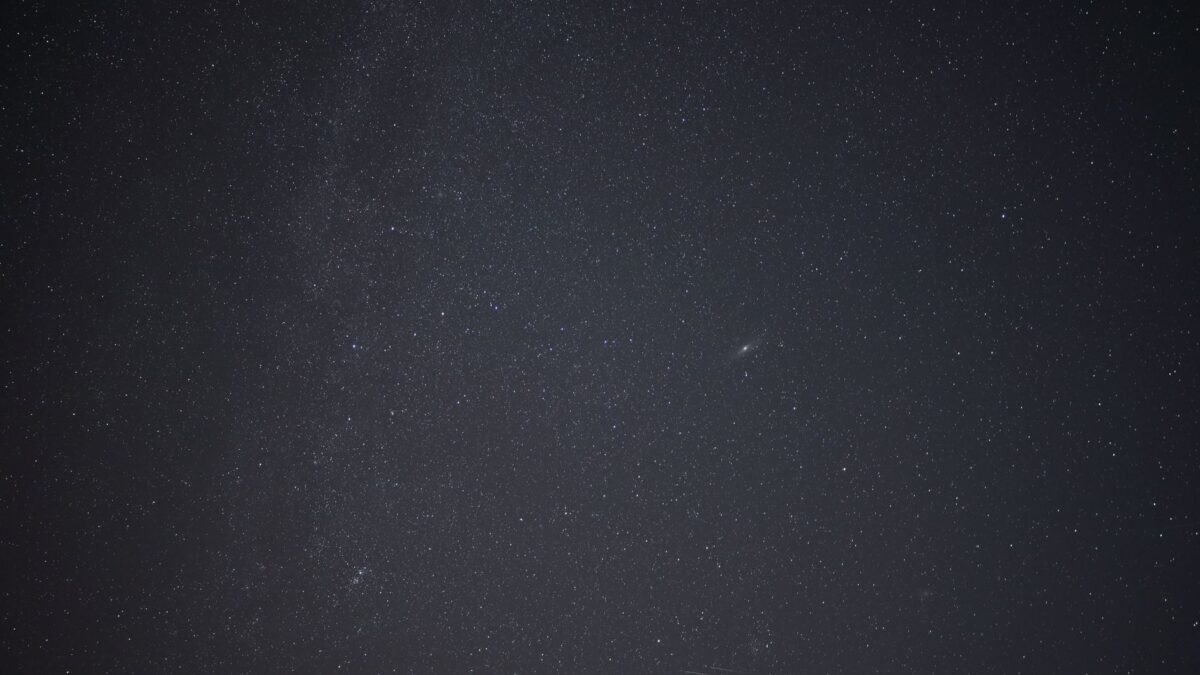
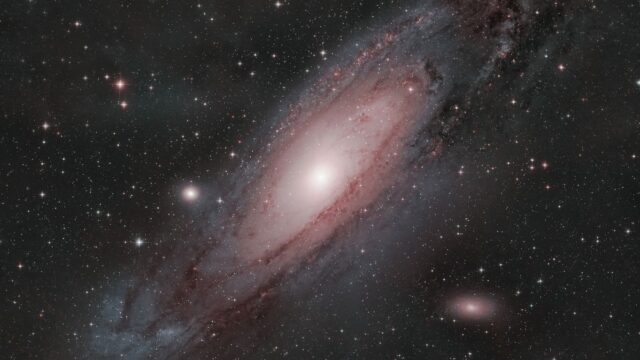
Astronomers have watched two stars in the Andromeda Galaxy spiral together and merge, following the event from its early warning signs through the eruption. The object, named AT 2025abao and nicknamed Bao, is the first case where a classical “common envelope” merger was monitored continuously from its onset to its culmination, according to a new paper in Nature led by Viraj Karambelkar of Columbia University.
The pair merged after only 7 orbits, about 7 years. Stars in such systems normally circle each other for thousands of years with little change, and take thousands of orbits to merge once they interact.
What a common envelope is
Many stars have a companion. When one star swells and overflows its Roche lobe (the region where its own gravity dominates), gas piles onto the other star. The process becomes unstable and both stars end up inside one shared cloud of gas, the common envelope. Drag from that gas pulls them closer together.
Two outcomes are possible. If the envelope is thrown off quickly, the stars remain as a tight binary. If it lingers, the drag keeps tightening the orbit until the stars merge and flare as a luminous red nova. Such mergers are hard to catch because they are rare and difficult to predict.
How Bao unfolded
Observations of the system go back to 2018. Until early 2025 it slowly brightened in optical light. It then faded in optical light while its infrared light kept rising. In October 2025 it erupted, brightening by 100 times in the r-band over 25 days, with its temperature jumping to about 8000 Kelvin. It then held a plateau for about 80 days while cooling to about 3000 Kelvin.
The James Webb Space Telescope observed Bao only 47 days after the eruption peaked, the earliest follow-up of an event like this. Karambelkar said the team had noticed something unusual in 2023 and kept watching. Kishalay De, a Columbia assistant professor, described the early slow brightening as the companion beginning to touch the primary star’s outer surface and peel away its layers.
NASA’s SPHEREx near-infrared observatory also caught the star in July 2025, during its rapid optical fading, giving a clear look at the star’s surface. Combined with simulations of common envelope evolution, led by Radboud University doctoral student Karel Temmink, that let the team estimate the masses of the two stars.
The two stars
The primary was seven times as massive as the Sun, with a radius 350 times larger and a brightness 18,000 times that of the Sun. Temmink called it “an absolute beast of a star.” The companion had about 0.7 solar masses, roughly one-tenth of the primary’s mass, and was far smaller and dimmer. The team calls them Big Bao and Little Bao.
Why it matters
Astronomers have so far reconstructed common envelope events after the fact. Bao also differs from known luminous red novae, whose primary stars are on the main sequence. Its primary was an evolved AGB star with an extended convective envelope, which is what classical theory predicts for this kind of event.
Only a few dozen luminous red novae have been detected. The Vera Rubin Observatory’s Legacy Survey of Space and Time is expected to find hundreds, possibly thousands, and the Nancy Grace Roman Space Telescope will detect some as well. The authors say their end-to-end observations show a path toward mapping the outcomes of common envelope evolution with those surveys. What the merged star looks like now will need further observations.
Source: Universe Today
Site editor: Nikita Sheikin