How Hearing Works and Why Loud Noise Damages It for Good
Hearing turns air vibrations into nerve signals using tiny hair cells in the inner ear. Loud noise destroys those cells, and they do not grow back in people.
Hearing works by turning pressure waves in the air into electrical signals in the auditory nerve. The outer ear funnels sound to the eardrum, three tiny bones pass the vibration to the fluid-filled cochlea, and sensory hair cells inside the cochlea convert that motion into nerve signals the brain reads as sound. Loud noise damages hearing because it overworks and kills those hair cells, and in humans dead hair cells do not grow back.
The result is noise-induced hearing loss, which is permanent but largely preventable. The National Institute on Deafness and Other Communication Disorders (NIDCD) says long or repeated exposure to sounds at or above 85 decibels can cause it.
What is sound, physically?
Sound is a series of pressure waves moving through air, water or solids. A vibrating object, such as a guitar string or vocal cords, pushes on nearby air molecules, which push on their neighbors. Two properties matter most for hearing:
- Frequency, measured in hertz (Hz), is how many waves pass each second. We hear it as pitch. Young, healthy ears pick up roughly 20 Hz to 20,000 Hz, and the upper limit drops with age.
- Intensity, measured in decibels (dB), is how strong the pressure changes are. We hear it as loudness.
The decibel scale is logarithmic. Every 10 dB step means about ten times more sound energy, so 90 dB carries far more energy than 80 dB, even though the numbers look close.
How does the ear turn sound into signals?
The ear has three parts, and each one does a separate job.
- The outer ear (the visible flap and the ear canal) collects sound and channels it to the eardrum, a thin membrane that vibrates when pressure waves hit it.
- The middle ear holds three small bones called the ossicles: the malleus, incus and stapes (hammer, anvil and stirrup). They act as levers that pass the eardrum’s motion to a small opening in the inner ear and raise its force. Without that boost, most of the sound energy would bounce off the fluid of the inner ear.
- The inner ear contains the cochlea, a snail-shaped tube filled with fluid. When the stapes pushes on the fluid, a wave travels along the basilar membrane, a flexible strip that runs the length of the cochlea.
The basilar membrane is tuned along its length. The end near the entrance responds to high pitches and the far end to low pitches, so each frequency makes a different spot move most.
What do hair cells do?
Hair cells are the sensors that sit on the basilar membrane. Each one has a bundle of stiff, hair-like projections called stereocilia on top. When the membrane moves, the bundles bend, tiny channels in them open, and the cell releases chemical signals to the auditory nerve. The nerve carries those signals to the brainstem and then to the auditory cortex, where they are interpreted as speech, music or noise.
There are two types. Inner hair cells do most of the sending to the brain. Outer hair cells change length in response to sound and amplify quiet sounds, which sharpens the ear’s sensitivity and its ability to tell close pitches apart.
Why does loud noise cause permanent damage?
Very loud sound moves the basilar membrane so hard that stereocilia can bend too far, break or fuse together. Intense, long exposure also wears hair cells out metabolically: they work at high speed for hours and can die from the chemical stress. Damage can also reach the connections between hair cells and nerve fibers.
Birds and fish can regrow hair cells, but mammals, including people, cannot. Once a hair cell dies, that part of the cochlea loses sensitivity for good. Hearing aids and cochlear implants can help, but they do not restore the original cells.
The high-pitch region near the cochlea’s entrance is usually damaged first. People with early noise damage often struggle to hear consonants such as “s” and “f”, and find speech hard to follow in noisy rooms even when quiet conversation seems fine.
How loud is too loud, and for how long?
Risk depends on both level and time. The National Institute for Occupational Safety and Health (NIOSH) recommends limiting workplace exposure to 85 dBA averaged over eight hours. Under its guidance, every 3 dB increase halves the safe time: 88 dBA for four hours, 91 dBA for two hours, and so on. Very short bursts of extreme sound, such as a gunshot or firecracker close to the ear, can cause immediate injury. The CDC’s NIOSH noise program and the NIDCD’s page on noise-induced hearing loss list typical levels of common sounds.
Warning signs after a loud event include muffled hearing, a feeling of fullness in the ears and ringing or buzzing, called tinnitus. Hearing often seems to recover within a day or two. That is a temporary threshold shift, and repeated episodes add up to permanent loss.
How can you protect your hearing?
- Lower the volume and shorten the time. Both reduce the total dose.
- Move away from the source. Distance cuts the sound level reaching the ear.
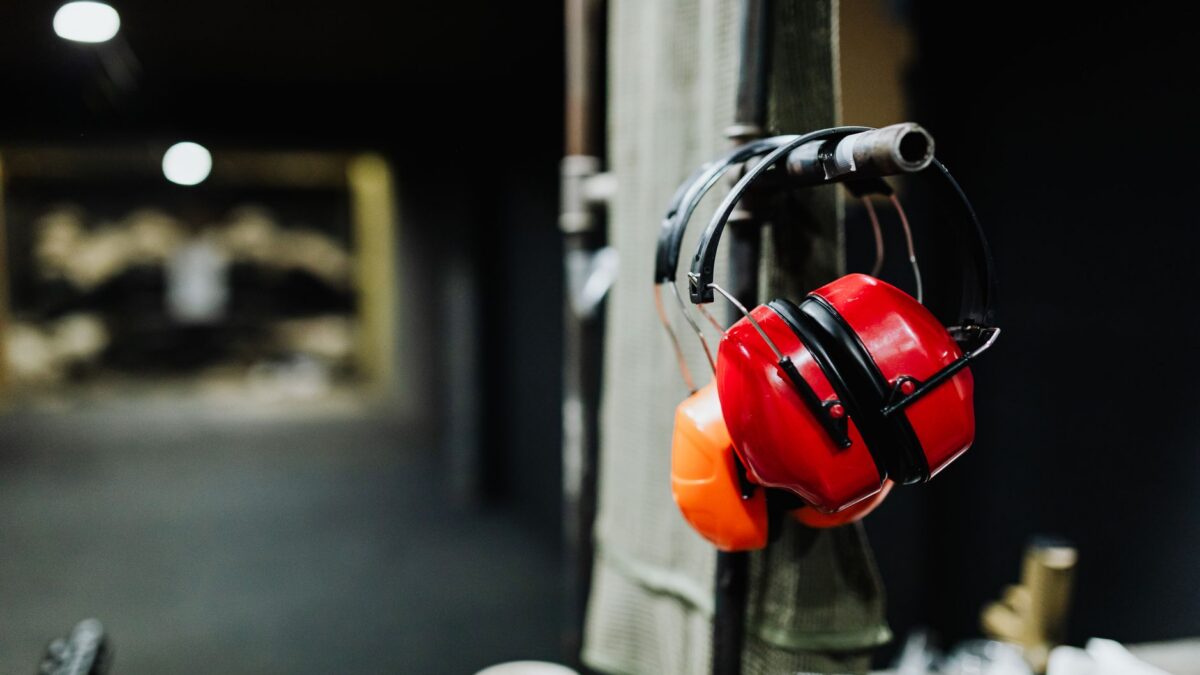
- Wear earplugs or earmuffs at concerts, sporting events, and when using power tools or lawn equipment. Foam plugs must be rolled and inserted fully to work.
- Use headphones that block outside noise, so music does not need to be turned up over traffic or engines. Noise-cancelling headphones use anti-noise to cut steady background sound.
- Give ears quiet time after loud exposure.
See a doctor or audiologist if hearing loss or ringing lasts more than a day or two, if it affects only one ear, or if it comes on suddenly. Sudden hearing loss in one ear needs prompt medical attention.
Common questions
Does ringing in the ears mean my hearing is damaged?
Ringing after a loud event is a sign the inner ear was overstressed. It often fades within hours or days, but repeated episodes can add up to lasting damage. Some medicines, including high doses of aspirin, can also cause ringing, a topic covered in our explainer on how common painkillers work.
Can hearing lost to noise come back?
Temporary dullness after one loud event can recover. Hearing lost because hair cells died does not return, since human hair cells do not regenerate. Hearing aids can make sounds easier to hear.
Is age-related hearing loss the same thing?
Age-related hearing loss, called presbycusis, also involves loss of hair cells and usually affects high pitches first. Noise exposure over a lifetime adds to it, so protecting ears when young helps preserve hearing later.
Site editor: Nikita Sheikin