Comet Encke’s Nucleus Measures 7 by 3 Km in Subaru Heat Data
Archival Subaru data show Comet 2P/Encke's nucleus is about 7 by 3 kilometers and 328 Kelvin at the surface. See how the team isolated it from the dust.
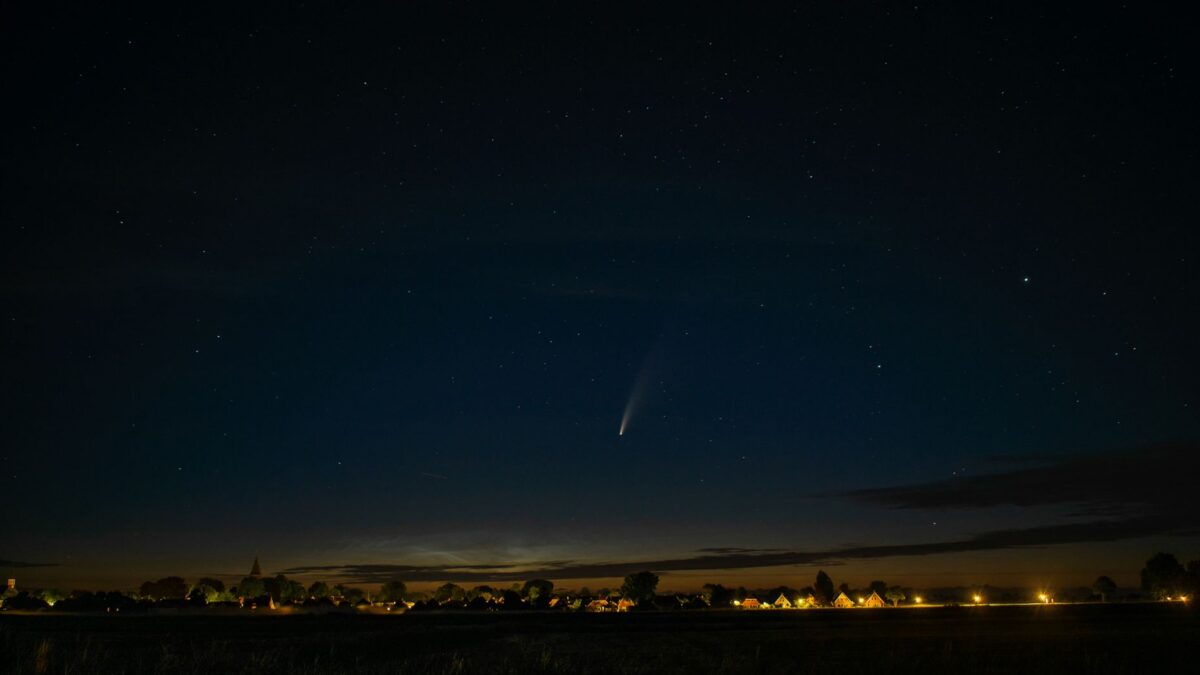
The nucleus of Comet 2P/Encke is about 7 kilometers by 3 kilometers (4.3 miles by 1.9 miles), and its surface temperature is estimated at about 328 Kelvin (55 degrees Celsius, 131 degrees Fahrenheit), according to a Japanese research team whose work was reported by Universe Today. The findings appear in The Astronomical Journal.
The nucleus is the solid, rocky core of a comet. It is usually hidden inside a cloud of gas and dust that grows as sunlight evaporates the comet’s ice, which makes the core hard to measure directly.
How the team pulled the nucleus out of the glow
The researchers did not collect new data. They reanalyzed archived observations from the Cooled Mid-Infrared Camera and Spectrometer, known as COMICS, on the Subaru Telescope. Mid-infrared light is heat radiation, so the instrument records how warm an object is rather than how brightly it reflects sunlight.
The observations were made in November 2003, when Encke passed about 0.26 astronomical units from Earth, or about 37 million kilometers (26 million miles). An astronomical unit is the average Earth-Sun distance. At that time the comet was about 1.09 AU from the Sun, roughly 163 million kilometers (101 million miles). Several ground-based telescopes observed it in the mid-infrared during that close pass.
The aim was to separate the signal of the nucleus from the surrounding ice, gas and dust. Lead author Dr. Takafumi Ootsubo, an assistant professor at the University of Occupational and Environmental Health in Japan, said the study showed that mid-infrared observations “can directly capture thermal emission from the nucleus itself.”
An orbit reshaped by Jupiter
Encke originated in the Kuiper Belt, according to the report. It is now a Jupiter-family comet, meaning Jupiter’s gravity captured it and reshaped its path into an orbit of only 3.3 years. Other comets can take decades to millions of years to travel from the outer solar system to the inner one.
A 3.3-year orbit does not bring Encke near Earth every cycle. The orbit keeps changing, and the comet has had few close approaches in recent decades. It passed within about 0.19 AU (28.5 million kilometers, 17.7 million miles) in July 1997. It is expected to pass within 0.62 AU (93 million kilometers, 58 million miles) in February 2027. For tips on spotting one, see our guide to what a comet looks like in the sky.
How sure is this?
The work was published in The Astronomical Journal, a peer-reviewed journal. The temperature is an estimate, and the size comes from analysis of a single set of archived observations from November 2003. The sources do not give uncertainty ranges or say how many individual exposures were used. They also do not say how the 2003 results compare with measurements from other telescopes that observed the comet at the same time.
COMICS was retired from Subaru in 2020, so the telescope has no mid-infrared instrument and can only use archival data for this kind of work.
What comes next
Ootsubo is working to restart COMICS. He said the hope is to study the shapes, temperatures and surface materials of many more comet nuclei in detail. No timeline for a restart was given.
Source: Universe Today
Site editor: Nikita Sheikin