How to See a Comet: Where to Look and Why Forecasts Miss
A fuzzy patch with a faint tail is what most comets look like. Here is where to point binoculars, how comet names work and why a promised great comet can fizzle.
To see a comet, look low in the sky in the direction of the Sun, in the hour after sunset or before sunrise, from a dark site. Most comets are faint fuzzy patches that need binoculars; only a few each decade become bright enough for the naked eye, such as C/2023 A3 (Tsuchinshan-ATLAS) in October 2024.
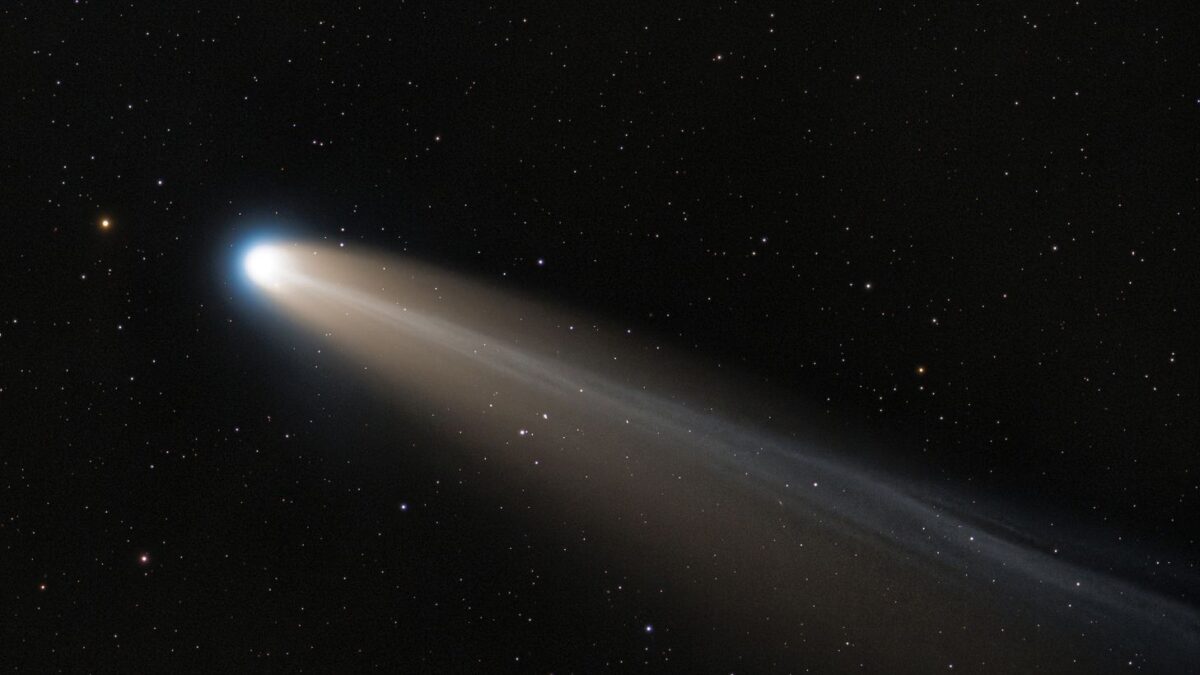
A comet near its best looks like a soft, slightly smudged star with a glowing head and, if you are lucky, a pale tail fanning away from it. It does not streak across the sky like a meteor. It drifts slowly against the stars from night to night, so you can come back to it again and again.
What does a comet look like through binoculars or with the naked eye?
Through binoculars, a typical comet looks like a round, glowing cotton ball, brighter in the middle. That glow is the coma, a cloud of gas and dust that forms when sunlight warms the comet’s frozen nucleus. NASA describes comets as mostly ice coated with dark organic material, with a nucleus often a few miles across and a coma that can stretch hundreds of thousands of kilometers.
A bright comet can show two tails. The dust tail is broad, curved and yellowish-white. The ion tail is thin, straight and bluish, and it often shows up better in photos than to the eye. Both tails point away from the Sun, because sunlight and the solar wind push the material outward. That means the tail can lead the comet as it heads back out of the inner solar system.
Where in the sky should you look for a comet?
Comets are brightest when they are close to the Sun, so they usually appear near the Sun’s direction, low in twilight. That is the main reason they are hard to catch.
- Evening comets sit low in the west or west-northwest after sunset. Start looking about 45 to 60 minutes after the Sun goes down.
- Morning comets sit low in the east before sunrise. Start about 90 minutes before sunrise and keep watching until the sky turns too bright.
- A clear horizon matters. A beach, a hilltop or a wide field with no trees or buildings in the way can make the difference.
Each comet follows its own path, so always check a finder chart for the dates you plan to observe. NASA’s monthly What’s Up skywatching pages mention comets when one is well placed, and astronomy magazines publish charts for brighter ones. The Minor Planet Center, which issues official comet designations, keeps the technical orbit data that those charts are built from.
Why are comet brightness forecasts so often wrong?
Comet forecasts are uncertain because a comet’s brightness depends on how much gas and dust its nucleus releases, and that changes as the comet heats up. A comet arriving from the outer solar system for the first time can brighten fast at first and then stall. Another can flare suddenly when a piece of its crust breaks away.
Some comets do not survive the trip. Comet ISON was expected to be bright in late 2013, but NASA reported that just before its closest approach to the Sun on Nov. 28, 2013, it went through a major heating event and was torn to pieces. What remained faded within days.
The opposite also happens. NASA said ahead of time that C/2023 A3 (Tsuchinshan-ATLAS) might reach naked-eye visibility in October 2024, and it did, with observers in the Northern Hemisphere spotting it in the evening sky during the middle of that month. The useful habit is to treat any forecast as a range, and to check reports from observers once the comet arrives.
How do you find a comet step by step?
- Check whether a comet is currently visible and where, using NASA’s skywatching notes or an observing guide that publishes finder charts.
- Note the date range, the side of the sky (west after sunset or east before sunrise) and the nearest bright star or planet on the chart.
- Pick a site with a low, open horizon in that direction and as little artificial light as possible.
- Arrive early. Let your eyes adjust to the dark for 20 to 30 minutes, and use a red light if you need one.
- Find the reference star or planet first, then sweep slowly with binoculars toward the comet’s charted position.
- Look for a fuzzy spot that stays fuzzy when you refocus. Stars sharpen to points; a comet does not.
- Come back on the next clear night. The comet will have moved slightly against the stars, which confirms what you saw.
Moonlight matters as much as it does for meteor showers. A bright Moon can hide a faint comet’s tail completely, so the best nights are near new Moon. Our full Moon calendar helps you avoid the brightest nights, and the advice on dark sites in our guide to seeing the Milky Way applies here too.
Can you photograph a comet with a phone?
Yes, a bright comet can be photographed with a recent phone, especially one with a night mode. Brace the phone on a small tripod or a wall, turn off the flash, and let the night mode run its full exposure. Tap on the comet’s area to focus at infinity, or lock focus on a bright star.
A camera on a tripod does better. A wide or standard lens, a high ISO and exposures of a few seconds will show a tail you may not see by eye. Longer exposures trail the stars, so take several short frames and keep the sharpest. Haze and light pollution near the horizon cut what any camera can record.
What do the letters in comet names mean?
A comet’s official designation tells you what kind of orbit it has and when it was found. The rules come from the International Astronomical Union and are applied by the Minor Planet Center.
| Prefix | Meaning |
|---|---|
| P/ | Periodic comet: orbit shorter than 200 years, or seen at more than one return |
| C/ | Comet that is not periodic in that sense |
| D/ | Periodic comet that has disappeared or no longer exists |
| X/ | Comet for which no meaningful orbit can be computed |
| A/ | Comet designation that turns out to belong to an asteroid |
So 1P/Halley is a periodic comet and C/2023 A3 (Tsuchinshan-ATLAS) is not. After the prefix comes the year, a letter for the half-month of discovery and a number for the order of discovery in that half-month. The name in brackets honors the discoverers, which today are often survey telescopes such as ATLAS. Periodic comets that return reliably also get a number in front, which is why Halley’s Comet is 1P.
Short-period comets, with orbits under 200 years, mostly come from the Kuiper Belt beyond Neptune. Many long-period comets fall in from the distant Oort Cloud and can take millions of years to complete one orbit, according to NASA. Some leave behind trails of dust that Earth crosses each year, and that is where most meteor showers come from.
Bottom line
Seeing a comet takes a chart, binoculars, a dark site with a low horizon and some patience in twilight. Expect a soft glow rather than a blazing streak, treat brightness forecasts as rough guesses and check observer reports before you drive anywhere. When a bright one does arrive, it is visible for days or weeks, so a cloudy night is not the end.
FAQ
Is there a comet visible tonight?
Usually at least one comet is within reach of binoculars or a small telescope, but a naked-eye comet is rare. Check NASA’s monthly skywatching notes or a current observing guide for finder charts before you go out.
What is the difference between a comet and a meteor?
A comet is an icy body orbiting the Sun, millions of kilometers away, and it moves slowly from night to night. A meteor is a grain of dust burning up in Earth’s atmosphere and lasts a second or two.
When will Halley’s Comet return?
Halley’s Comet has an orbit of roughly 76 years, and its next return to the inner solar system is expected in 2061. Exact viewing conditions for that return will be published by observatories closer to the date.
Can a comet hit Earth?
Comet impacts are possible over very long timescales but extremely rare, and no known comet is on a collision course. NASA tracks comets and asteroids that come near Earth; our article on asteroid impact risk explains how that monitoring works.