How Color Vision Works: Cones, Color Blindness and the Dress
Your eye has no yellow detector, yet you see yellow. Color is something the brain works out by comparing three kinds of cells, which explains a lot, from screens to a viral dress.
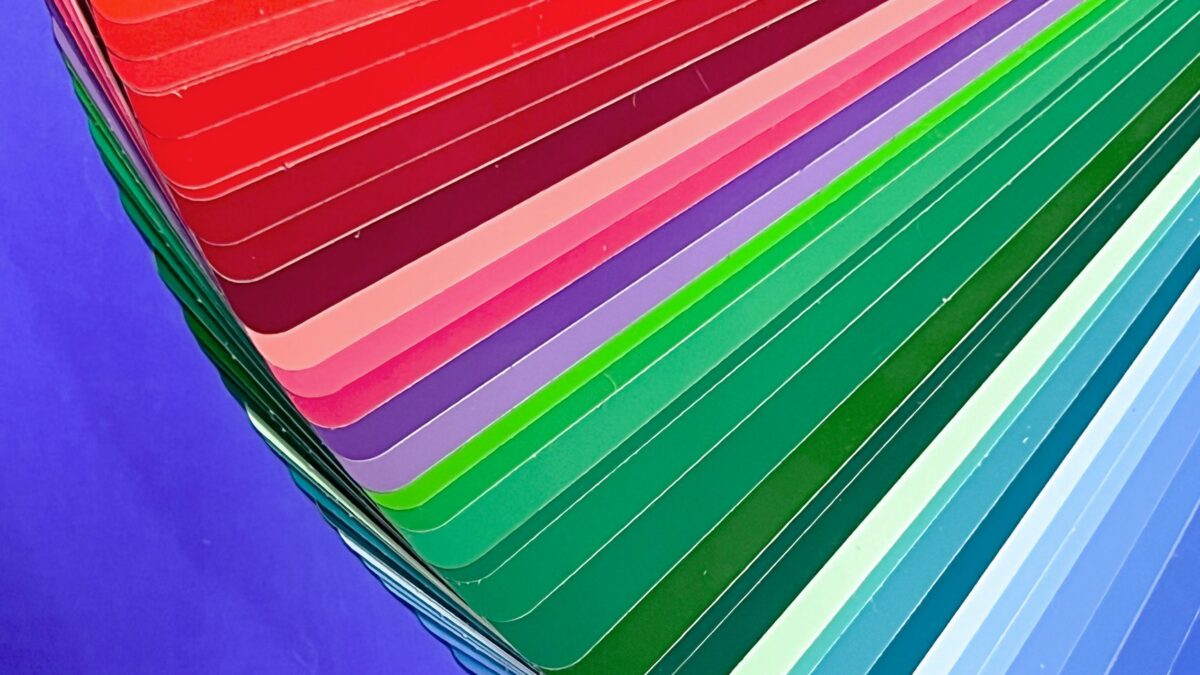
Humans see color with three types of cone cells in the retina, each most sensitive to a different part of the spectrum: short (blue-violet), medium (green) and long (yellow-green to red) wavelengths. The brain compares how strongly each type responds and turns that ratio into the colors we experience. That is why three colored lights on a screen can fake almost any color, and why missing or shifted cones cause color blindness.
Color, in other words, is partly physics and partly the brain’s best guess, which is how a single photo of a dress could split the internet.
What do the three types of cones respond to?
Each cone type contains a light-sensitive pigment that absorbs some wavelengths better than others, and the three ranges overlap. In a classic 1980 study in the Journal of Physiology, Bowmaker and Dartnall measured single cells from a human retina and found peak sensitivities near these values:
| Cell type | Common name | Peak sensitivity | Role |
|---|---|---|---|
| S cones | “Blue” cones | About 420 nm (violet-blue) | Color in daylight |
| M cones | “Green” cones | About 534 nm (green) | Color in daylight |
| L cones | “Red” cones | About 563 nm (yellow-green) | Color in daylight |
| Rods | None | About 498 nm (blue-green) | Dim light; no color |
The so-called red cones actually peak in the yellow-green. They are called red cones because they respond more than the green cones to long red wavelengths, and it is that difference the brain reads. A single cone cannot tell color on its own: a dim light at its peak and a bright light off its peak can make it fire equally. Only by comparing cone types does the brain pin down the color.
Why does mixing red and green light make yellow?
Red and green light together make yellow because they stimulate your L and M cones in about the same ratio that pure yellow light does. The brain receives the same signals in both cases, so it reports the same color. Two lights that look identical but have different wavelength mixes are called metamers.
Phone and TV screens rely on this. Each pixel has only red, green and blue elements, yet by mixing them in different strengths, a screen can match most colors people see. Mixing paint is different: pigments absorb light, so mixing them subtracts wavelengths, which is why red and green paint make a muddy brown rather than yellow. How light itself gets sorted by color in the atmosphere is a separate story, told in why the sky is blue.
Why is color blindness more common in men?
About 1 in 12 men has some form of color vision deficiency, according to the National Eye Institute, and the most common type makes it hard to tell red from green. Most cases are inherited.
The reason men are affected more often lies in where the genes sit. A 1986 study in Science by Nathans and colleagues found that the genes for the red and green cone pigments lie side by side on the X chromosome. Men have one X chromosome, so a single altered copy can change their color vision. Women have two, and a working copy on the second X usually covers for the other. In most red-green deficiency, one cone type is missing or its pigment is shifted toward the other, so red and green produce similar signals.
This is a description of the biology only. Anyone with questions about their own eyesight should see an eye care professional.
Why do we see no color at night?
At night we see mostly with rods, which are far more sensitive than cones but come in only one type. With one type there is nothing to compare, so the brain gets brightness but no color. That is why a moonlit garden looks gray.
It also explains why faint auroras often look pale gray or whitish to the eye while a camera captures strong greens and reds. Our guide to seeing the northern lights from the US covers what to expect.
Do animals see colors we cannot?
Many animals see a different range than we do. Honeybees are sensitive to ultraviolet light and see patterns on flowers that are invisible to us, and many birds have a fourth cone type that reaches into violet or ultraviolet. Some sea creatures make their own light for signals, as we describe in bioluminescent animals.
The mantis shrimp is the famous extreme. Some species have 12 different photoreceptor types covering 300 to 720 nanometers, from deep ultraviolet to far red. You might expect them to see far more colors than we do. A 2014 study in Science by Thoen and colleagues found the opposite: in behavioral tests, mantis shrimp were surprisingly poor at telling close colors apart. The authors suggest they use a different system, recognizing colors quickly by scanning their eyes across a scene, rather than finely comparing receptors the way humans do.
Why did people see the dress differently?
In 2015, a photo of a striped dress went viral because some people saw it as white and gold and others as blue and black. The pixels themselves are blue and brown. What differs is how each person’s brain guesses the lighting.
A study in Current Biology surveyed 1,401 people. Most reported white and gold or blue and black, and some said blue and brown. Older people and women were more likely to see white and gold. The researchers proposed that people who assume the dress is lit by cool, bluish daylight mentally subtract blue and see white and gold, while people who assume warm indoor light subtract yellow and see blue and black. Adding clear lighting cues to the picture could flip what people saw.
Bottom line
Human color vision rests on three cone types with peak sensitivities near 420, 534 and 563 nm, and the brain compares their signals to produce color. Red plus green light looks yellow because it triggers the cones the same way yellow light does. About 1 in 12 men has a color vision deficiency, mostly red-green, because the key genes sit on the X chromosome. The dress showed that the brain’s guess about lighting shapes the color we see.
FAQ
How many colors can humans see?
Estimates vary widely depending on the method and how finely colors are distinguished. Researchers agree the number is large because the brain compares three cone signals that each vary smoothly.
Do mantis shrimp see more colors than humans?
Not in the usual sense. They have up to 12 photoreceptor types, but a 2014 Science study found they are worse than humans at telling similar colors apart.
What color was the dress really?
The real dress was blue and black. The photo’s colors and lighting were ambiguous enough that many people’s brains read it as white and gold.