How Old Is Stonehenge? Building Stages, Stone Sources and Purpose
Stonehenge was built and rebuilt over roughly 1,500 years, with stones hauled from Wiltshire, Wales and, it now appears, northern Scotland. Here is the timeline and what the evidence says it was for.
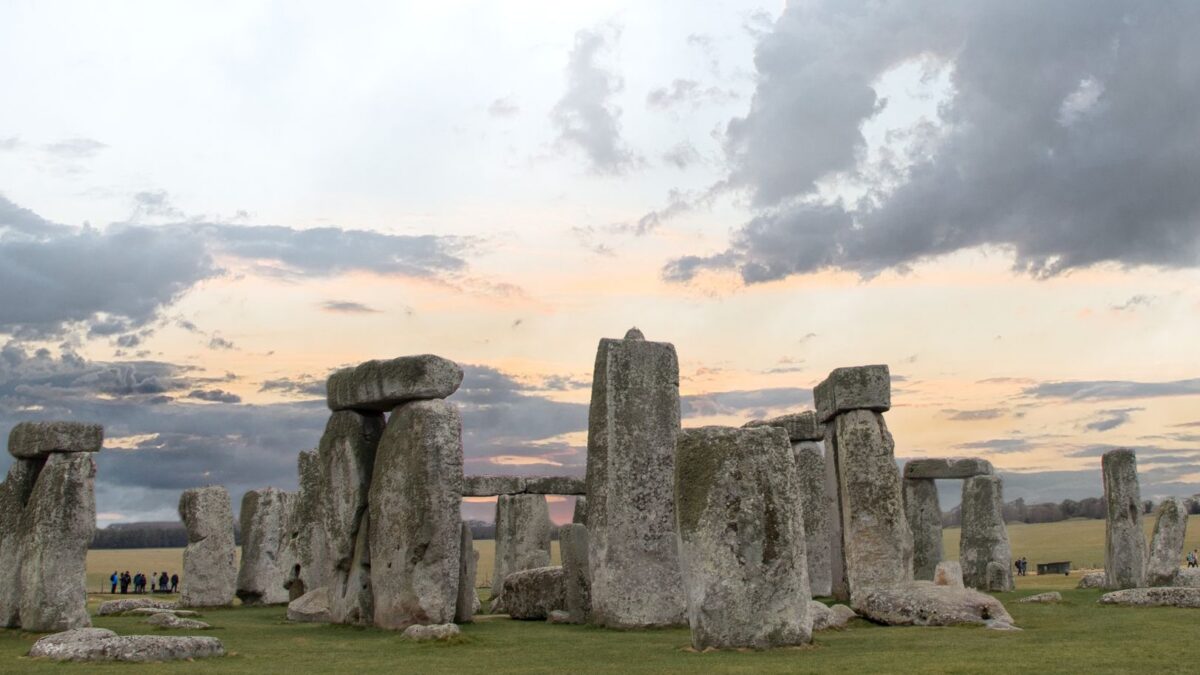
Stonehenge is about 5,000 years old. Its first version, a circular ditch and bank, was dug around 3000 BC, and the giant sarsen stones that define the monument today were raised around 2500 BC, according to English Heritage. Builders kept reshaping it for about another thousand years, using stones from Wiltshire, Wales and, a 2024 study found, northeast Scotland.
Stand in the middle of Stonehenge on a midwinter evening and the Sun sets in the gap of the tallest stone archway, the great trilithon, or would if half of it had not fallen. That alignment with the solstices is one of the few things about its purpose that the stones themselves make clear. The rest has been pieced together from excavation, radiocarbon dates and rock chemistry.
When was Stonehenge built?
Stonehenge was built in stages from about 3000 BC to about 1500 BC. English Heritage’s history of the site sets out the main phases:
| Approximate date | What happened |
|---|---|
| About 3000 BC | A circular ditch with inner and outer banks, about 100 meters (330 feet) across, with 56 pits called the Aubrey Holes inside it |
| Early centuries of the monument | Cremation burials placed at the site; about 64 have been found, perhaps from around 150 people in total |
| About 2500 BC | Sarsens raised in an outer circle and an inner horseshoe of trilithons, with bluestones set between them |
| About 200 to 300 years later | Bluestones rearranged into a circle and an inner oval; the Avenue built toward the River Avon |
| About 1800 to 1500 BC | Rings of pits (the Y and Z holes) dug, possibly for a rearrangement never finished |
| About 1750 to 1500 BC | Axe-head shapes carved into four sarsens |
English Heritage describes the cremation burials as the largest late Neolithic cemetery in the British Isles. Dates like these come mainly from radiocarbon measurements of organic material found in the ditches and stone holes; our explainer on how carbon dating works shows how such dates are made.
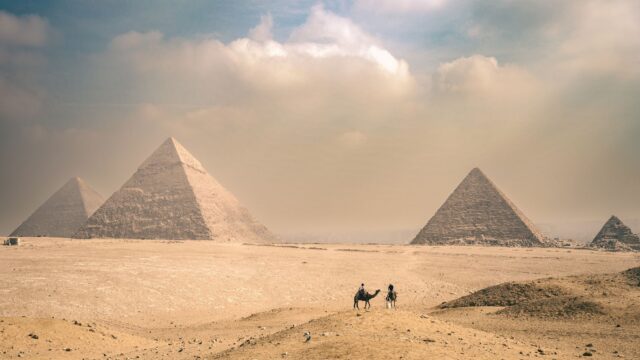
For comparison, Stonehenge’s first earthwork is older than the Great Pyramid of Giza, while the sarsen circle went up within roughly the same century as the pyramid. Our article on how the pyramids were built covers that project.
Where did the stones come from?
The stones came from three very different places:
- Sarsens. The big stones, averaging about 25 tons, are a local sandstone. Most came from the Marlborough Downs, and geochemical research has pinpointed West Woods, southwest of Marlborough, as the likely main source, much closer to Stonehenge than the other stones.
- Bluestones. The smaller stones, weighing 2 to 5 tons each, are of varied rock types but all came from the Preseli Hills in southwest Wales, English Heritage says, about 135 miles (220 km) away in a straight line.
- The Altar Stone. This roughly six-ton slab of sandstone lying at the center was long assumed to be Welsh. A 2024 study in Nature (doi.org/10.1038/s41586-024-07652-1), led by Anthony Clarke of Curtin University, matched the age of mineral grains in it to rocks of the Orcadian Basin in northeast Scotland, at least 750 km (about 465 miles) from Stonehenge.
A follow-up study by an overlapping team ruled out Mainland Orkney as the source, so the exact location in northeast Scotland is still being searched for.
How were the stones moved?
No record survives, so the methods are reconstructed from experiments and from the landscape. For the sarsens, the likely answer is sledges pulled by large teams over prepared tracks or timber rails. The short distance from West Woods makes this realistic for a well-organized community.
The bluestones raise harder questions. Researchers have argued for overland routes, for rafts along the coast, or a mix of both, and none has been proven. The Altar Stone’s journey from Scotland is the biggest puzzle: a land route would cross much of Britain, and a sea route would mean moving a six-ton block along a rugged coast. Both remain hypotheses.
A minority of geologists have argued that glaciers carried the bluestones part of the way. Most archaeologists working on the question favor human transport, and the debate is a reminder that the Welsh leg of the story is not settled.
What was Stonehenge for?
English Heritage says the most widely accepted interpretation is a prehistoric temple aligned with the movements of the Sun, while stressing that its purpose can only be inferred. The evidence for that reading is in the stones:
- At the midsummer solstice, the Sun rises in the northeast close to the Heel Stone, as seen from the center.
- At the midwinter solstice, the Sun sets in the southwest between the uprights of the tallest trilithon. One of those stones was carefully shaped to create a vertical slot for that view.
Stonehenge was also a burial place, especially in its early centuries, and it sits in a landscape full of other monuments and barrows. Many archaeologists see it as a ceremonial center tied to the dead and the cycle of the year. The axe carvings added later may have been symbols of power or status.
Ideas such as Stonehenge being built by the Romans, the druids or Merlin, as Geoffrey of Monmouth wrote in 1136, are not supported. The monument was finished long before Iron Age druids or Roman Britain existed.
Bottom line
Stonehenge began as an earthwork around 3000 BC and got its great sarsen stones around 2500 BC, with changes continuing to about 1500 BC. Its builders used local sarsens, bluestones from Wales and an Altar Stone that a 2024 study traced to northeast Scotland. Its solstice alignments point to a ceremonial role linked to the Sun, but its full purpose is still debated.
FAQ
Who built Stonehenge?
Stonehenge was built by Neolithic and early Bronze Age communities in Britain over many generations. No single group or ruler built it, and the builders left no writing.
Is Stonehenge older than the pyramids?
Its first phase, around 3000 BC, is several centuries older than the Great Pyramid. The sarsen circle, raised around 2500 BC, is roughly the same age as the Great Pyramid.
Why is Stonehenge aligned with the solstices?
The builders placed the main axis along the line of midsummer sunrise and midwinter sunset. Archaeologists read this as evidence of ceremonies linked to the turning points of the year.